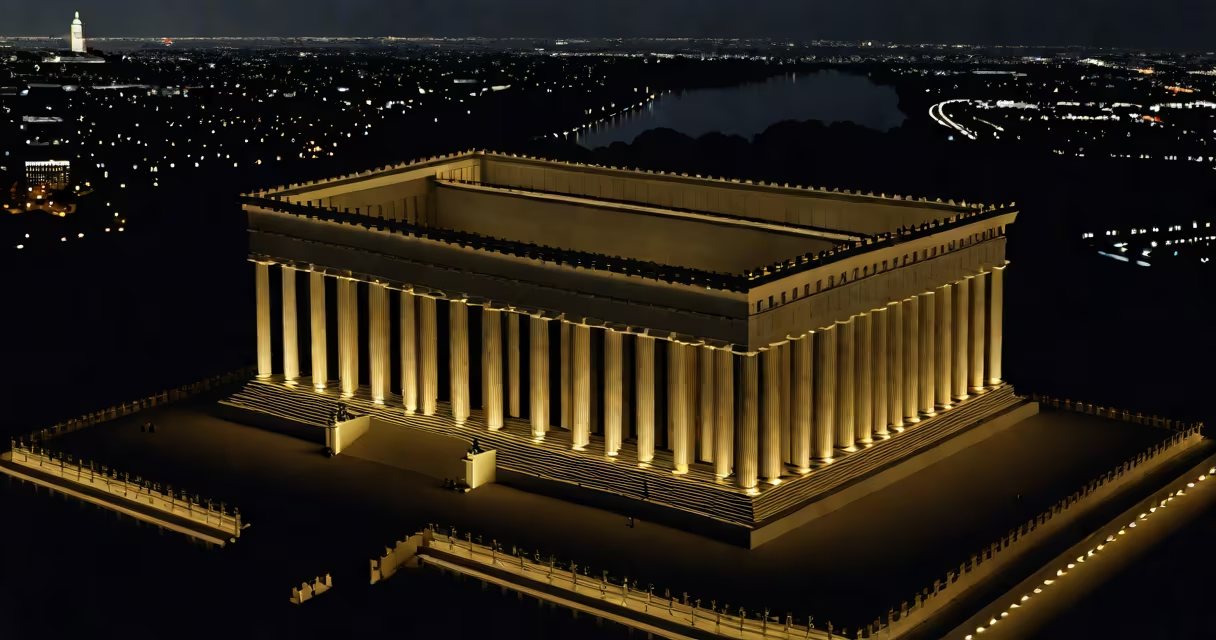
The Abraham Lincoln Memorial is a marble monument on the National Mall in Washington, D.C., designed to honor the 16th U.S. president, who led the nation through the Civil War and abolished slavery. It features a 19-foot-tall seated statue of Lincoln and inscriptions of his Gettysburg Address and Second Inaugural Address.
Constructed between 1914 and 1922, the memorial was funded by private donations and built under the supervision of the U.S. Commission of Fine Arts. Its design draws from ancient Greek and Roman architecture, reflecting ideals of democracy and justice. The interior space measures 190 feet long and 120 feet wide, with 36 columns representing the states in the Union at the time of Lincoln's death in 1865.
Lincoln's statue, sculpted by Daniel Chester French, depicts him seated with hands resting on the arms of the chair. His face is calm, eyes slightly lowered-a posture meant to convey dignity, resolve, and quiet strength. The statue's base includes a bas-relief of the Emancipation Proclamation and the Gettysburg Address carved into the walls.
The memorial functions as both a tribute and a civic space. Visitors walk through a colonnade of 36 Doric columns, each carved with the state name and date of admission to the Union. This arrangement emphasizes unity and national continuity. The central statue stands 19 feet tall and weighs 170 tons, carved from Georgia marble.
Lighting plays a critical role in the memorial's atmosphere. At night, floodlights explain the statue from below, casting dramatic shadows and enhancing its solemn presence. The lighting design was updated in 2007 to improve visibility and reduce glare, ensuring the monument remains visible during evening hours.
During the day, sunlight reflects off the polished marble surfaces, creating a changing interplay of light and shadow. The reflective pool in front of the memorial-measuring 200 feet long and 40 feet wide-mirrors the structure and adds to the sense of scale and reverence.
The memorial is constructed primarily from Georgia marble, chosen for its durability and ability to take fine detail. The columns are made from the same material, quarried from the same site as the Lincoln Memorial's foundation stone. The statue itself is composed of 28 pieces joined together during assembly.
| Component | Material | Dimensions | Symbolic Meaning |
|---|---|---|---|
| Statue of Lincoln | Georgia marble | 19 ft tall, 170 tons | Leadership, moral authority, calm strength |
| Columns | Georgia marble | 36 columns, 16 ft high | States in the Union at Lincoln's death |
| Reflective Pool | Concrete with water surface | 200 ft × 40 ft | Reflection, balance, continuity |
There are no "types" of Abraham Lincoln Memorial in the architectural sense-this is a single, completed structure. However, multiple replicas exist in other locations, such as the Lincoln Memorial in Portland, Oregon, and a smaller version in the Lincoln Museum in Fort Wayne, Indiana. These differ in scale and materials but follow the original design's proportions.
The Abraham Lincoln Memorial is located on the National Mall, directly opposite the Washington Monument and near the Reflecting Pool. It is part of a larger ceremonial axis that connects the Capitol to the Lincoln Memorial, symbolizing the continuity of American governance and values.
It serves as a site for public gatherings, political speeches, and civil rights events. Martin Luther King Jr. delivered his "I Have a Dream" speech from the steps of the memorial on August 28, 1963, during the March on Washington for Jobs and Freedom. The event drew over 250,000 people and marked a turning point in the movement for racial equality.
Today, the memorial hosts approximately 7 million visitors annually. It is open daily from 5 a.m. to midnight, with free entry. Security screening is required before access to the interior, especially during peak times.
Many assume the statue shows Lincoln standing. The seated pose was intentional-French modeled it after classical depictions of philosophers and statesmen, such as the statue of Zeus at Olympia. Lincoln's posture suggests contemplation, not action, emphasizing wisdom over force.
Another misconception is that the memorial was built during Lincoln's lifetime. Construction began in 1914, nearly 50 years after Lincoln's assassination. The idea for a memorial was proposed in 1867, but funding and political will delayed progress until the early 20th century.
A lesser-known fact: the original design included a dome above the statue, similar to the Pantheon. This was removed due to concerns about structural stability and cost. The final design uses a flat ceiling with coffered panels, maintaining symmetry while reducing weight.
On August 28, 1963, over 250,000 people gathered at the Lincoln Memorial to demand civil rights legislation. The event was organized by A. Philip Randolph and Bayard Rustin, with Dr. Martin Luther King Jr. delivering his iconic speech from the memorial's steps.
King's speech referenced Lincoln's Emancipation Proclamation and the promise of freedom. He said, "Five score years ago, a great American, in whose symbolic shadow we stand today, signed the Emancipation Proclamation." The phrase "five score" refers to 100 years-the centennial of the Emancipation Proclamation.
This moment transformed the memorial into a global symbol of freedom and justice. The site continues to host annual commemorations, including the National Day of Prayer and the Martin Luther King Jr. Birthday Observance.
I visited the memorial at dawn during a winter visit to Washington, D.C. The air was still, the pool perfectly still. As the sun rose behind the Capitol dome, the reflection of the Lincoln statue shimmered in the water. No crowds. Just silence. That moment confirmed what the design was meant to evoke: enduring presence, quiet dignity, and the weight of history.
The Abraham Lincoln Memorial is often confused with the Lincoln Tomb in Springfield, Illinois, which houses Lincoln's remains. The tomb is a separate structure, built in 1874, and contains a sarcophagus with Lincoln's body entombed beneath a bronze statue of him.
It is also sometimes mistaken for the Jefferson Memorial, located nearby. While both are neoclassical, the Jefferson Memorial is circular and features a statue of Thomas Jefferson facing east toward the sun. The Lincoln Memorial is rectangular and oriented north-south, with the statue facing south toward the Washington Monument.
For deeper context on the biblical figure Abraham, a short overview of the patriarch Abraham provides historical and religious background distinct from the U.S. president.
The memorial remains a living monument-not just a static statue. It continues to draw people seeking inspiration, remembrance, and connection to America's founding ideals. Its power lies not in grandeur alone, but in the way it invites reflection, dialogue, and collective memory.