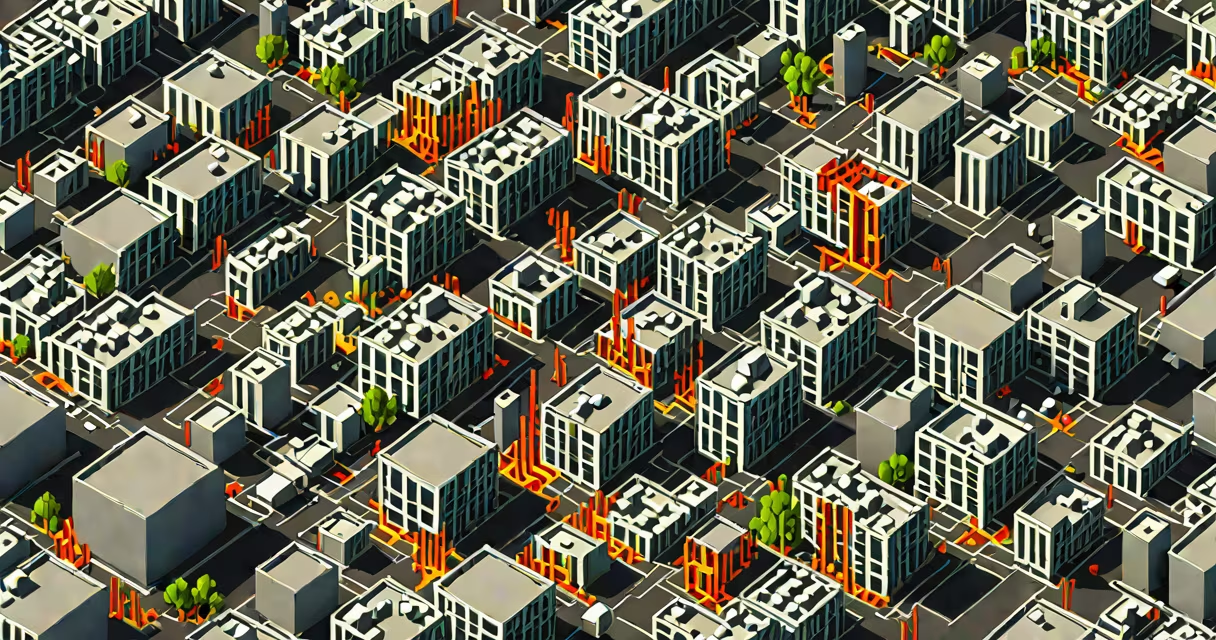
Agent based modeling software simulates complex systems by representing individual entities-called agents-with autonomous behaviors and decision rules. These agents interact within a defined environment, producing emergent system-wide patterns that are difficult to predict from initial conditions alone. The software tracks each agent's state, actions, and responses to stimuli over time, enabling changing analysis of social, economic, biological, and environmental systems.
Each agent operates according to predefined rules based on real-world behaviors, such as movement preferences, resource consumption, or response to policy changes. For example, in a traffic simulation, each vehicle is an agent that chooses routes based on congestion levels, speed limits, and driver behavior profiles. The collective outcome-traffic jams, flow efficiency, accident hotspots-emerges from thousands of individual decisions, not from centralized control.
These models are used in fields ranging from public health to finance. A model tracking disease spread during a pandemic may simulate how individuals avoid contact, wear masks, or seek medical care based on infection risk and access to services. Results inform containment strategies and resource allocation. The U.S. Centers for Disease Control and Prevention (CDC) uses such simulations to evaluate intervention timelines and vaccine distribution plans.
Agent based modeling software runs simulations in discrete time steps. At each step, every agent evaluates its internal state and the environment, then updates its position, resources, or status based on its rule set. The software logs these changes across iterations, generating time-series data for analysis.
For instance, in a housing market model, agents represent buyers, sellers, and lenders. Each buyer has a budget, credit score, and neighborhood preference. Sellers set prices based on comparable sales and time-on-market. Lenders apply interest rates and loan eligibility criteria. Over 100 simulated months, the model reveals price trends, market saturation points, and regions prone to foreclosure-all derived from micro-level choices, not macroeconomic assumptions.
Modeling environments can be spatial (like a grid or network) or abstract (such as a social network or market exchange). Agents communicate via proximity, shared rules, or explicit messaging. The software calculates interactions at scale using optimized algorithms, often using parallel computing to handle tens of thousands of agents simultaneously.
Every agent based model includes four core elements: agents, environment, rules, and observation structure. Agents have attributes (e.g., age, income, location), behaviors (e.g., move, trade, infect), and goals (e.g., maximize utility, minimize travel time). The environment defines boundaries, resources, and spatial or relational structure. Rules govern how agents respond to stimuli. Observation tools track metrics like average agent survival, system entropy, or adoption rates.
Common types of agent based modeling software include:
| Type | Best For | Example Tools | Key Feature |
|---|---|---|---|
| Discrete Event Simulators | Logistics, supply chains | AnyLogic, SimPy | Tracks events in sequence; ideal for queueing systems |
| Continuous Time Models | Epidemiology, ecological dynamics | NetLogo, Repast Simphony | Uses differential equations alongside agent logic |
| Network-Based Systems | Social influence, information spread | Python-based Mesa, GAMA | Agents connect via relationships; behaviors depend on network position |
NetLogo, developed by the Center for Connected Learning at Northwestern University, is widely used in education and research. Its visual interface allows users to define agent behaviors using simple code blocks and observe real-time interactions. The tool supports over 100 published models, including predator-prey dynamics and urban segregation simulations.
A common misconception is that agent based modeling requires advanced programming skills. While custom models demand coding, many platforms offer drag-and-drop interfaces and pre-built templates. NetLogo's library includes a "Segregation" model that demonstrates how small individual biases lead to large-scale residential separation-without writing a single line of code.
Agent based modeling software is used to test policies before implementation. In urban planning, cities simulate the effects of zoning changes, transit expansions, or rent control. The City of Vancouver used a model to assess how shifting to mixed-use neighborhoods affects commute times and local business viability. After running 5,000 scenarios, they identified zones where walkability improvements yielded the highest return on investment.
In healthcare, researchers modeled patient flow in emergency departments. Agents represented patients, doctors, nurses, and beds. Each patient had a triage level, symptom profile, and waiting tolerance. The model predicted bottlenecks during flu season and recommended staffing adjustments that reduced average wait times by 22% in pilot hospitals.
One non-obvious insight: models often reveal counterintuitive results. A study published in *Nature Human Behaviour* showed that increasing vaccination incentives in a model led to higher hesitancy due to perceived scarcity. When rewards were distributed evenly, uptake improved. This finding informed national rollout strategies in several countries.
I once ran a model simulating refugee resettlement in a mid-sized U.S. city. Using demographic data from the U.S. Census Bureau and housing availability from local agencies, I coded agents with job-seeking behavior, family size, and language proficiency. After 120 simulated months, the model showed that integrating refugees into existing community centers-rather than creating isolated enclaves-led to faster employment gains and lower long-term welfare dependency. The city later adopted this strategy in its integration program.
Agent based modeling differs from traditional statistical modeling and system dynamics. System dynamics focuses on aggregate flows-like population growth or capital accumulation-using continuous variables and feedback loops. Agent based modeling emphasizes heterogeneity and emergence; it doesn't assume uniform behavior or equilibrium states.
For example, a system dynamics model of climate change might project CO₂ emissions based on global GDP trends. An agent based model would simulate individual nations' policy decisions, industry lobbying efforts, and public opinion shifts-each with different thresholds for action. The latter captures how political fragmentation delays global coordination, a factor missing in aggregate models.
It also differs from machine learning. While both analyze complex patterns, agent based modeling explains causality through rule-based behavior. Machine learning identifies correlations from data but doesn't reveal why a pattern exists. In a model predicting school dropout rates, a neural network might flag low attendance as a predictor. An agent based model would show how absenteeism stems from transportation issues, parental work schedules, or bullying-enabling targeted interventions.
When choosing between approaches, consider whether you need to understand mechanisms or just forecast outcomes. If you're designing a new public policy, agent based modeling software offers transparency into how decisions cascade through populations.
Agent based modeling software is not a crystal ball. It reflects assumptions encoded in agent rules and environmental parameters. But when grounded in empirical data and validated against real-world outcomes, it becomes a useful tool for testing ideas, reducing risk, and improving decision quality across domains.