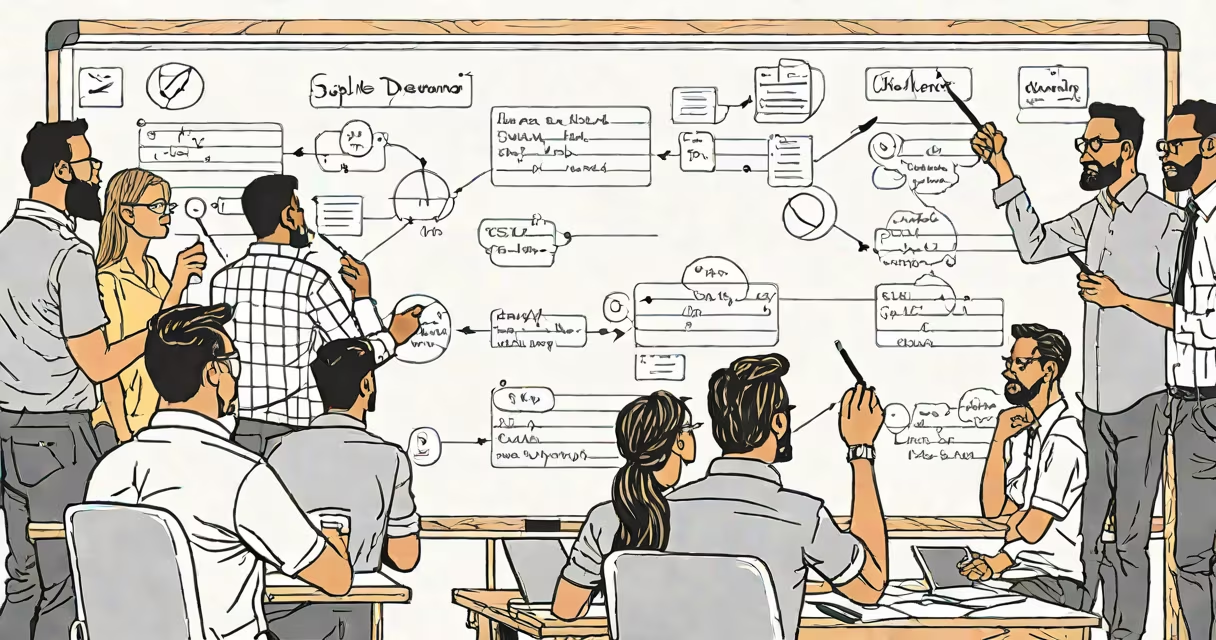
The agile product development process is an iterative methodology that delivers functional product increments through time-boxed cycles called sprints. It prioritizes customer feedback, cross-functional teamwork, and adaptability over rigid planning. This approach reduces time-to-market, increases transparency, and improves alignment between business goals and technical execution.
Agile product development operates in short cycles-typically two to four weeks-where teams build, test, and refine small pieces of functionality. After each cycle, stakeholders review the work, provide feedback, and adjust priorities. This enables rapid adaptation to changing requirements, minimizing wasted effort on features that don't meet user needs.
Unlike traditional waterfall models, which require full specification upfront, agile allows teams to pivot based on real-world usage. For example, a fintech startup using agile methods launched a beta version of its mobile wallet within 60 days. After collecting user behavior data from early adopters, they removed two underused features and added biometric login-resulting in a 40% increase in daily active users during the next sprint cycle.
At its foundation, the agile product development process relies on four principles from the Agile Manifesto: individuals and interactions over processes and tools, working software over complete documentation, customer collaboration over contract negotiation, and responding to change over following a plan.
Teams organize work into sprints-fixed-length iterations where a set of prioritized features is developed. Each sprint begins with a planning meeting where the product owner defines goals and the team commits to delivering specific user stories. During the sprint, daily stand-up meetings ensure alignment and surface blockers quickly.
At the end of each sprint, a review session demonstrates completed work to stakeholders. A retrospective follows, where the team reflects on what went well and what could improve. These ceremonies create accountability and continuous learning. According to the 2023 State of Agile Report by Digital.ai, 78% of organizations using agile reported faster delivery times and higher product quality compared to non-agile peers.
Each agile product development process includes defined roles, artifacts, and events. The product owner manages the backlog-a prioritized list of features, enhancements, and bug fixes. They ensure the team always works on the highest-value items based on customer needs and business impact.
Developers, testers, designers, and UX researchers form the cross-functional team. They collaborate closely throughout the sprint. The scrum master facilitates meetings, removes obstacles, and ensures agile practices are followed. In larger organizations, multiple teams may align under a scaled structure like SAFe or LeSS.
| Component | Description | Example |
|---|---|---|
| Backlog | Prioritized list of work items | User story: "As a user, I want to reset my password via email so I can regain access." |
| Sprint | Time-boxed iteration (usually 2-4 weeks) | A 3-week sprint focused on completing login flow improvements. |
| Daily Stand-up | 15-minute sync to report progress and blockers | "I finished the API integration. Need access to staging environment." |
| Review & Retrospective | End-of-sprint meetings for feedback and process refinement | Team identifies communication delays and implements shared Slack channels. |
One common misconception is that agile means "no planning." In reality, it shifts planning from upfront documentation to ongoing adjustment. Teams commit to deliverables in each sprint, but those commitments are revisited weekly. This changing planning prevents overcommitment and keeps focus on high-impact outcomes.
Many teams label themselves "agile" while missing core elements. A team may hold daily stand-ups but skip retrospectives, leading to recurring issues. Others treat sprints as deadlines rather than opportunities for learning. Without regular reflection, teams fail to improve their processes over time.
Another frequent error is treating the product owner as a proxy for customers. The role requires direct engagement with real users, not just internal stakeholder requests. Research from the Harvard Business Review shows that teams with product owners who conduct at least five user interviews per month see 30% higher feature adoption rates.
Agile is often mistaken for simply "doing more faster." But speed without value creates waste. A team shipping features that users don't use wastes engineering time and erodes trust. The true measure of success is not velocity-it's customer satisfaction and business impact.
In 2021, a healthcare SaaS company adopted agile product development to redesign its patient portal. They broke the project into 10 sprints, focusing on one major workflow per cycle-appointment scheduling, medication tracking, and secure messaging. After each sprint, they ran usability tests with 5-8 actual patients.
During Sprint 4, users struggled with the appointment calendar. The team adjusted the UI to show availability in color-coded blocks and added a "find nearby" button. Post-sprint testing showed a 65% reduction in task completion time. This insight was incorporated into the next sprint, avoiding months of rework.
I observed this process firsthand during a consulting engagement. The client had previously spent six months building a dashboard with full analytics-only to find users ignored it. Switching to agile reduced the initial release timeline to eight weeks. The first version included only three metrics, chosen based on frontline staff feedback. Within two sprints, the team added filtering and export options based on real usage patterns.
Results: 92% of clinic staff used the tool daily after three months-up from 18% in the previous version. The team shipped 12 features in 12 weeks, compared to 3 in 18 months under the old model.
Agile product development works best for complex, evolving problems. It struggles when requirements are stable and well-defined-such as regulatory reporting systems with fixed formats. In such cases, a phased or waterfall approach may reduce overhead and ensure compliance.
Highly regulated industries like medical devices or financial trading systems may require formal documentation and audit trails. Agile can still apply, but with additional controls. For example, a bank using agile for mobile app updates still maintains detailed change logs and approval chains for security reviews.
Teams must also avoid applying agile to projects with unclear goals. Without a defined problem space, sprints can drift toward feature accumulation rather than solution validation. Before starting, define the problem -e.g., "Reduce user drop-off during account creation from 60% to 30% in six months."
The agile product development process is not a single technique-it's a mindset. It demands courage to ship early, humility to accept feedback, and discipline to inspect and adapt. When applied correctly, it turns uncertainty into progress and customer needs into measurable results.