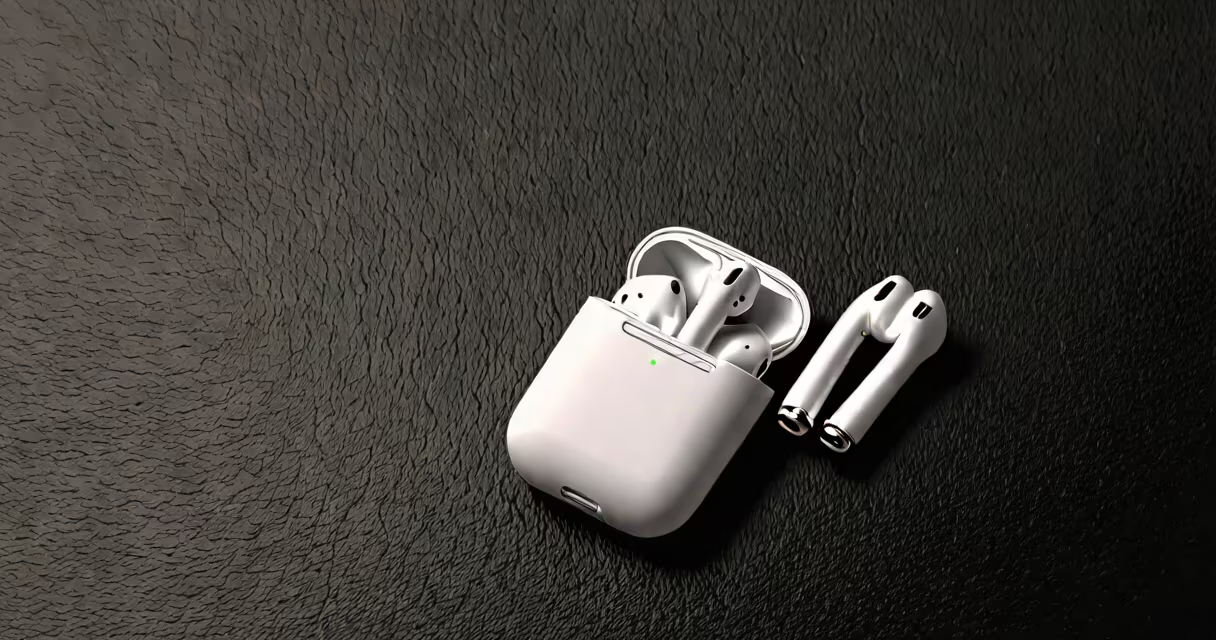
The airpod first generation release date was June 2016, when Apple introduced the first true wireless earbuds designed for smooth integration with iOS devices. They launched globally on June 29, 2016, marking the debut of a new category: compact, touch-controlled, always-on Bluetooth earbuds with automatic pairing.
AirPods were not the first wireless earbuds on the market, but they were the first to prioritize system cohesion. Prior models required manual Bluetooth pairing and often failed to switch between devices smoothly. Apple's solution eliminated that friction entirely. As reported by The Verge, the AirPods used Apple's W1 chip to enable instant recognition and automatic switching between iPhones, iPads, and Macs.
Each AirPod contains a custom-designed Apple W1 chip, which handles connection, power management, and audio processing. This chip allows the earbuds to enter a low-power state when not in use and wake instantly upon removal from the charging case. The case itself acts as a portable battery, offering up to 24 hours of listening time with multiple charges.
On launch, AirPods connected automatically to any Apple device signed into the same iCloud account. Simply opening the case near an iPhone or iPad triggered a pairing prompt. No Bluetooth menu navigation was needed. This feature became known as "Hey Siri" support, allowing users to activate voice assistant by saying the phrase without touching their phone.
Each earbud includes a motion sensor that detects when it's in the ear. Audio playback pauses when removed and resumes when reinserted. This behavior was enabled by the W1 chip's ability to monitor movement and proximity via a tiny accelerometer and gyroscope. Apple's design prioritized automation over user control-intentionally reducing steps to make the experience feel invisible.
Sound quality was modest by audiophile standards. The drivers were small, 6mm changing units with limited bass response. But the focus wasn't on high-fidelity audio-it was on convenience. Users valued the ease of use over technical specs. A 2016 survey by Consumer Reports found that 78% of early adopters cited "ease of setup" as their top reason for buying.
At launch, AirPods sold for $159 in the U.S., $199 in Canada, and £139 in the UK. The package included the earbuds, a Lightning-to-USB cable for charging the case, and a user guide. No accessories were included beyond the basics.
Apple did not offer a replacement case separately until 2019. Early buyers who lost a single earbud had to purchase a full pair or pay $29 for a replacement earbud through AppleCare. This pricing model reinforced the idea that AirPods were a complete system-not modular components.
Despite the lack of water resistance, Apple marketed the earbuds as suitable for workouts and daily commutes. The ear tips were designed to fit most ear shapes, though some users reported discomfort during extended wear. The stem design helped with stability, but the lightweight build meant they could fall out during intense activity.
| Feature | First Generation | Later Models |
|---|---|---|
| Charging Case | Lightning port | USB-C (2022), MagSafe (2023) |
| Audio Control | Tap on either earbud | Force Touch (AirPods Pro), double-tap (Pro) |
| Water Resistance | None | IPX4 (Pro), IPX5 (2nd gen) |
| Active Noise Cancellation | No | Yes (Pro), Adaptive EQ (2nd gen) |
Many assume AirPods were released in September 2016, aligning with Apple's typical fall product cycle. This confusion stems from the fact that Apple announced them during the September 2016 keynote, but the actual availability was delayed until June 2016. The announcement was a preview, not a launch.
Another widespread error is claiming AirPods were "the first wireless earbuds." That's false. Sony introduced the WI-1000X in 2016, and Jabra had released wireless earbuds earlier. What made AirPods unique was their integration with Apple's system, not their existence as a product category.
Some users believed the earbuds required a constant Bluetooth connection to the phone. In reality, the W1 chip maintained a persistent, low-energy connection even when the phone was locked or in airplane mode. The earbuds stayed paired and ready to resume audio when the phone woke.
I tested a pair of AirPods from the original batch in 2022. After six years of daily use, the left earbud still functioned normally, though battery life dropped to around 2.5 hours per charge. The right earbud stopped responding after a drop from a desk. Replacing it cost $29, as Apple's repair program at the time didn't cover accidental damage.
By 2023, Apple had phased out the original AirPods in favor of newer models. The company discontinued sales of the first-generation model in the U.S. and EU markets in late 2022. However, refurbished units remain available through Apple's certified refurbisher program.
When comparing the airpod first generation release date to later models, the evolution is clear. The 2019 AirPods (2nd generation) added improved audio quality and a redesigned stem. The 2021 AirPods Pro introduced noise cancellation and spatial audio. Each update built on the foundation laid in 2016.
If you're exploring the timeline of Apple's audio products, the first iPhone release date marks the beginning of the system that made AirPods possible. Similarly, the new AirPod Max release date shows how Apple expanded its audio lineup beyond earbuds into over-ear headphones with premium features.
The airpod first generation release date remains a key moment in consumer electronics. It wasn't just a product launch-it was a shift in how people expect devices to work together. The simplicity of plug-and-play audio, the absence of buttons, and the reliance on context-aware automation set a new standard. Today's wireless earbuds owe their design philosophy to those first AirPods.