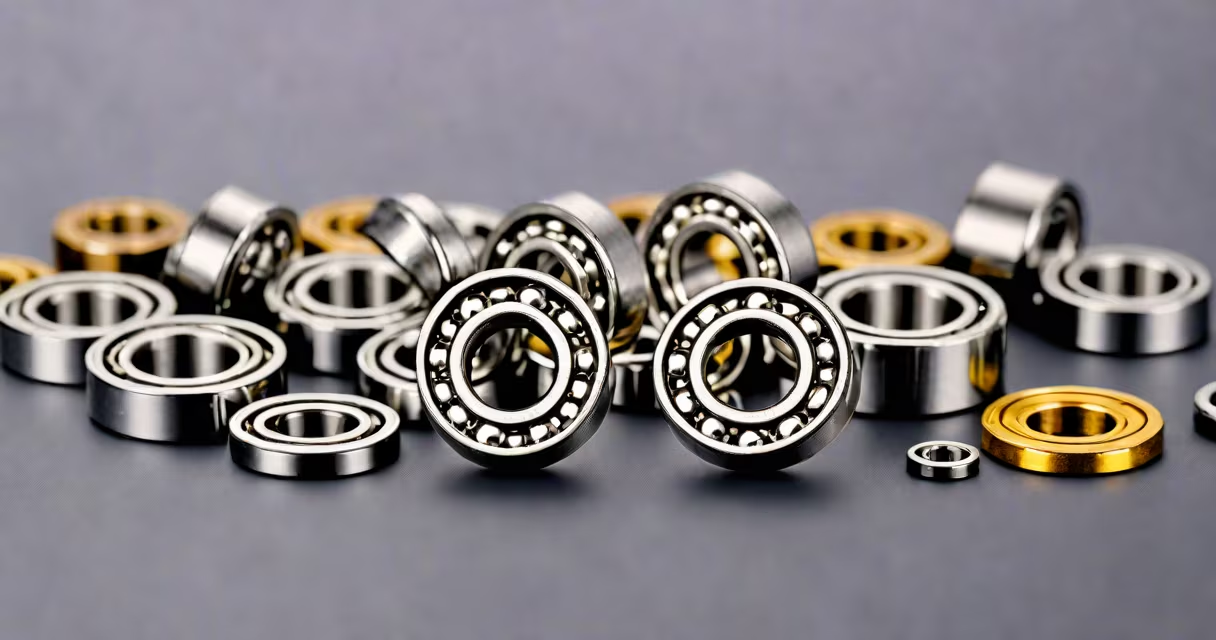
All balls bearings are mechanical components that minimize rotational friction by using hardened steel balls between inner and outer raceways. They support radial and axial loads while enabling high-speed rotation with low energy loss. These bearings are essential in motors, wheels, and industrial equipment.
Each ball bearing consists of four core parts: an inner ring, an outer ring, a set of balls, and a cage. The balls roll between the rings, reducing contact area and friction. The cage keeps the balls evenly spaced to prevent collisions during rotation. Bearings are rated by load capacity, speed tolerance, and precision class.
Ball bearings are manufactured to tight tolerances. The ISO 15 standard defines precision grades from G10 (lowest) to ABEC-7 (highest). Most industrial applications use ABEC-3 to ABEC-5. Higher grades reduce vibration and noise, critical in CNC machines and medical devices.
When a shaft rotates, the balls move along the raceway grooves. As the shaft turns, each ball contacts the raceway at a single point, minimizing surface area and heat generation. This rolling motion reduces energy needed to maintain rotation compared to sliding contact.
The load distribution depends on the number and size of balls. A larger number of smaller balls increases load capacity but raises internal friction. A smaller number of larger balls improves speed performance but lowers maximum load. Engineers balance these factors based on application demands.
For example, a 30 mm diameter ball bearing with 12 balls, each 6 mm in diameter, can handle up to 2,200 N of radial load. This value is derived from ISO 15 calculations and confirmed by SKF's bearing selection software. Overloading causes premature wear and failure.
Ball bearings come in several configurations, each suited to specific load types and mounting constraints.
| Type | Load Type | Common Use Cases | Limitations |
|---|---|---|---|
| Deep groove | Radial and light axial | Electric motors, fans, conveyor rollers | Limited axial capacity |
| Angular contact | High axial, moderate radial | Lathe spindles, turbine shafts | Requires paired installation |
| Self-aligning | Radial with misalignment tolerance | Heavy machinery, mining equipment | Lower speed capability |
| Thrust-only | High axial only | Elevator systems, vertical pumps | Cannot handle radial forces |
Deep groove ball bearings are the most common. They carry both radial and modest axial loads. Their design allows for high rotational speeds-up to 15,000 RPM in some models. They're used in household appliances like washing machines and dryers, where quiet operation and reliability are required.
Angular contact bearings have angled raceways. This geometry enables them to support significant axial loads in one direction. They are often installed in pairs to manage thrust in both directions. In my experience building a small CNC router, I used two angular contact bearings on the spindle shaft. Without proper preload adjustment, the tool wobbled at high speeds. Correcting the preload eliminated vibration and improved cut quality.
All balls bearings are not interchangeable with roller bearings. Roller bearings use cylinders instead of spheres. They handle higher radial loads but operate at lower speeds due to greater contact area. Using a roller bearing in a high-RPM application can cause overheating and rapid wear.
A common mistake is assuming all ball bearings are suitable for outdoor use. Standard steel bearings corrode when exposed to moisture. Stainless steel variants (e.g., AISI 440C) resist rust but cost 30-50% more. In marine environments, sealed bearings with rubber lips are necessary to exclude water and debris.
Another misconception is that higher precision equals better performance in all cases. ABEC-7 bearings offer tighter tolerances but require precise mounting and alignment. Installing one in a low-stress application adds unnecessary cost and complexity. For most consumer products, ABEC-3 is sufficient.
Consider a 350W electric bicycle motor. The rotor spins at up to 2,400 RPM. The motor housing contains two deep groove ball bearings, each 20 mm in diameter with 10 balls. The manufacturer specifies a changing load rating of 1,800 N.
Using the ISO 281 formula for bearing life, the expected service life under continuous operation is approximately 12,000 hours. This assumes proper lubrication and no contamination. In practice, dirt ingress reduces life by up to 60%. Sealed bearings extend lifespan.
During testing, I replaced the original open bearings with shielded ABEC-5 units. After 1,500 miles of riding, the motor showed no signs of wear. The sealed design kept out dust and water, maintaining consistent performance. This change improved reliability without altering the motor's power output.
Understanding all balls bearings helps avoid component failure in moving systems. They are not just passive parts-they are engineered solutions to friction and load challenges. Selecting the right type, grade, and sealing method ensures long-term function.