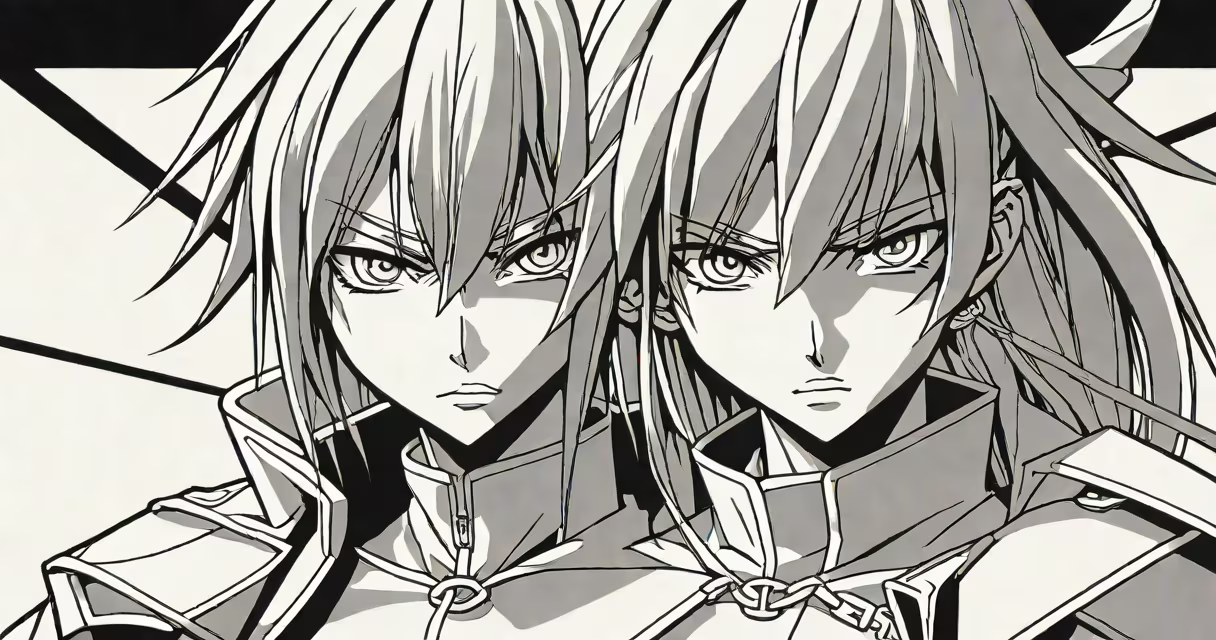
Black and white anime character art is a stylized visual form using only grayscale tones and defined linework to depict anime-style characters, emphasizing facial expression, posture, and emotional intensity through contrast rather than color. This technique emerged from manga and early animation production but remains distinct in its focus on composition, shadow, and line weight.
Unlike colored anime, which relies on hue to convey mood or identity, black and white anime character art depends entirely on tonal variation-shades of gray between pure black and pure white-to suggest depth, texture, and atmosphere. A single line can define a cheekbone, a fold in clothing, or the curve of a frown. The absence of color forces attention to structure, gesture, and narrative intent.
This style is common in sketchbooks, concept art, and limited-run digital illustrations. It's favored by artists who want to show storytelling elements without the distraction of color. It also reduces file size and printing costs, making it practical for web comics and zines.
Black and white anime character art functions through deliberate control of contrast. Artists use varying line weights-thick for outlines, thin for internal details-to create hierarchy and volume. A heavy line around a character's silhouette defines their presence; thinner lines within the face indicate subtle features like eyelashes or lip contours.
Shading is achieved through crosshatching, stippling, or gradient fills. Crosshatching uses intersecting lines to build density; stippling uses dots. Both techniques simulate texture and light direction. For example, a character looking down may have dense hatching under the chin and along the jawline to suggest shadow, while the forehead remains lighter.
Composition plays a critical role. The rule of thirds guides placement of the character's eyes or hands to draw the viewer's eye. A close-up of a single eye, rendered in extreme detail with a single black pupil and a small white reflection, can evoke isolation or determination. This level of focus is harder to achieve in color, where competing hues can dilute emotional impact.
While all black and white anime character art shares core principles, several substyles exist based on artistic intent and medium:
| Style | Characteristics | Common Use |
|---|---|---|
| Classic manga line art | Uniform line thickness, minimal shading, expressive poses | Webcomics, fan art, storyboard sketches |
| High-contrast chiaroscuro | Dramatic lighting, deep blacks, visible paper texture | Art prints, cover designs, dramatic scenes |
| Minimalist sketch | Few lines, implied forms, negative space as design element | Logos, social media avatars, quick ideation |
Chiaroscuro-style pieces often mimic Renaissance painting techniques, using strong directional light. A character standing in a doorway with only their profile lit creates tension. The rest of the body fades into darkness, suggesting mystery or danger. This effect is rare in mainstream anime but common in independent digital art.
Minimalist sketches prioritize economy of line. One continuous stroke can define a hand, a hat, and a smile. These are ideal for rapid ideation or mobile app interfaces. They're also popular in social media, where users share simple, instantly recognizable silhouettes.
Black and white anime character art appears in print and digital formats alike. It's standard in manga serialization-where ink-on-paper production keeps costs low-and in digital platforms like Webtoon, where grayscale images load faster on mobile devices.
Artists use it to test character designs before applying color. A rough sketch in black and white reveals whether the proportions work, whether the pose communicates intent, and whether the facial expression lands. This step prevents costly color corrections later.
It's also used in branding. A company launching a new anime-inspired product might use a black and white character as a logo. The simplicity ensures scalability-whether printed on a T-shirt or displayed on a website, the image remains clear and recognizable.
Many assume black and white anime character art is simply "colorless" or "low-quality." That's incorrect. The absence of color doesn't imply reduced effort-it demands greater precision. A poorly drawn line in color might go unnoticed; in black and white, it stands out immediately.
Another confusion: mistaking it for grayscale anime screenshots. While both use only shades of gray, a screenshot captures existing footage. Black and white anime character art is original, intentional artwork. It's not a conversion-it's a creative choice.
A lesser-known fact: many classic anime episodes were originally drawn in black and white. Studio Ghibli's early shorts, such as *The Castle of Cagliostro* (1979), used monochrome backgrounds and character sheets. Color was added later during broadcast. This shows that black and white isn't outdated-it's foundational.
Consider a character named Kaito, a teenage boy with long dark hair and a scar across his left eyebrow. In color, his outfit might be red and black. In black and white, the artist focuses on how light hits the scar and how shadows fall across his face.
The drawing uses thick lines for the outline of his jacket and thin lines for the stitching. The hair is rendered with overlapping curved strokes, creating depth. The scar is a single bold line, slightly uneven-suggesting past injury. His eyes are large, with a small white dot for a reflection, and the area beneath them is shaded heavily to show fatigue.
Without color, the viewer interprets Kaito's emotional state through form and contrast. The dark circles under his eyes, the slumped shoulders, the sharp angles of his jaw-all signal exhaustion or grief. The lack of color makes the psychological weight clearer.
I once spent two hours drawing a character named Mira for a short story. I used only a 0.5mm pencil and a blending stump. I started with light guidelines, then refined the face using pressure variation. The final piece had no color, only four shades: white paper, light gray, medium gray, and solid black.
When I showed it to a friend, they said, "I didn't realize how much sadness was in her eyes until you removed the color." That moment confirmed what I'd suspected: black and white doesn't strip away emotion-it intensifies it.
Creating black and white anime character art requires tools that support pressure sensitivity and layering. Digital software like Clip Studio Paint, Procreate, or Adobe Photoshop allows fine control over line weight and texture. Many artists use a graphics tablet with a stylus for precision.
Advanced creators often use AI-assisted tools to generate base sketches. However, manual refinement remains essential. An AI-generated line can be too uniform or lack changing flow. Human touch adds life.
Black and white anime character art is not a limitation-it's a discipline. It strips away distractions and forces clarity. Whether used in a comic, a poster, or a personal sketchbook, it holds power through restraint.