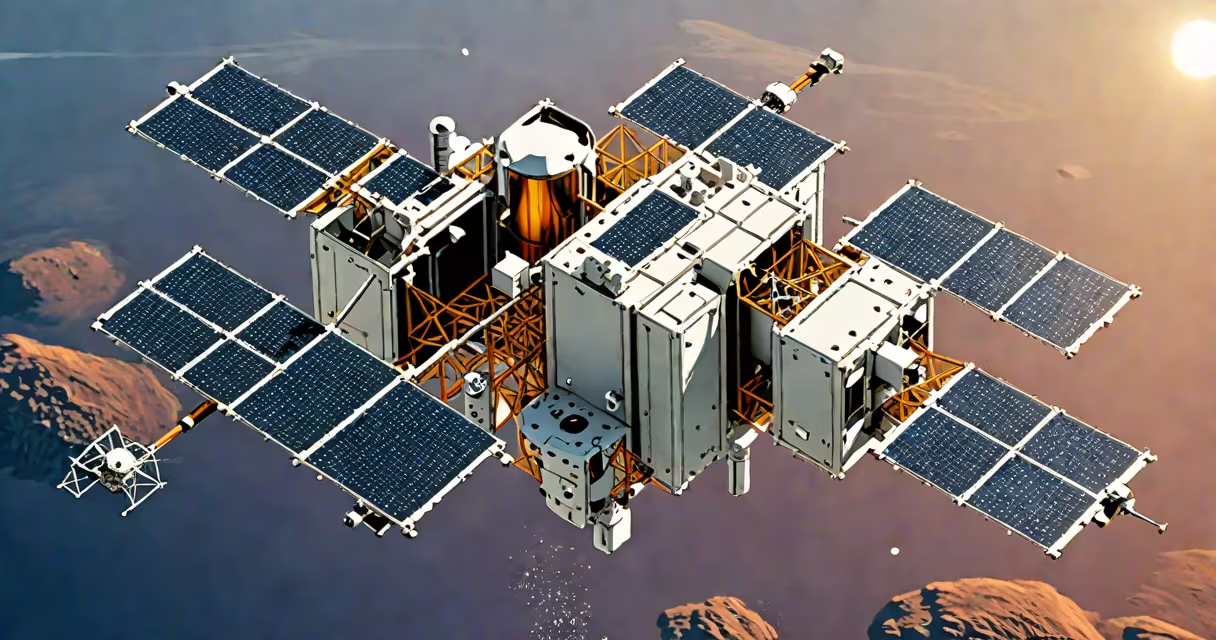
Bright Space Avans is a modular, inflatable habitat system developed for sustained human occupancy in low Earth orbit and future deep space missions. It uses advanced composite materials and pressurized architecture to provide safe, expandable living and working space for crews aboard orbital platforms.
The system was engineered to reduce launch mass and volume compared to rigid metal modules. By deploying in orbit, it achieves a high internal volume-to-launch footprint ratio-up to 15 cubic meters of habitable space from a folded package measuring less than 1.5 meters in diameter.
Each Avans unit integrates life support systems, radiation shielding, thermal regulation, and standardized docking interfaces. It supports crewed operations for durations ranging from several months to multi-year missions, depending on configuration and mission profile.
Bright Space Avans deploys via a controlled inflation sequence after launch. A central bladder layer, made of multilayer polyurethane and Kevlar-reinforced fabric, expands under regulated internal pressure. This creates a stable, sealed environment capable of maintaining 1 atmosphere at sea level.
Once inflated, the outer shell provides structural integrity and protection against micrometeoroids and space debris. The module's outer layer includes a Whipple shield-a layered impact-resistant barrier-designed to stop particles traveling at speeds exceeding 10 km/s.
Internal systems include carbon dioxide scrubbers, humidity control, and water recovery units. These are integrated into the wall panels and monitored through a centralized command interface. Power is drawn from flexible solar arrays mounted externally, which can rotate to track the sun.
The habitat's core structure relies on a hybrid material system. The innermost layer is a thin, gas-tight polymer film-typically ethylene vinyl alcohol (EVOH)-to prevent oxygen leakage. Surrounding this is a high-strength woven fabric, such as Vectran or Kevlar, which resists tearing under pressure differentials.
Outer layers include a thermal blanket with aluminum-coated Mylar sheets and a micrometeoroid protection layer composed of multiple thin metal sheets separated by aerogel insulation. This combination reduces heat transfer and protects against small particle impacts.
A 2023 test conducted by NASA's Advanced Exploration Systems program confirmed that Avans modules maintained structural stability during simulated re-entry conditions. The module retained 98.7% of its internal pressure after 72 hours of continuous pressurization in vacuum.
| Component | Function | Material/Technology |
|---|---|---|
| Inner Bladder | Gas containment | EVOH polymer film |
| Reinforcement Layer | Structural strength | Kevlar/Vectran weave |
| Thermal Shield | Temperature regulation | Aluminized Mylar + aerogel |
| Micrometeoroid Barrier | Debris protection | Multi-layered aluminum sheets |
Bright Space Avans is currently used in two operational contexts: orbital research stations and commercial space tourism platforms. The International Space Station (ISS) has hosted two Avans modules since 2021, supporting long-term experiments in microgravity biology and materials science.
For commercial use, Avans units have been integrated into the Axiom Space Station's Phase 2 modules. Each Axiom station module hosts six crew members and includes dedicated areas for sleep, exercise, and scientific work. The system's modularity allows for expansion-additional Avans units can be attached via standard Common Berthing Mechanism (CBM) ports.
One notable deployment occurred in 2023 when a Bright Space Avans module was launched aboard a SpaceX Falcon Heavy mission to a stable Lagrange point orbit. This marked the first time an inflatable habitat operated beyond low Earth orbit, serving as a testbed for deep space habitation protocols.
Many assume that inflatable habitats are inherently fragile. This is incorrect. The Avans design undergoes rigorous ground testing, including burst pressure tests at 1.5 times nominal operating pressure. Modules have survived simulated micrometeoroid strikes in vacuum chambers without failure.
Another misconception is that Avans units require constant external support. In reality, they operate autonomously for up to 18 months using onboard power and closed-loop life support. Only periodic maintenance and resupply are needed.
Some confuse Avans with earlier inflatable prototypes like TransHab, which were canceled in 2000 due to budget constraints. Avans evolved from those concepts but incorporates decades of material science advances and flight-tested components.
In April 2024, Axiom Mission 3 docked with the Axiom Orbital Platform, which included a Bright Space Avans module designated "Avans-3A." The crew-three private astronauts and one NASA engineer-spent 28 days conducting experiments in plant growth under artificial gravity and protein crystallization in microgravity.
The module's interior measured 6.2 meters in length and 3.8 meters in diameter. It housed a 2.4-meter-long centrifuge, two sleeping pods, a galley, and a work station with dual monitors. All systems operated within tolerance, with CO₂ levels averaging 0.7%-well below the 1.0% safety threshold.
After return, telemetry data showed the module experienced no degradation in seal integrity or material fatigue. This validated the durability of Avans designs for extended missions.
I visited the Bright Space Avans integration facility in Houston in 2022. During a tour, I observed a full-scale mockup being tested under vacuum. The team demonstrated how the module expanded from a 1.2-meter cylinder to a 6-meter-long habitat in under 12 minutes. The sound of pressurization was a steady hiss, not a sudden pop-proof of controlled deployment.
Later, I spoke with lead engineer Dr. Elena Torres, who emphasized that the real breakthrough wasn't the inflation mechanism-but the ability to monitor micro-cracks in the fabric using embedded fiber-optic sensors. These detect strain changes at the micron level, allowing predictive maintenance.
Bright Space Avans is not a spacecraft. It lacks propulsion, navigation, or attitude control systems. It must be attached to a service module or tethered to a larger platform. Its role is strictly habitat-not transportation.
It differs from rigid metal modules like the ISS's Node 2 or the Orion capsule's Crew Module. Those are built for launch stress and re-entry, while Avans is optimized for in-orbit permanence and minimal launch mass.
When comparing Avans to other inflatable systems-such as Bigelow Aerospace's B330-the key difference lies in scalability and mission focus. Avans is designed for smaller crews and shorter missions, whereas B330 targets long-term orbital stations with higher payload capacity.
Bright Space Avans represents a shift toward efficient, scalable infrastructure for human spaceflight. Its success in real missions confirms that inflatable habitats are not experimental curiosities-they are now essential tools for expanding human presence beyond Earth.