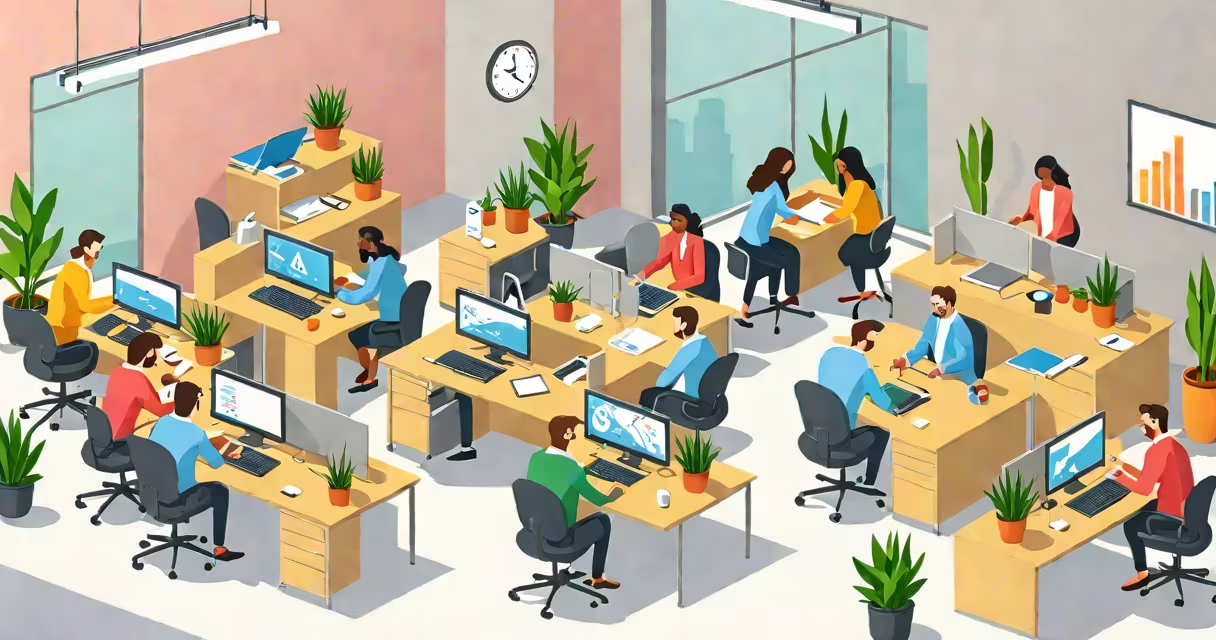
An inclusive environment is a setting-whether educational, professional, or community-based-where all individuals feel safe, respected, and empowered to contribute based on their identities, abilities, and perspectives. It goes beyond equal access to ensure equitable participation and belonging for everyone.
Inclusion is not a passive state. It requires intentional design, ongoing assessment, and structural adjustments to remove barriers that marginalize people. A classroom where students with learning differences have tailored materials and verbal cues during lessons is an example of an inclusive environment. So is a tech company that holds team meetings with live captioning and rotating facilitators to share leadership.
Inclusive environments function through consistent practices that address both visible and invisible barriers. These include accessible communication, flexible policies, and leadership accountability. For example, a university that offers course content in multiple formats-text, audio, and video-and allows students to choose their preferred mode of engagement creates an environment where neurodiverse learners can succeed.
Psychological safety is foundational. Research from Google's Project Aristotle found that teams with high psychological safety outperformed others-not because members were smarter, but because they felt free to speak up, ask questions, and admit mistakes without fear of embarrassment or punishment.
When systems are designed inclusively from the start, outcomes improve for everyone. A city that installs tactile paving, audio signals at crosswalks, and multilingual signage doesn't just serve people with disabilities-it makes navigation easier for tourists, elderly residents, and parents pushing strollers.
Inclusive environments vary by context but share common elements. Below are the primary types and their defining features:
| Type | Key Features | Real-World Example |
|---|---|---|
| Workplace | Flexible schedules, bias training, employee resource groups | A software firm that rotates meeting times to accommodate global teams and provides mental health days without requiring documentation |
| Educational | Universal Design for Learning (UDL), culturally responsive curricula | A middle school that uses project-based learning with student choice in topics and presentation formats, including digital storytelling and oral presentations |
| Community | Language interpretation services, accessible venues, youth advisory boards | A public library offering weekly storytime in ASL and Spanish, with books available in five languages and sensory-friendly hours |
Each type relies on proactive planning rather than reactive fixes. For instance, installing ramps after a building is completed is compliance. Designing a campus with ramps from the outset is inclusion.
Many assume that inclusion means treating everyone the same. This is incorrect. True inclusion involves equity-giving people what they need to thrive, not just equal treatment. A student who is blind needs screen-reader-compatible textbooks, not the same printed book as sighted peers.
Another misconception is that inclusion is solely about race or gender. While representation matters, inclusion addresses all dimensions of identity: disability, age, socioeconomic status, religion, sexual orientation, and neurotype. A single-parent family attending a school event may feel excluded if all communications assume dual-parent households.
One non-obvious distinction: inclusion is not the same as acceptance. Acceptance implies tolerating difference. Inclusion demands active integration. A school that allows a student to wear a religious head covering is accepting. A school that invites students to discuss cultural traditions in class and integrates those perspectives into history lessons is inclusive.
In 2021, the Seattle Public Schools district launched a district-wide initiative to assess and improve inclusivity. They began by surveying students, staff, and families using anonymous tools focused on belonging, safety, and voice. Results showed that 68% of Black and Latinx students reported feeling less welcome than their peers.
Leaders responded by revising hiring practices to prioritize candidates from underrepresented backgrounds, introducing restorative justice circles in middle schools, and creating a student-led Equity Task Force. Teachers received training in trauma-informed instruction and implicit bias recognition.
Within two years, attendance rates rose by 12% among historically marginalized groups. More, student surveys indicated a 40% increase in feelings of being "seen" and "valued." This outcome wasn't due to a single program-it was the result of coordinated changes across policy, culture, and practice.
I observed this transformation firsthand while volunteering at a high school during the rollout. One teacher shared that she had previously avoided discussing systemic racism in her U.S. history class. After training, she introduced primary source documents from formerly enslaved people and structured debates on constitutional amendments. Her students, especially those from minoritized backgrounds, began speaking more in class and requesting additional reading.
Understanding the definition of inclusive environment prevents superficial efforts. Diversity without inclusion leads to tokenism. Representation without access results in burnout. A team with mixed ethnicities but no psychological safety will underperform.
According to the Harvard Business Review, companies with inclusive cultures report 1.7 times higher innovation revenue and 1.8 times greater customer satisfaction. In education, research from the National Center for Education Statistics shows that students in inclusive classrooms score 15% higher on standardized tests than those in segregated settings.
The definition of inclusive environment centers on dignity, agency, and shared ownership. It's not about perfection. It's about progress-measured not in slogans, but in who feels safe to speak, who gets invited to lead, and who walks away feeling they belong.