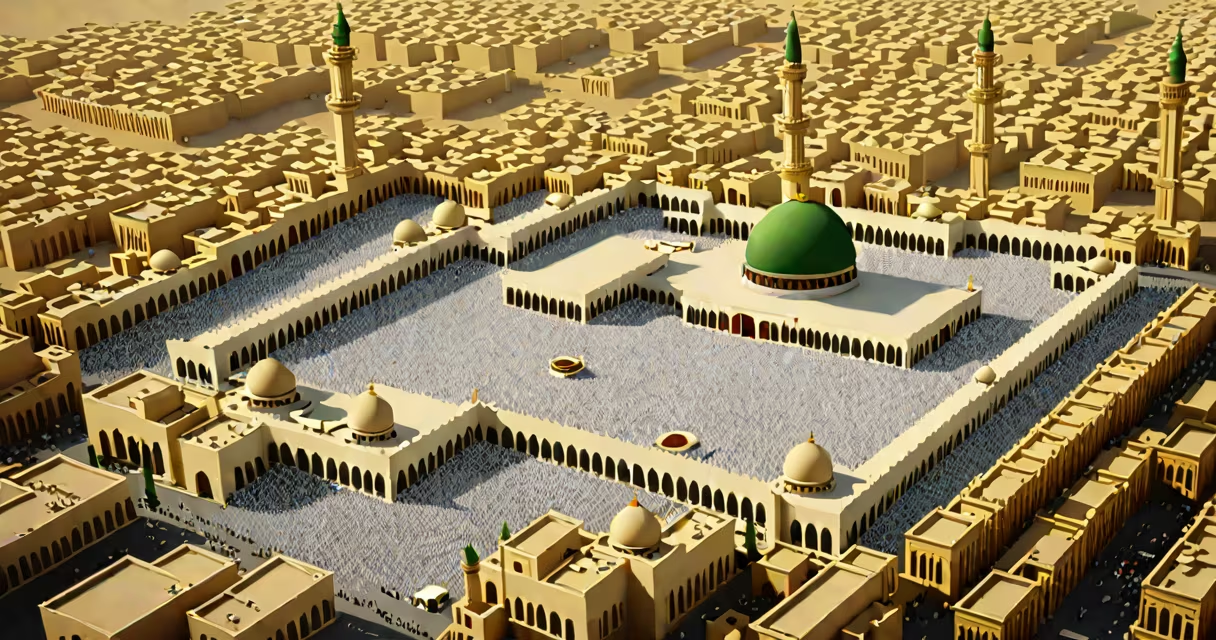
Mecca is the holiest city in Islam, located in western Saudi Arabia. It is the birthplace of the Prophet Muhammad and the site of the Kaaba, the sacred cube toward which Muslims pray five times daily. Every year, millions of Muslims travel to Mecca to perform the Hajj pilgrimage, one of the Five Pillars of Islam.
The city's religious centrality stems from its association with Abraham, Ishmael, and Muhammad. According to Islamic tradition, Abraham and his son Ishmael rebuilt the Kaaba as a house of monotheistic worship. The Kaaba, now enclosed within the Grand Mosque (Masjid al-Haram), is the focal point of Muslim prayer worldwide. Pilgrims circle it seven times during the Hajj, a ritual that symbolizes unity and submission to God.
Mecca's status is not symbolic only-it is a physical, geographic reality. It lies in the Hejaz region, near the Red Sea, at an elevation of approximately 277 meters. The city's population swells from around 1.5 million to over 2 million during the Hajj season, which lasts five days each year according to the Islamic lunar calendar. The Saudi government manages access through a strict visa system based on national quotas and health screening.
Every Muslim who is physically and financially able is required to perform the Hajj at least once in their lifetime. This obligation applies regardless of nationality, language, or sect. The pilgrimage involves specific rituals performed over several days: standing in prayer at Mount Arafat, throwing stones at symbolic pillars representing Satan, and offering animal sacrifices.
These acts are not arbitrary. They reenact events from Islamic scripture. For example, the stoning of the pillars recalls Abraham's rejection of Satan's temptation to disobey God's command to sacrifice Ishmael. The ritual of running between Safa and Marwah hills commemorates Hagar's desperate search for water, which led to the miraculous emergence of the Zamzam well.
Modern Mecca is a highly regulated urban center. The Saudi government has expanded infrastructure to handle mass gatherings, including elevated walkways, climate-controlled prayer areas, and a dedicated rail system. Despite these upgrades, the city remains closed to non-Muslims-a policy enforced since the 1930s. Non-Muslims may view Mecca from afar via satellite imagery or official videos, but entry is prohibited under Saudi law.
The term "Mecca" functions in multiple ways depending on context. In religious discourse, it denotes a spiritual destination. In geopolitics, it represents a site of international influence. In popular culture, it serves as a metaphor for any place of intense desire or central importance.
| Type | Description | Example |
|---|---|---|
| Religious | Center of Islamic faith and practice | "The Kaaba in Mecca is the qibla for all mosques." |
| Geographic | Physical location in Saudi Arabia | "Mecca is situated in the Hijaz region, 70 km inland from the Red Sea." |
| Cultural | Symbolic reference in language and media | "He called the concert hall 'Mecca' for music lovers." |
One common confusion arises from equating Mecca with Medina. While both cities are sacred in Islam, they serve different roles. Medina is the burial site of the Prophet Muhammad and the location of his mosque. Mecca is the origin of revelation and the direction of prayer. The two cities are connected by the Hejaz Railway, but they are distinct in theological function.
Some assume Mecca is a modern invention or a political construct. This is incorrect. Historical records show that Mecca was a major trade hub in pre-Islamic Arabia. The Quraysh tribe controlled the city and managed the pilgrimage to pagan shrines, including the Black Stone embedded in the Kaaba. Muhammad's revelations began in Mecca, and he preached there before migrating to Medina in 622 CE.
Another misconception is that all Muslims visit Mecca at once. In reality, the Hajj occurs annually, but only a subset of eligible pilgrims attend each year due to limited space and strict eligibility criteria. The Saudi Ministry of Hajj and Umrah reports that 2.5 million people participated in the 2023 Hajj, a number adjusted downward from previous years due to pandemic-era restrictions and capacity limits.
A lesser-known fact: the original Kaaba structure predates Islam. Archaeological evidence from the 1970s shows that the building had earlier layers of construction, including a stone foundation dating to the 1st century BCE. The current structure, rebuilt in 605 CE, was later rededicated to monotheism under Islamic rule. The Kaaba's orientation toward the east-facing Jerusalem initially-was changed during Muhammad's lifetime, aligning it with the new Islamic direction of prayer.
In 2019, I attended a lecture at the American University of Beirut on Islamic architecture. A scholar from King Saud University presented a 3D model of the Grand Mosque's expansion project. He noted that the new underground tunnels now carry 100,000 pilgrims per hour during peak Hajj hours. The design includes thermal regulation systems to maintain safe temperatures in summer, when desert heat can exceed 50°C (122°F).
One detail stood out: the black cloth covering the Kaaba-the Kiswah-is replaced annually. The fabric, woven in Egypt using gold thread, weighs nearly 600 kilograms. The process takes weeks and involves teams of artisans working under religious oversight. The old Kiswah is burned in a ceremonial fire, a practice rooted in the idea of renewal and purification.
When visiting Mecca, even briefly, one senses the weight of collective devotion. The air hums with recitation. The scent of incense lingers. The sight of thousands in identical white ihram garments creates a visual echo of unity. This is not merely a city-it is a living ritual.
Understanding the definition of Mecca requires recognizing its layered identity: a place of worship, a historical site, a logistical challenge, and a cultural touchstone. Its significance extends beyond religion into diplomacy, tourism, and global identity. For Muslims, Mecca is not just a destination-it is a return to origin.