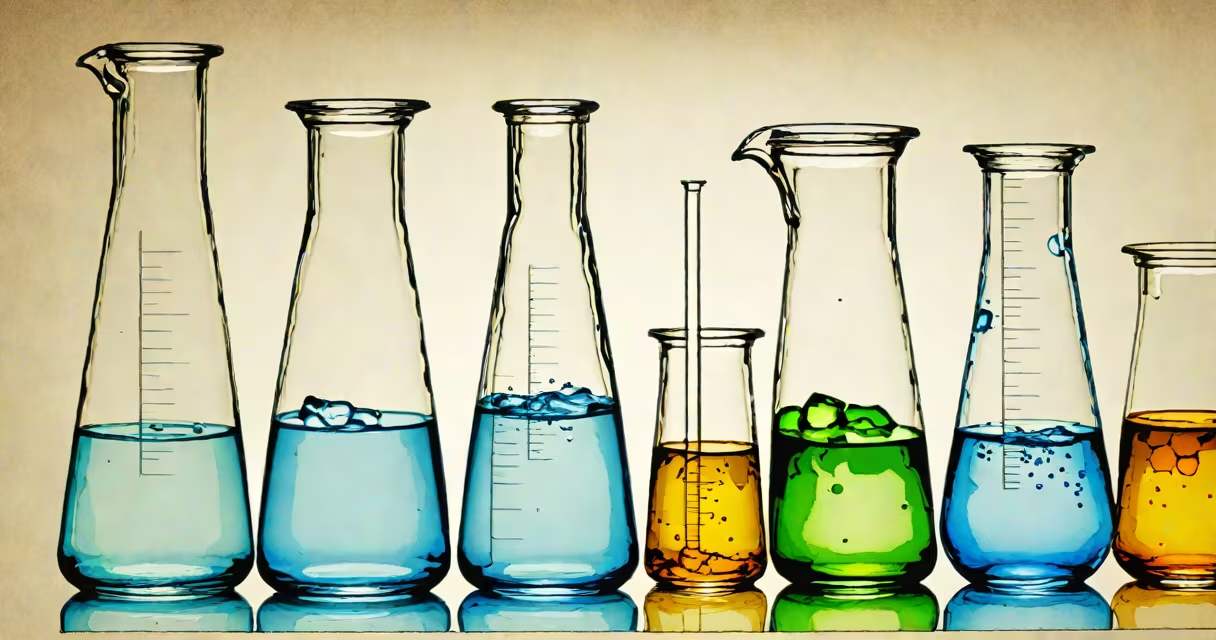
A pure substance consists of only one type of particle with a fixed chemical composition and distinct physical properties, while a mixture contains two or more substances physically combined, each retaining its original identity and separable by physical means.
Pure substances have consistent melting and boiling points under standard conditions. For example, pure water boils at exactly 100°C at sea level. Mixtures do not-saltwater, for instance, boils above 100°C due to dissolved ions altering its behavior. This difference enables quick experimental identification: if a sample's boiling point varies during heating, it is likely a mixture.
Chemical composition defines purity. Water (H₂O) is a pure substance because every molecule is identical. Air, though often assumed to be uniform, is a mixture of nitrogen, oxygen, argon, carbon dioxide, and trace gases. Even if well-blended, air separates into components when cooled below −196°C-liquid nitrogen boils off first, then oxygen. This phase separation confirms mixtures lack fixed composition.
Pure substances are either elements or compounds. Elements consist of a single atom type-oxygen (O₂), gold (Au), or sulfur (S₈). Compounds form when atoms bond in fixed ratios-water (H₂O), sodium chloride (NaCl), glucose (C₆H₁₂O₆). All molecules in a pure compound are identical, ensuring predictable reactions and measurable constants like density and refractive index.
Mixtures vary in structure. Homogeneous mixtures appear uniform throughout-like sugar dissolved in tea. Heterogeneous mixtures show visible differences-sand in water, oil and vinegar salad dressing. Both types can be separated using physical techniques: filtration, distillation, evaporation, or magnetic attraction.
Consider iron filings mixed with sulfur powder. Visually, it's a black-and-gold speckled blend. Heating the mixture causes a chemical reaction: Fe + S → FeS (iron sulfide), forming a new solid with different properties. But before heating, the mixture remains physically separable-using a magnet pulls out iron, leaving sulfur behind. This demonstrates that mixtures do not undergo chemical change upon mixing.
| Feature | Pure Substance | Mixture |
|---|---|---|
| Composition | Fixed ratio of particles | Variable proportions |
| Separation Method | Only via chemical reaction | Physical processes only |
| Boiling/Melting Point | Sharp, constant value | Range or variable value |
| Examples | Distilled water, pure gold, CO₂ gas | Saltwater, air, trail mix |
Many assume all liquids are pure substances. Tap water, for example, contains minerals, chlorine, and dissolved gases-making it a mixture. Even "pure" bottled water may include added fluoride or magnesium. True purity requires laboratory-grade standards, such as those defined by the National Institute of Standards and Technology (NIST).
Another error: thinking homogeneity equals purity. A solution of ethanol and water is homogeneous but still a mixture. Its boiling point ranges from 78°C to 100°C depending on concentration. Distillation separates it into pure components-proof that homogeneity doesn't imply a single substance.
Even complex materials like granite are mixtures. Composed of quartz, feldspar, mica, and other minerals, granite shows visible grain boundaries. Each mineral retains its crystal structure and chemical identity. You can separate them mechanically-grinding and sieving-without changing their molecular makeup.
In pharmaceuticals, purity is critical. A drug compound must be a pure substance to ensure accurate dosing. Impurities in a batch can cause adverse effects. Regulatory agencies like the U.S. Food and Drug Administration (FDA) require strict testing to confirm that active ingredients meet purity thresholds, often using chromatography or mass spectrometry.
Industrial processes rely on separating mixtures. Crude oil refining uses fractional distillation to split hydrocarbons based on boiling points. Gasoline, diesel, kerosene-all emerge as distinct fractions. The process depends entirely on the mixture nature: each component boils at a known temperature, allowing precise recovery.
I once tested a sample labeled "pure alcohol" in a high school lab. Using a thermometer and heat source, I measured its boiling point: 78.3°C. That matched ethanol's known value. But when I added a few drops of water, the boiling point rose to 80°C. The shift confirmed the presence of a mixture-even small amounts of water altered the behavior. This hands-on test revealed how sensitive physical properties are to impurities.
The difference between pure substance and mixture hinges on consistency and separability. Pure substances maintain unchanging composition and physical properties. Mixtures combine multiple substances without chemical bonding, allowing physical separation. This distinction underpins chemistry, environmental science, and quality control across industries.
When analyzing a material, ask: Can it be broken down into simpler parts using physical methods? If yes, it's a mixture. If no, and it has a fixed composition and sharp phase transition, it's a pure substance. Always verify with measurable data-not appearance or labeling.