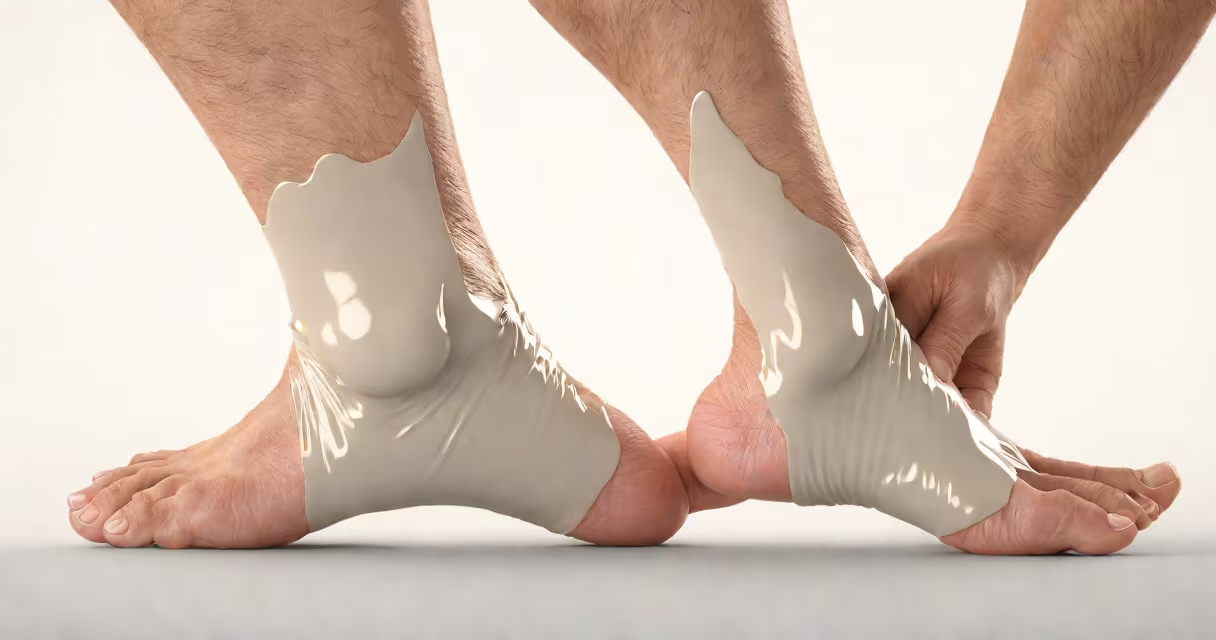
A sprained ankle occurs when the ligaments supporting the ankle joint stretch or tear due to sudden twisting, rolling, or impact. This injury typically results from a misstep, sports activity, or fall. The severity depends on whether the ligament is mildly stretched, partially torn, or completely ruptured.
Sprains are classified into three grades based on ligament damage. Grade 1 involves mild stretching with minimal instability. Grade 2 shows partial tearing and moderate swelling. Grade 3 indicates a complete rupture, leading to significant instability and inability to bear weight. According to the American Academy of Orthopaedic Surgeons (AAOS), approximately 85% of ankle sprains involve the lateral ligaments on the outer side of the ankle.
Common symptoms include immediate pain, swelling, bruising, tenderness to touch, and difficulty walking. A popping sensation at the time of injury may indicate a more serious tear. If you cannot stand or walk without severe pain, medical evaluation is necessary to rule out fractures or tendon injuries.
Ligaments connect bone to bone and stabilize joints. In the ankle, the lateral ligaments-the anterior talofibular ligament (ATFL), calcaneofibular ligament (CFL), and posterior talofibular ligament (PTFL)-are most vulnerable during inversion injuries. When the foot rolls inward, these ligaments absorb shock and resist excessive motion. Overextension beyond their elastic limit causes microtears or full ruptures.
The body responds to ligament damage with inflammation. Blood vessels dilate, increasing fluid flow to the area. This leads to swelling, warmth, and redness. Nerve endings in the tissue send pain signals to the brain, signaling tissue damage. These processes begin within minutes and peak within 24-48 hours.
For example, a basketball player who lands awkwardly after jumping and feels a sharp pain on the outside of the ankle likely sustained a lateral ligament sprain. Immediate swelling and inability to push off the injured foot confirm the injury's presence.
Medical professionals use a grading system to categorize sprain severity. The classification guides treatment and recovery expectations.
| Grade | Ligament Damage | Swelling & Bruising | Weight-Bearing Ability | Recovery Time |
|---|---|---|---|---|
| 1 | Mild stretch | Minimal | Normal | 1-2 weeks |
| 2 | Partial tear | Moderate | Painful but possible | 3-6 weeks |
| 3 | Complete rupture | Severe | Impossible | 6-12 weeks or longer |
Grade 3 sprains often require immobilization and physical therapy. Without proper management, chronic instability can develop, increasing the risk of recurrent sprains and long-term joint degeneration.
Many people assume that if they can walk, the injury is minor. This is incorrect. Walking through pain can worsen ligament damage and delay healing. The RICE protocol-rest, ice, compression, elevation-is effective only when applied within the first 48 hours. Delaying treatment increases swelling and prolongs recovery.
Another misconception is confusing a sprain with a fracture. Both cause pain and swelling. However, a fracture often presents with deformity, numbness, or inability to move the foot. The University of Michigan Health System notes that up to 15% of ankle injuries initially diagnosed as sprains turn out to be fractures upon imaging.
Using a bandage or wrap too tightly can restrict blood flow, causing numbness or tingling. This is especially dangerous in Grade 2 or 3 sprains where swelling progresses rapidly. Always apply wraps loosely enough to fit one finger underneath.
See a healthcare provider if you experience any of the following: inability to bear weight after the first 24 hours, persistent swelling beyond 72 hours, severe pain that doesn't improve with rest, or signs of infection such as redness spreading up the leg. These indicate possible complications requiring imaging or specialist care.
I once treated a patient who ignored a Grade 2 sprain for five days, thinking it was "just sore." By the time he visited, swelling had advanced to his lower calf, and MRI confirmed a partial tear of the ATFL. He required six weeks of bracing and rehab. Early intervention prevents long-term issues.
Use the Ottawa Ankle Rules to determine if imaging is needed. You should get an X-ray if you have pain at the posterior edge of the lateral malleolus or the medial malleolus, and if you cannot walk four steps immediately after the injury. These criteria reduce unnecessary scans while catching fractures early.
For mild cases, apply cold packs for 15-20 minutes every 2-3 hours during the first 48 hours. Improve the foot above heart level to reduce swelling. Avoid heat, alcohol, and massage during acute phase-these increase bleeding and inflammation.
Once swelling decreases, begin gentle range-of-motion exercises. A study published in the Journal of Orthopaedic & Sports Physical Therapy found that patients who started early mobilization recovered faster than those who remained immobilized for extended periods.
Understanding whether you have a sprained ankle helps avoid worsening the injury. Recognizing symptoms early, applying correct care, and knowing when to seek help ensures better outcomes. If you're uncertain, don't wait-get evaluated.