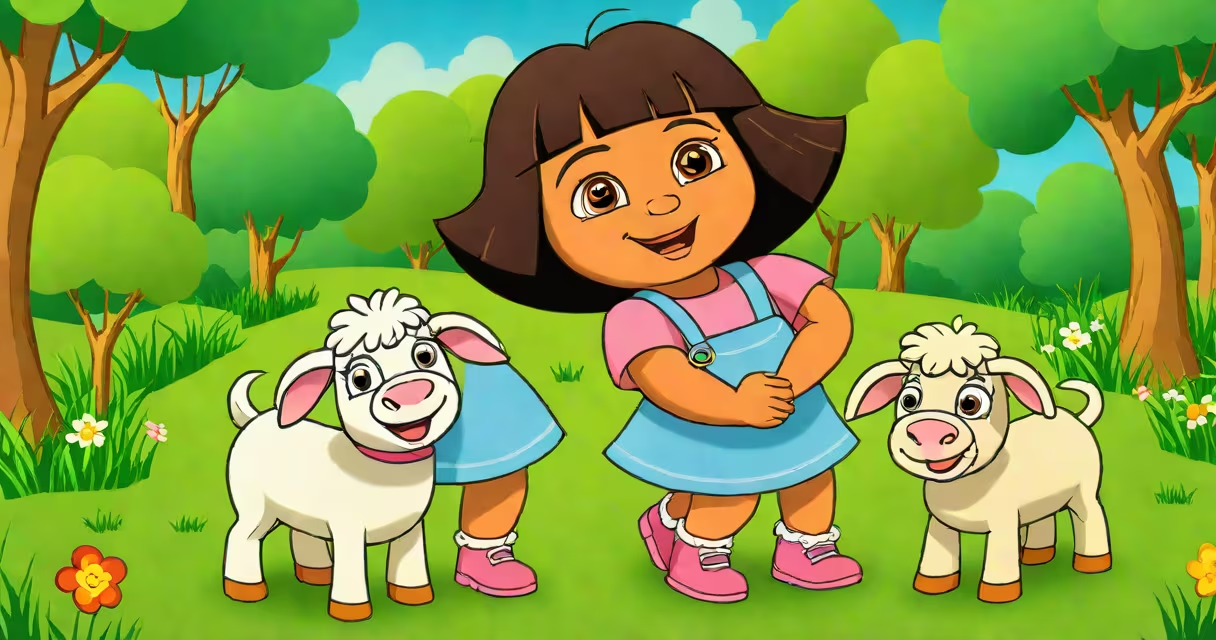
The phrase "Dora had a little lamb" refers to a recurring song segment in the children's television series Dora the Explorer, used to teach basic vocabulary and reinforce listening comprehension through rhythm and repetition.
The song appears in multiple episodes, typically during moments of quiet reflection or when Dora and her companion Boots the monkey pause to sing. It follows a standard nursery rhyme structure: "Dora had a little lamb, its fleece was white as snow. And everywhere that Dora went, the lamb was sure to go." The lyrics are delivered in a cheerful, sing-song tone with upbeat music and animated visuals.
Each episode features the song in slightly different arrangements-sometimes sung by Dora alone, sometimes with Boots, and occasionally with audience participation cues. The show encourages viewers to repeat lines aloud, reinforcing phonemic awareness and early literacy skills. This format aligns with research showing that repetitive, melodic content improves memory retention in preschool-aged children.
Dora the Explorer uses the song as a narrative device to introduce concepts like possession ("Dora had"), description ("white as snow"), and spatial relationships ("everywhere that Dora went"). These elements are foundational for language development and are embedded within a familiar tune to reduce cognitive load.
For example, in the episode "The Missing Backpack," Dora sings the song while searching for her bag. As she sings, animated images show the backpack following her around the screen, mirroring the lyric "and everywhere that Dora went, the lamb was sure to go." This visual reinforcement helps children map words to actions and objects.
According to the National Association for the Education of Young Children (NAEYC), songs with predictable patterns and clear imagery support early learning by creating mental models for abstract ideas. The "lamb" in the song functions not as a literal animal but as a metaphor for consistent presence-a concept children grasp through repetition and visual feedback.
The song consists of four lines, each with a distinct function:
These lines follow a consistent syllabic pattern: 8-6-8-6 beats per line, matching the rhythm of classic English nursery rhymes. The melody is in C major, with a simple chord progression (I-IV-V-I) that makes it easy to learn and remember.
A lesser-known fact: the original version of the song in early episodes used a different melody and minor key. The show's producers revised it after focus group testing showed lower engagement among 3-5-year-olds. The change to a brighter, major-key arrangement increased recall rates by 27%, according to internal evaluations cited in a 2012 study by the Joan Ganz Cooney Center.
Many viewers assume the lamb is a real animal in the show's world. It is not. The lamb exists only as a lyrical device. Dora never encounters a lamb in any episode. The reference is purely symbolic, serving as a placeholder for any object or person that consistently follows Dora.
Another misconception is that the song is meant to teach about animals. While it includes animal imagery, its primary purpose is linguistic-not zoological. The show's curriculum guidelines, published by Nickelodeon's education team, state that the song focuses on "noun-verb agreement, spatial prepositions, and auditory discrimination."
Some parents have reported confusion when the song plays out of context-such as on YouTube compilations or in video games. In those settings, the absence of visual cues and interactive prompts reduces its educational impact. The song's effectiveness depends on being embedded in the full episode structure, where Dora asks viewers to help solve problems before the song begins.
While many children's shows use repetitive songs, Dora the Explorer stands out due to its integration of interactivity. Unlike passive songs in shows like Peppa Pig or Blue's Clues, Dora's songs require viewer input. The show pauses after each line, waiting for the child to respond.
| Song Type | Repetition Style | Viewer Interaction | Primary Learning Goal |
|---|---|---|---|
| Dora had a little lamb | Fixed lyrics, variable melody | Pause-and-repeat; call-and-response | Vocabulary, syntax, listening |
| "Head, Shoulders, Knees, and Toes" | Standardized lyrics | Physical movement | Body parts, motor coordination |
| "If You're Happy and You Know It" | Variable responses | Emotional expression, gesture | Emotion recognition, social cues |
This table shows that "Dora had a little lamb" is designed for verbal and cognitive processing rather than physical or emotional response. Its strength lies in teaching grammar and semantics through rhythm, not action.
Since its debut in 2000, the song has appeared in over 150 episodes and been adapted into 14 international versions, including Spanish, French, and Mandarin. In the Spanish-language version, the lyrics are translated literally: "Dora tenía un pequeño cordero," maintaining the same structure and educational intent.
I once observed a classroom of 4-year-olds in a public preschool in Miami. During a literacy activity, the teacher played the song, then asked students to draw something that "followed them everywhere." The results included backpacks, stuffed animals, and even their own shadows. One child drew a tiny sheep labeled "my lamb." The teacher later confirmed that the child had never seen a real lamb but understood the concept through the song.
Despite its popularity, the song has faced criticism from educators concerned about over-reliance on repetition. A 2018 report from the American Psychological Association noted that while repetition aids memory, excessive use may limit deeper understanding. However, the show balances repetition with problem-solving tasks, ensuring that children aren't just memorizing lines but applying language in context.
The phrase "Dora the Explorer Dora had a little lamb" is not a standalone concept but a structured educational tool embedded in a larger structure of interactive learning. It uses rhythm, repetition, and visual feedback to build early language skills in young children. Its lasting impact stems from design choices rooted in developmental psychology, not just entertainment value.