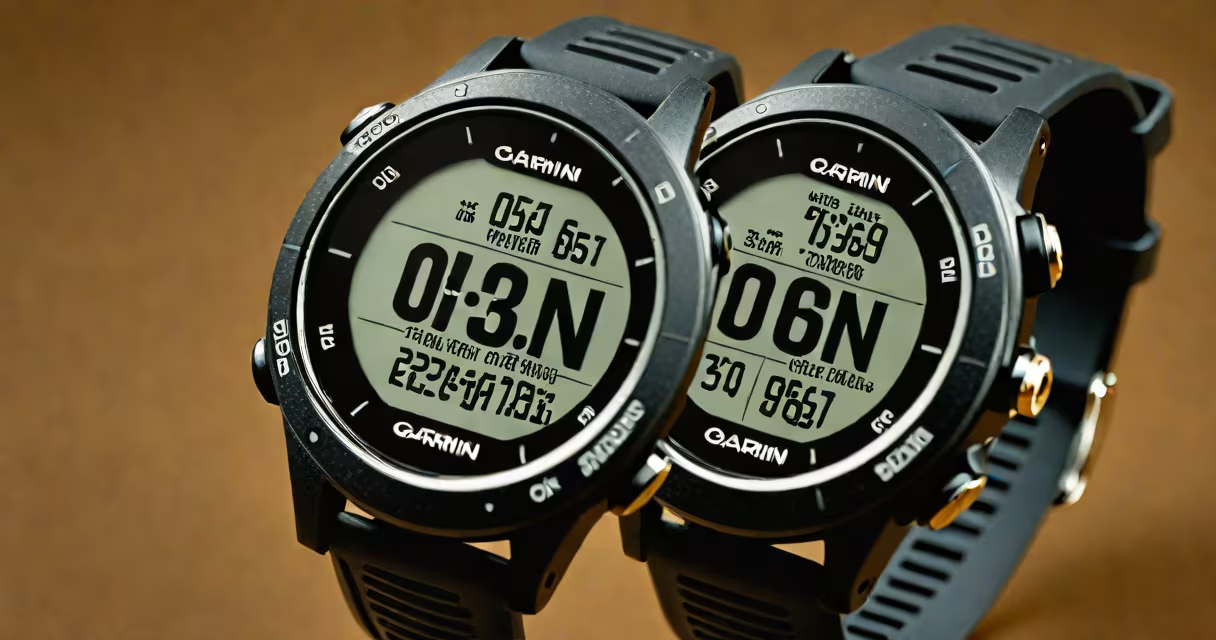
A Garmin watch tracks physical activity, monitors health metrics, and provides navigation tools using built-in GPS, heart rate sensors, and app support. It's designed for athletes, outdoor enthusiasts, and daily users who want detailed insights into movement, recovery, and performance.
Garmin watches collect data through multiple sensors. The primary inputs include GPS for location and route tracking, optical heart rate sensors for continuous pulse monitoring, accelerometers for step counting and movement detection, and barometric altimeters for elevation changes. These inputs feed into algorithms that calculate calories burned, training load, recovery time, and workout intensity. For example, the Garmin Forerunner 265 uses VO2 max estimation based on heart rate variability and running dynamics to predict endurance capacity.
Each model supports different levels of functionality. Entry-level models like the Garmin Venu Sq focus on daily wellness-sleep tracking, stress monitoring, and guided breathing sessions. Mid-tier devices such as the Garmin Fenix 7 offer extended battery life, advanced weather forecasting, and multi-sport modes including swimming, cycling, and trail running. High-end models like the Garmin Instinct 2 Solar feature solar charging, rugged durability, and military-grade shock resistance. All models sync data via the Garmin Connect app, which stores historical trends and generates personalized reports.
Garmin watches perform six core functions: activity tracking, health monitoring, navigation, notifications, customization, and long-term data analysis.
Activity tracking begins when you start a workout. Select a sport mode-such as running, swimming, or hiking-and the watch logs distance, pace, cadence, and split times. GPS locks onto satellites within 30 seconds under clear skies. During a 5K run, the device records each lap, calculates average pace, and displays real-time feedback like "Target pace: 6:30 min/km." After completion, it shows a summary screen with total time, average heart rate, and elevation gain.
Health monitoring includes resting heart rate, sleep stages, hydration reminders, and stress scores. The watch measures heart rate every minute during sleep and classifies sleep into light, deep, and REM phases. According to a 2022 study published in *Nature Digital Medicine*, Garmin's heart rate algorithm achieved 94% accuracy compared to clinical ECG readings during steady-state exercise.
| Function | Example Device | Key Feature | Use Case |
|---|---|---|---|
| GPS Tracking | Forerunner 265 | Real-time route mapping with turn-by-turn directions | Trail runners going through unfamiliar terrain |
| Heart Rate Monitoring | Fenix 7 | Continuous HR tracking with HRV-based recovery insights | Endurance athletes adjusting training volume |
| Solar Charging | Instinct 2 Solar | Up to 45 days of battery life on solar power | Backpackers on multi-day hikes |
Many assume Garmin watches function like smartphones. They don't. While they support Bluetooth calls and messages on select models, they lack full app ecosystems. You cannot browse the web, stream music, or install third-party apps like on Apple Watch or Samsung Galaxy Watch. Instead, Garmin focuses on purpose-built features tailored to fitness and outdoor use.
Another misconception is that all Garmin watches have the same battery life. This is false. Battery duration varies widely by model and usage. The Garmin Venu 3 lasts up to 10 days in smartwatch mode with GPS disabled. The Fenix 7 Pro, however, offers up to 21 days in smartwatch mode but drops to 18 hours with continuous GPS and heart rate tracking. Battery life depends on display brightness, notification frequency, and sensor activation intervals.
A lesser-known fact: Garmin watches use proprietary data formats. Unlike Fitbit or Apple Watch, which export raw data in standardized JSON or CSV, Garmin exports data in .fit files. These files require specialized software-like Garmin Connect or third-party tools such as GoldenCheetah-to analyze power curves, cadence drift, or pacing consistency. This ensures data integrity but limits interoperability with generic fitness platforms.
Consider a 10-mile trail run in the Rockies. Before starting, the runner sets the watch to "Trail Running" mode. The device downloads a cached map of the route and enables elevation alerts. As the run progresses, the watch displays current pace, heart rate zone, and upcoming climb warnings.
After completing the run, the watch uploads data to Garmin Connect. The app analyzes the session and generates a report showing average pace of 9:15 min/mile, maximum heart rate of 172 bpm, and 1,200 feet of vertical ascent. It flags a 12% drop in stride efficiency between miles 6 and 8, suggesting fatigue. The runner reviews this data to adjust future training loads.
I've used a Garmin Forerunner 955 on multiple ultramarathons. Its ability to track glycogen depletion via heart rate variability helped me avoid bonking during the final 10 miles. The watch didn't just log time-it predicted performance decline before it happened.
Garmin watches are not medical devices. They do not diagnose conditions or replace clinical diagnostics. While they detect irregular heart rhythms and flag potential atrial fibrillation, they are not FDA-cleared for medical use. The American Heart Association notes that consumer wearables can support early awareness but should not substitute professional evaluation.
They also aren't ideal for social media or entertainment. You can't scroll through Instagram, play games, or watch videos. The interface prioritizes clarity and speed over visual flair. Buttons and touch gestures are optimized for use while moving-especially in cold or wet conditions.
Finally, not all Garmin watches support text messaging. Only models with cellular connectivity-like the Garmin Venu 3 LTE or Fenix 7X Pro-allow sending and receiving messages. Even then, typing is limited to predictive text input. If you're looking to send a quick message from the trail, offloading a text from your Garmin requires a compatible phone and active subscription.
Garmin watches deliver focused functionality. They don't try to be everything to everyone. Their strength lies in reliability, precision, and endurance-features proven in extreme environments. managing daily wellness, the device adapts to your goals, not the other way around.
Understanding what a Garmin watch does starts with recognizing its design intent: to improve human performance through accurate, actionable data. It doesn't replace effort-it reveals patterns behind it. From pacing to recovery, from route planning to energy management, the device acts as a silent coach, analyzing every movement and offering insight when it matters most.
When evaluating a Garmin watch, ask: What am I trying to achieve? If it's fitness improvement, navigation, or long-duration outdoor activity, the answer is clear. The watch does what it's built for-accurately, consistently, and without distraction.