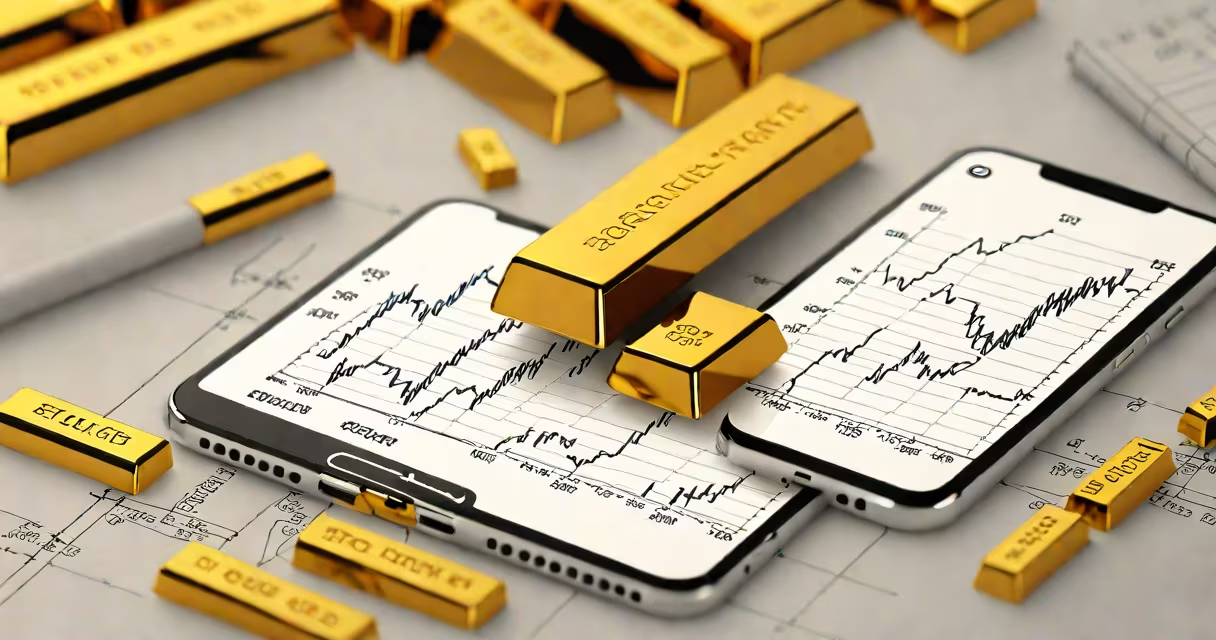
Gold fund investment refers to allocating capital into professionally managed funds that hold gold-related assets such as physical bullion, gold mining equities, or gold-backed exchange-traded funds (ETFs). These funds allow investors to gain exposure to gold without owning or storing physical metal.
Gold funds operate as pooled investment vehicles. A fund manager selects and manages a basket of gold-linked securities based on a stated objective-such as tracking gold prices, gaining use to gold price movements, or investing in companies that extract gold. Investors buy shares in the fund, which are traded on exchanges like stocks.
Unlike buying a gold coin or bar, gold fund investment provides liquidity, diversification, and lower storage costs. It's suitable for individuals seeking to hedge against inflation, currency devaluation, or market volatility without the complexities of physical ownership.
Each gold fund follows a specific strategy. Some hold actual gold bars stored in vaults, others invest in mining company stocks, and some track gold prices via derivatives. The fund's net asset value (NAV) fluctuates daily based on the underlying assets' market value.
For example, the SPDR Gold Shares ETF (GLD) holds physical gold bars stored in London and New York. Each share represents 1/10th of an ounce of gold. As gold prices rise, GLD's share price increases. Investors can buy and sell shares during market hours just like any stock.
Funds that invest in gold mining companies behave differently. Their returns depend on both gold prices and company-specific factors like production costs, management efficiency, and geopolitical risks in mining regions. A 10% rise in gold prices may lead to a 20% gain in a high-use mining stock-but also a 30% drop if operations fail.
Not all gold funds are the same. Here's how they differ:
| Type | Underlying Assets | Liquidity | Best For |
|---|---|---|---|
| Gold ETFs | Physical gold held in vaults | High (traded daily) | Hedging inflation, low-maintenance exposure |
| Gold Mining Stocks | Equities of gold-producing companies | High | Higher return potential, risk tolerance required |
| Gold Mutual Funds | Mix of gold ETFs, mining stocks, and sometimes futures | Medium (priced once daily) | Portfolio diversification, long-term allocation |
| Gold Futures Funds | Derivatives contracts tied to gold prices | High | Speculation, short-term trading |
Gold ETFs like GLD or IAU are the most transparent. They publish daily holdings and are audited by independent firms. According to the World Gold Council, over 2,500 tons of gold are held in ETFs globally as of 2023-enough to fill a standard Olympic swimming pool.
A lesser-known fact: some gold funds use synthetic replication. Instead of holding physical gold, they use swaps or derivatives to mimic gold's price movement. This reduces custody risk but introduces counterparty risk-the risk that the bank or institution backing the swap fails.
Investors use gold fund investment to balance risk in a portfolio. During periods of economic uncertainty, gold often rises while stocks fall. This inverse relationship makes gold funds useful for risk mitigation.
For example, in 2020, when global markets plunged due to the pandemic, gold prices rose 25% year-on-year. Investors who held gold ETFs saw gains even as equity indices dropped. The S&P 500 fell 34% in March 2020, while GLD rose 16% over the same period.
Central banks also allocate to gold funds. The U.S. Federal Reserve and China's People's Bank of China have bought billions in gold since 2010. While they don't typically trade ETFs, their demand supports gold's long-term value. The World Gold Council reports central banks purchased 1,136 tonnes of gold in 2022-the highest annual total since 1971.
Many mistake gold fund investment for direct ownership of gold. You do not receive a gold bar when you buy shares in GLD. You own a claim on a portion of the fund's gold reserves, backed by trust agreements and audits.
Another misconception: gold funds are always safe. They're not. A gold mining fund can lose value even if gold prices rise-due to operational issues, regulatory changes, or poor management. In 2013, the VanEck Gold Miners ETF (GDX) dropped 50% in six months despite gold rising 12% that year.
Also, not all gold funds charge the same fees. Expense ratios vary widely. GLD charges 0.40% annually, while some niche mining funds charge 1.5% or more. Over 10 years, a 1.1% difference in fees can reduce returns by nearly 12% due to compounding.
Suppose you have $50,000 to invest and want 10% in gold. That's $5,000. You choose GLD, which trades at $55 per share (as of May 2024). You buy 90.9 shares ($5,000 ÷ $55 ≈ 90.9).
Over the next year, gold rises 10%. GLD's share price goes to $60.50. Your position is now worth $5,494.50-a 9.9% return. You didn't pay storage, insurance, or transaction fees beyond brokerage commissions. No need to worry about theft or market timing.
I've used this strategy since 2018. In 2022, when inflation hit 9%, I rebalanced my portfolio to include 12% gold funds. By early 2023, gold had risen 18%, and my allocation added $6,000 in value without any action on my part.
Gold fund investment provides a structured, accessible way to participate in gold's long-term value. It's not a guaranteed profit, but it adds stability during turbulent times. Choose a fund based on your goals-whether you want pure price tracking, leveraged exposure, or growth from mining operations.