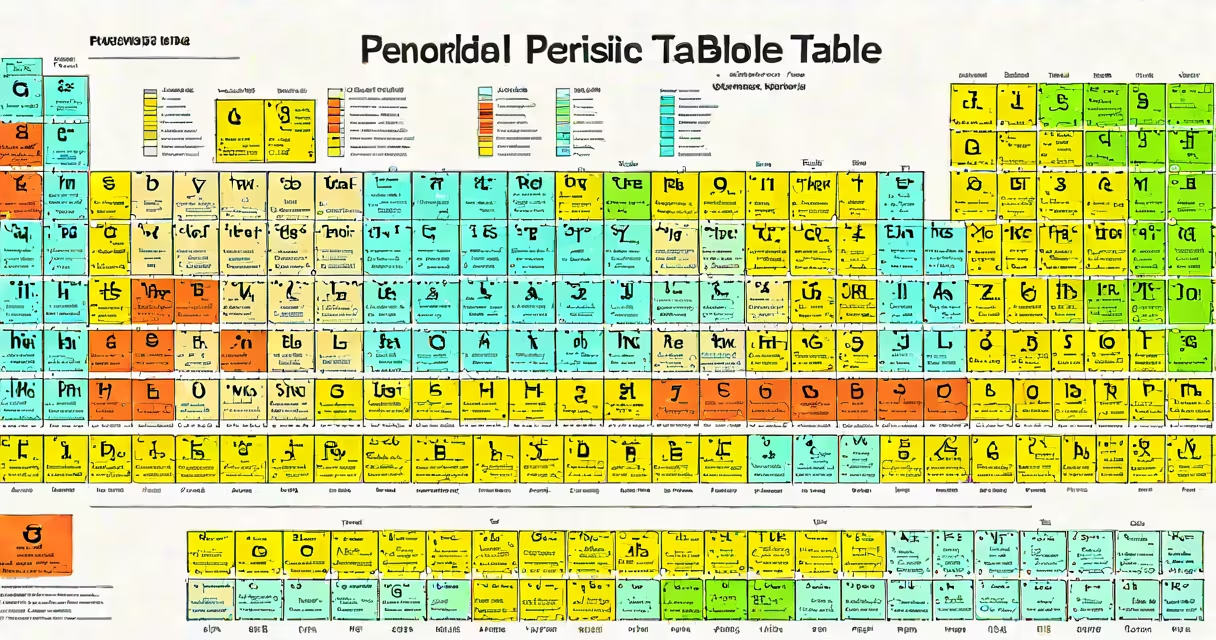
The periodic table organizes all known chemical elements by increasing atomic number, revealing repeating patterns in their physical and chemical properties. Elements are arranged in rows (periods) and columns (groups), with each position reflecting electron configuration and reactivity trends.
Elements are ordered left to right and top to bottom by atomic number-the number of protons in the nucleus. This sequence places hydrogen (1 proton) at the start and ununoctium (118 protons) at the end of the current table. The layout reveals periodicity: similar behaviors recur every few elements due to repeating electron shell structures.
For example, lithium (atomic number 3) and sodium (11) both have one electron in their outermost shell. They react vigorously with water, form +1 ions, and belong to Group 1-alkali metals. This pattern repeats across the table, making it predictive. A student who learns the group trends can anticipate how an unknown element behaves based on its position.
The table has seven horizontal rows called periods. Each period begins with an alkali metal and ends with a noble gas. Period 1 contains only two elements: hydrogen and helium. Period 2 includes lithium through neon. As you move across a period, elements progress from metals to metalloids to nonmetals.
Vertical columns are groups or families. Elements in the same group share similar valence electron counts and chemical properties. Group 1 (alkali metals) all lose one electron to form +1 ions. Group 17 (halogens) gain one electron to form -1 ions. Group 18 (noble gases) have full outer shells and rarely react.
Blocks divide the table by electron subshell filling: s-block (Groups 1-2), p-block (Groups 13-18), d-block (transition metals, Groups 3-12), and f-block (lanthanides and actinides, below the main table). The f-block elements are often placed separately because they fill inner orbitals not seen in main-group elements.
| Block | Electron Subshell | Examples | Key Feature |
|---|---|---|---|
| s | ns² | Lithium, Calcium | Reactive metals; form +1 or +2 ions |
| p | np⁶ | Oxygen, Chlorine, Argon | Nonmetals and metalloids; form covalent bonds |
| d | (n-1)d¹⁰ | Iron, Copper, Zinc | Transition metals; variable oxidation states |
| f | (n-2)f¹⁴ | Cerium, Uranium | Rare earths and actinides; complex chemistry |
The periodic table predicts element behavior. For instance, fluorine (F, atomic number 9) lies in Group 17, Period 2. Its electron configuration is 1s² 2s² 2p⁵-just one electron short of a stable octet. It readily gains an electron to form F⁻, making it highly reactive. This explains why fluorine attacks glass and reacts violently with water.
Chemists use the table to design materials. Silicon (Si, 14) sits in Group 14, Period 3. It's a metalloid with four valence electrons-ideal for semiconductors. Its position explains why silicon forms covalent networks like quartz and why doping it with phosphorus creates n-type semiconductors used in solar cells and microchips.
In 2016, the International Union of Pure and Applied Chemistry (IUPAC) confirmed the discovery of four new elements: nihonium (113), moscovium (115), tennessine (117), and oganesson (118). These were added to the seventh period, completing the current layout. Their placement predicted stability trends-oganesson, despite being a noble gas, may not behave like others due to relativistic effects on its electrons.
Many assume the periodic table is purely alphabetical or sorted by weight. It is not. Elements are ordered by atomic number, not mass. For example, tellurium (Te, atomic number 52) has a higher atomic mass than iodine (I, 53), yet appears before it. This was a historical puzzle resolved only after understanding atomic number as the defining property.
Another myth: all elements in a group behave identically. While Group 1 elements all form +1 ions, reactivity increases down the group. Lithium reacts mildly with water; cesium explodes on contact. This trend arises because larger atoms lose electrons more easily due to reduced effective nuclear charge.
A lesser-known fact: the periodic table's original version by Dmitri Mendeleev in 1869 left gaps for undiscovered elements. He predicted properties of gallium (eka-aluminum), germanium (eka-silicon), and scandium (eka-boron) with notable accuracy. His predictions were validated within years, proving the table's predictive power beyond mere organization.
Suppose you encounter an unknown element with atomic number 35. Find it in the table: it's in Period 4, Group 17. That places it among the halogens-fluorine, chlorine, bromine, iodine. You now know:
This element is bromine (Br). Its position explains why it's a liquid at room temperature-intermediate between chlorine (gas) and iodine (solid)-due to increasing London dispersion forces down the group.
When I taught high school chemistry, students struggled until we mapped elements to real-world objects. We labeled a classroom wall with elements: iron nails (Fe), copper wiring (Cu), aluminum foil (Al), and salt (NaCl). Students connected abstract symbols to tangible materials. One boy asked, "Is gold in my ring?" After checking the table, he confirmed Au (79) was in Group 11-explaining its resistance to tarnish and value.