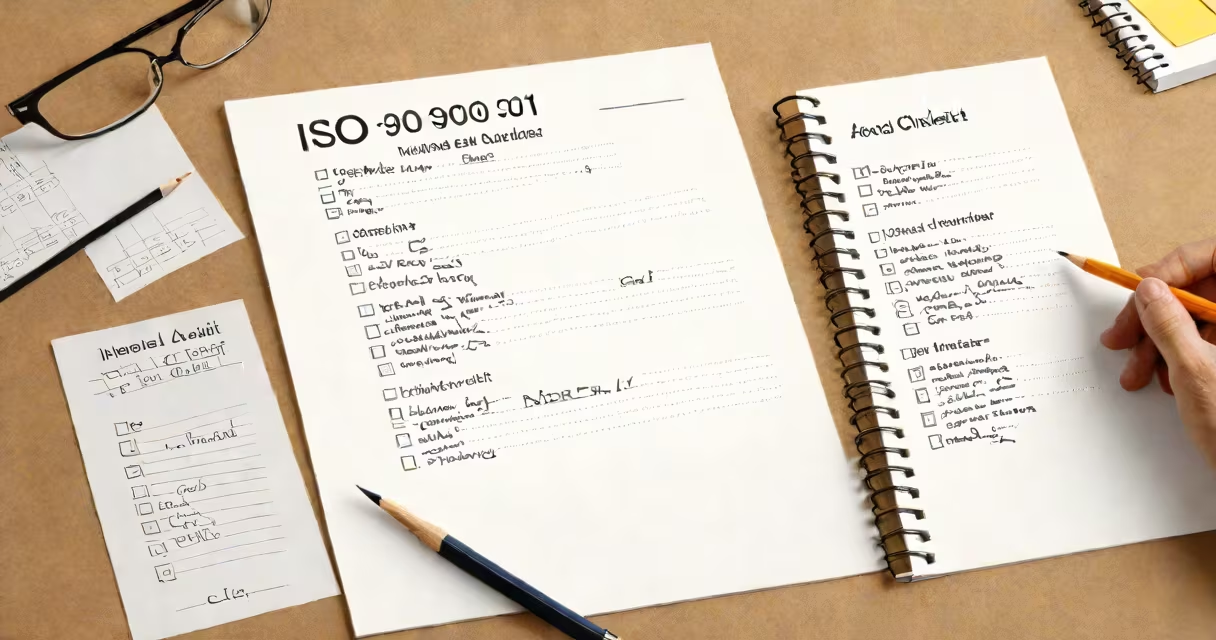
An iso 9001 internal audit checklist is a structured document used by organizations to systematically evaluate their quality management system (QMS) against the requirements of ISO 9001:2015. It ensures consistency, identifies gaps, and verifies compliance across departments, processes, and records.
Internal audits are required by ISO 9001:2015 Clause 9.2 to confirm that the QMS operates effectively and meets documented procedures. The checklist serves as a standardized tool to guide auditors through each clause, verify evidence, and record findings. Without it, audits risk becoming subjective or inconsistent across teams.
For example, a manufacturing company using the checklist might review whether customer feedback is logged within 48 hours (Clause 9.1.2), whether corrective actions are closed within 30 days (Clause 10.2), and whether training records are updated annually (Clause 7.2). Each item is checked off with evidence or noted as nonconforming.
The checklist functions as a procedural roadmap during an audit. Auditors follow predefined questions or statements tied to specific clauses of ISO 9001. They observe processes, inspect documents, interview staff, and collect evidence to confirm whether requirements are met.
Each checkmark or notation corresponds to a yes/no answer, a rating (e.g., 1-5), or a comment. This creates a traceable record for management review and future audits. For instance, if a department fails to maintain calibration logs for measuring instruments (Clause 7.1.5), the auditor marks it as noncompliant and references the specific standard.
After completion, the checklist becomes part of the audit report. It supports decisions on corrective action, resource allocation, and readiness for external certification audits. A well-maintained checklist reduces the likelihood of recurring issues and strengthens organizational accountability.
Checklists vary by organization size, industry, and complexity. However, they all align with ISO 9001's core clauses. Common types include:
| Type | Focus Area | Use Case |
|---|---|---|
| Process-based | Specific workflows (e.g., procurement, production) | Used in high-volume operations to track execution accuracy |
| Clause-specific | Individual ISO 9001:2015 clauses (e.g., 4.3, 6.1, 8.2) | Best for first-time auditors learning the standard |
| Departmental | Functional areas (HR, engineering, logistics) | Applied in cross-functional audits to assess interdepartmental coordination |
A process-based checklist for a software development team might include items like "Are code reviews documented?" and "Is version control access restricted to authorized personnel?" These map directly to Clause 8.5.1 (control of production and service provision).
One non-obvious distinction: many organizations treat checklists as static templates. But effective ones evolve. After each audit cycle, teams update the checklist based on findings, new regulations, or changes in workflow. A 2022 study by the American Society for Quality found that companies updating their checklists quarterly reduced audit closure time by 37% compared to those using outdated versions.
Some assume the checklist replaces auditor judgment. That's incorrect. The checklist provides structure, but auditors must interpret evidence, ask probing questions, and assess context. A checklist cannot detect subtle failures in leadership engagement or cultural resistance to change.
Another error is treating the checklist as a pass/fail tool. Compliance is not binary. A score of 85% on a checklist doesn't mean the QMS is compliant. ISO 9001 requires continuous improvement, not just meeting thresholds. An auditor may flag a minor gap in document retention (Clause 7.5) while still concluding the system is effective.
Some organizations apply the same checklist across all departments. This leads to irrelevant questions. A checklist for HR should focus on recruitment, training, and performance appraisal. One for production should cover equipment calibration, material traceability, and nonconformance handling. Tailoring improves relevance and reduces audit fatigue.
In 2021, a medical device manufacturer preparing for a third-party certification audit used a clause-specific iso 9001 internal audit checklist. The team reviewed Clause 8.3 (design and development) and discovered that design validation reports were signed by the same person who performed the test-violating separation of duties.
They documented the finding, assigned a corrective action plan, and revised the checklist to include a verification step: "Are validation sign-offs performed by an independent reviewer?" This change prevented recurrence and passed the external audit with zero nonconformities.
This example shows that the checklist isn't just a formality-it drives real improvements. It also highlights the value of periodic review. The company updated its checklist annually and added a new item after a regulatory change in FDA guidelines.
ISO 9001:2015 emphasizes risk-based thinking and leadership involvement. The checklist should reflect both. For example, Clause 5.1 (Leadership) requires top management to demonstrate commitment. A good checklist includes questions like "Has the CEO attended at least one QMS review meeting in the past quarter?" and "Are quality objectives communicated to all levels?"
According to the International Organization for Standardization (ISO), internal audits must be planned, conducted independently, and reported objectively. The checklist ensures independence by reducing bias-auditors follow the same steps regardless of department or relationship.
When creating or selecting a checklist, prioritize clarity, alignment with the latest standard, and ease of use. Avoid overly complex formats. A simple, well-organized list with clear instructions performs better than a dense, multi-page template.
The iso 9001 internal audit checklist is not a compliance box to tick. It's a living tool that supports transparency, continuous improvement, and trust in the quality system. Used correctly, it turns abstract standards into actionable insights.