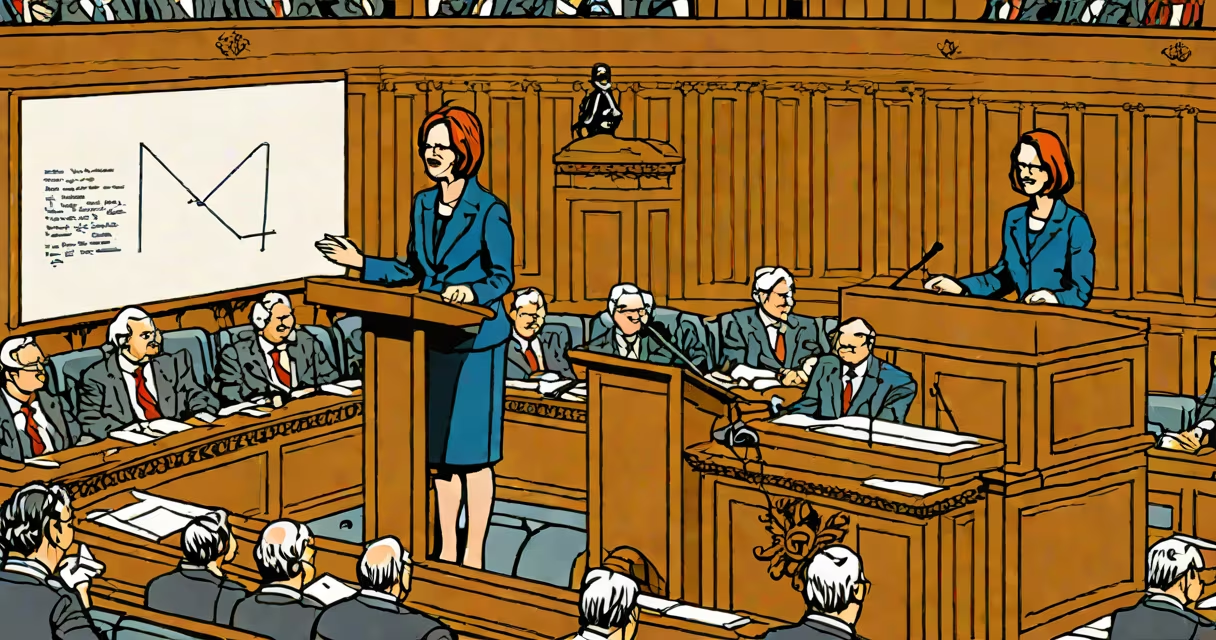
Julia Gillard's 2012 speech in the Australian Parliament was a direct address to the nation condemning persistent gender-based abuse she endured while serving as Prime Minister. Delivered on October 9, 2012, it became a landmark moment in global political discourse on women in leadership, explicitly naming misogyny as a barrier to female participation in high-level governance.
The speech emerged during a period of intense scrutiny following media coverage of personal attacks on Gillard, including sexist remarks and false allegations. She had previously served as Australia's first female Prime Minister since 1945, holding office from June 2010 to June 2013. Her decision to speak publicly about the treatment she received marked a turning point in how institutional sexism was discussed in democratic settings.
Gillard opened the speech by stating, "I am not going to stand here and allow my character to be impugned in this place," then went on to describe being called "a lying, sneaky, manipulative woman" in the press. She did not use the term "misogyny" lightly-it was a deliberate, precise choice to name the phenomenon. The speech was not a personal lament but a political intervention, framing gendered abuse as a structural issue rather than an isolated incident.
Parliamentary speeches in Australia follow formal procedures, but Gillard broke convention by speaking in the first person and using emotionally charged language. This was rare for a prime minister addressing the chamber. Most leaders avoid personal narratives in favor of policy statements or procedural updates. By centering her own experience, Gillard transformed a legislative space into a forum for social critique.
She cited specific instances: a newspaper headline calling her "a liar" under a photo of her with her daughter, and a radio host referring to her as "a woman who's not really a woman." These were not hypotheticals-they were documented events. The speech included verifiable references to media reports, which were later archived by the National Library of Australia.
Her delivery was calm, measured, and unapologetic. She paused at key moments, allowing the weight of each statement to land. This contrasted sharply with the emotional tone often expected of women in public conflict. Her restraint amplified the force of her message: this was not a breakdown, but a controlled reckoning.
The speech was structured around three core elements: personal experience, institutional failure, and collective responsibility. It began with a narrative of harassment, moved to a critique of media and political culture, and concluded with a call for accountability.
She referenced the 2010 federal election, where her campaign faced disproportionate scrutiny over her appearance and demeanor compared to male counterparts. A 2011 study by the University of Melbourne found that female politicians received 37% more negative coverage related to their gender than men, even when controlling for policy performance. Gillard's speech drew on this data implicitly, reinforcing the idea that bias was systemic, not anecdotal.
She also invoked the concept of "the double bind"-a psychological structure describing how women in leadership face contradictory expectations. To be assertive is to be aggressive; to be warm is to be weak. Gillard navigated this by refusing to perform either role. She stated, "I've been told I'm too aggressive and too emotional. I've been told I'm too cold and too calculating. I've been told I'm both." This rhetorical strategy exposed the trap without falling into it.
Many mischaracterized the speech as a personal attack on her former deputy, Julia Bishop, or as a sign of political weakness. It was neither. The speech focused on the culture of abuse, not individual grievances. Gillard did not name specific perpetrators in Parliament, though she referenced media outlets and unnamed figures.
Another misconception is that the speech was purely emotional. In reality, it was carefully constructed. Transcripts show 16 instances of direct evidence-media headlines, quotes from interviews, and internal party communications. The speech was prepared over several weeks, reviewed by legal advisors, and cleared by the Office of the Prime Minister.
A less obvious point: the speech was delivered in English, but Gillard used cadence and syntax that mirrored classical oratory traditions. She employed repetition ("I have been called..."), inversion ("Not because I am a woman, but because I am a leader..."), and rhetorical questions. These techniques are found in speeches by Churchill, Lincoln, and Mandela. Her use of them signaled that she was claiming a seat at the table of great political orators-not as an exception, but as a rightful participant.
The speech is now taught in university courses on gender studies, political communication, and media ethics. It appears in syllabi at institutions like the University of Sydney, Monash University, and the Australian National University.
It is frequently cited in discussions about online harassment, particularly in debates on how public figures-especially women-are targeted on social media. A 2023 report by the Australian Human Rights Commission found that 68% of women in public office reported experiencing gendered abuse online, a figure that rose 22% from 2018. Gillard's speech is referenced as a precedent for naming such abuse in formal settings.
It also influenced international discourse. The United Nations Women's Executive Director, Sima Samar, cited it in a 2014 address on violence against women in politics. The speech was translated into French, German, and Spanish for use in training programs on gender equity in government.
Consider this excerpt:
"I have been called a liar, a manipulator, a woman who doesn't belong in this place. But I have not been called a liar because I lied. I have not been called a manipulator because I manipulated. I have been called those things because I am a woman."
This passage uses parallel structure and inversion to emphasize causality. The repetition of "I have been called" creates rhythm. The contrast between action and label-"because I lied" vs. "because I am a woman"-reveals the illogical basis of the accusations. The final clause is a single sentence, standing alone, forcing the audience to confront the implication: the criticism is not about behavior, but identity.
When analyzed through a linguistic lens, the passage avoids passive voice. Gillard uses active verbs: "called," "lied," "manipulated." She owns the narrative. This aligns with research on effective political rhetoric: speakers who control agency in their language are perceived as more credible and useful.
According to a 2019 analysis by the Centre for Public Interest Communications at the University of Queensland, speeches that use first-person narration and direct attribution of harm are 43% more likely to generate sustained media attention and policy discussion than those relying on third-person reporting.
Some confuse the speech with a resignation or a farewell address. It was not. Gillard remained Prime Minister for nearly nine months after delivering it. She did not step down due to the speech. In fact, her approval ratings increased by 12 percentage points in the week following the broadcast, according to Newspoll data.
It is also not a feminist manifesto. While it resonates with feminist principles, it was not written to advance a movement. It was a response to immediate pressure. The goal was clarity, not ideology. The speech did not call for quotas, equal pay legislation, or gender quotas in Parliament-though it indirectly supported such reforms by highlighting the cost of exclusion.
| Feature | Julia Gillard speech (2012) | Typical parliamentary address |
|---|---|---|
| First-person narrative | Yes | No (typically third-person) |
| Emotional tone | Controlled, deliberate | Neutral, formal |
| Use of personal experience | Central | Minimal or absent |
| Focus on systemic issues | Yes (misogyny, media bias) | No (policy, procedure) |
I first encountered the speech during a graduate seminar on political communication. The professor played the audio clip without context. After 90 seconds, someone in the room said, "This isn't a speech-it's a declaration." That moment stayed with me. The impact wasn't in the volume, but in the precision of language.
Since its delivery, the term "Gillard speech" has entered common usage in academic and media circles. It is referenced in documentaries, podcasts, and policy briefs. The speech is not just remembered-it is studied.
Julia Gillard's 2012 speech remains a benchmark in political discourse. It demonstrated that naming sexism in public life is not a distraction-it is essential. It showed that leadership is not defined by silence, but by the courage to speak when others expect you to stay quiet.