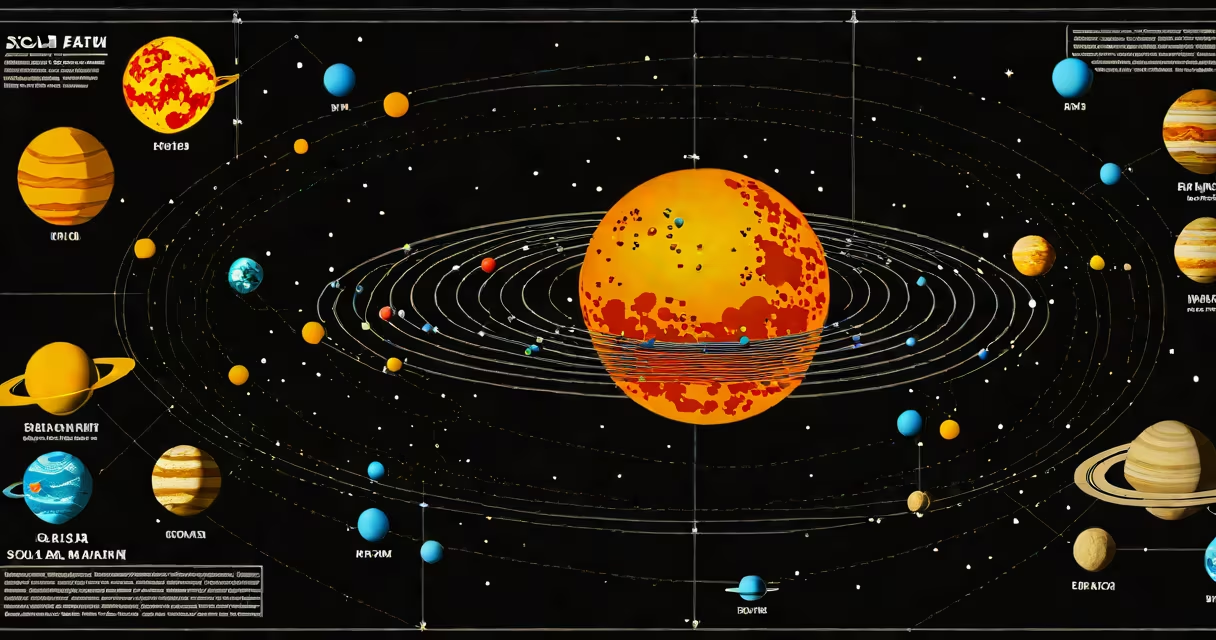
The solar system consists of the Sun and the objects bound to it by gravity, including eight planets, their moons, dwarf planets, asteroids, and comets. Misconceptions often arise from oversimplified media portrayals, outdated textbooks, or internet rumors. Accurate understanding requires distinguishing long-held myths from evidence-based science.
Gravity governs motion in the solar system. The Sun, containing 99.8% of the system's mass, exerts gravitational pull that keeps planets in orbit. Planets follow elliptical paths, not perfect circles, as described by Kepler's laws. Earth completes one orbit around the Sun in 365.25 days, defining our calendar year.
Planetary rotation and revolution are independent. Mercury rotates three times for every two orbits around the Sun-a 3:2 spin-orbit resonance confirmed by radar observations from NASA's MESSENGER mission. Venus rotates backward (retrograde) compared to most planets, completing one rotation every 243 Earth days-longer than its orbit.
Space is not empty. The interplanetary medium contains charged particles from the solar wind, dust from asteroid collisions, and occasional meteoroids. The Parker Solar Probe, launched in 2018, measures solar wind properties within 6 million kilometers of the Sun's surface-data that refines models of space weather.
One persistent myth is that all planets orbit the Sun in the same plane. While most do-within 7 degrees-the orbits of Mercury (7° inclination) and Pluto (17°) deviate. This variation results from early gravitational interactions during planet formation.
Another myth: "The Sun is yellow." The Sun emits light across the visible spectrum, peaking in green-yellow. From space, it appears white. Human eyes perceive it as yellow due to atmospheric scattering, which filters shorter wavelengths. This is why sunsets appear red-Rayleigh scattering removes blue light.
A third myth: "There are nine planets." Pluto was reclassified as a dwarf planet in 2006 by the International Astronomical Union (IAU) based on formal criteria: it must orbit the Sun, be spherical, and have cleared its orbital neighborhood. Pluto failed the last test-it shares its orbit with Kuiper Belt objects. The IAU defines five recognized dwarf planets: Pluto, Ceres, Eris, Haumea, and Makemake.
| Type | Examples | Orbital Characteristics | Key Fact |
|---|---|---|---|
| Terrestrial planets | Mercury, Venus, Earth, Mars | Rocky, close to Sun, small size | Earth is the only known planet with liquid water on its surface. |
| Giant planets | Jupiter, Saturn, Uranus, Neptune | Gas/ice giants, large size, distant orbits | Jupiter's Great Red Spot has persisted for at least 180 years, based on historical records. |
| Dwarf planets | Pluto, Ceres, Eris | Orbit Sun, spherical, not dominant in orbit | Ceres, located in the asteroid belt, may harbor subsurface brine. |
| Asteroids | 4 Vesta, 1 Ceres | Rocky, mostly between Mars and Jupiter | Over 1 million asteroids larger than 1 km are cataloged by NASA's Minor Planet Center. |
Media often simplifies complex systems for public consumption. For example, the "solar system model" used in classrooms typically shows planets in a flat plane with equal spacing-misleading because actual distances vary widely. Jupiter is 5.2 AU from the Sun; Neptune is 30 AU away-over five times farther.
Popular culture reinforces myths. Movies like *Interstellar* depict black holes with accretion disks shaped like rings, but real simulations show warped, asymmetric structures due to relativistic effects. The film's depiction of time dilation near Gargantua is accurate-based on equations derived by physicist Kip Thorne-but the visual representation exaggerates clarity for narrative effect.
Even scientific institutions occasionally misrepresent data. A 2014 claim that Mars had flowing water based on seasonal dark streaks (recurring slope lineae) was later challenged. Analysis from the Mars Reconnaissance Orbiter showed that salt deposits, not liquid water, likely cause the features. This highlights how preliminary findings can become entrenched before peer review.
In 2021, the James Webb Space Telescope detected methane in the atmosphere of Jupiter's moon Europa. This finding supports the hypothesis that subsurface oceans exist beneath its icy crust-potentially habitable. The detection relied on spectroscopy, measuring light absorption at specific wavelengths. Methane presence suggests ongoing geological activity, possibly hydrothermal vents.
Another example: the 2015 flyby of Pluto by New Horizons revealed a heart-shaped region called Tombaugh Regio. High-resolution images showed nitrogen glaciers flowing slowly across the surface. This contradicted earlier assumptions that Pluto was geologically dead. The discovery proved that even cold, distant worlds can exhibit changing processes.
I once watched a live feed from the European Space Agency's Rosetta mission as it orbited comet 67P/Churyumov-Gerasimenko. The spacecraft's instruments detected organic molecules like glycine-amino acids essential to life-on the comet's surface. This confirmed that comets could have delivered prebiotic material to early Earth, supporting theories about the origin of life.
People frequently confuse "planet" with "star." Stars generate energy through nuclear fusion; planets do not. Jupiter, despite being massive, lacks the core temperature (over 10 million Kelvin) needed to ignite fusion. It is a "failed star"-a brown dwarf-but not a true star.
Another confusion: "All planets rotate eastward." Venus and Uranus rotate westward. Uranus spins on its side, with its axis tilted 98 degrees. Scientists believe this resulted from a giant impact early in its history. The tilt affects seasons-Uranus experiences 42-year-long winters and summers.
Finally, many assume that space is silent. Sound waves require a medium, such as air or water. In vacuum, sound cannot propagate. The silence of space is literal-not metaphorical. Audio clips from space missions are synthesized from electromagnetic data, not actual sound.