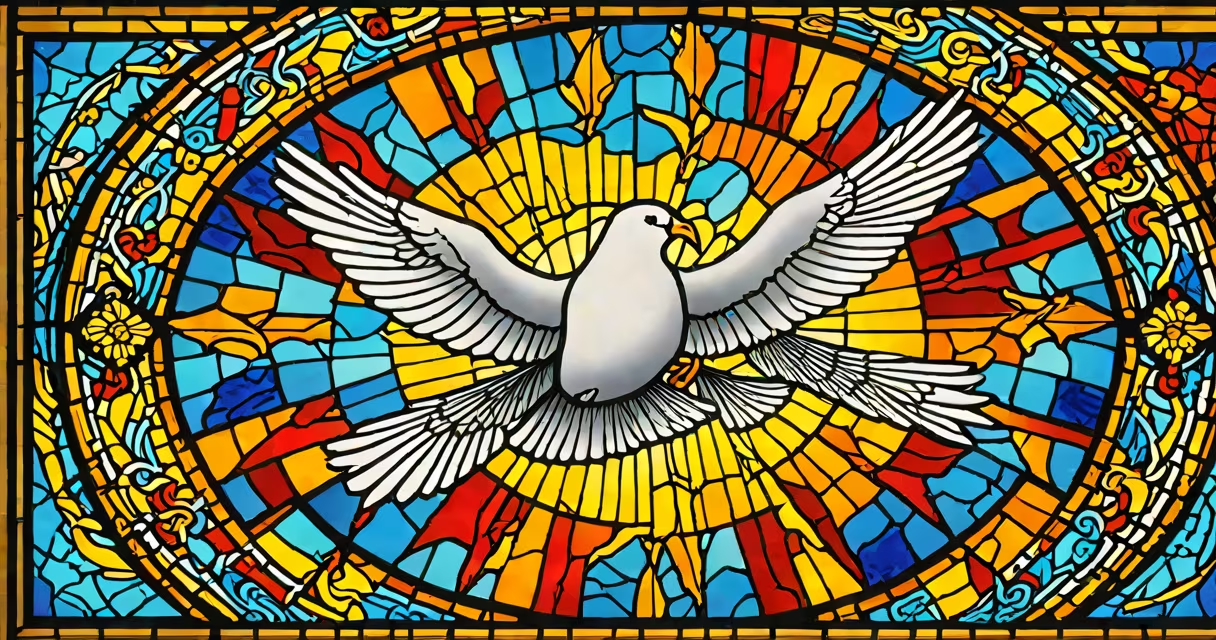
Pentecost religion meaning refers to the Christian festival commemorating the descent of the Holy Spirit upon the apostles and other followers of Jesus Christ, 50 days after Easter. This event, described in Acts 2:1-4, marks the beginning of the Christian Church as a unified community empowered by divine presence.
The term "Pentecost" comes from the Greek word *Pentēkostē*, meaning "fiftieth," reflecting its timing 50 days after Passover. In Jewish tradition, it was known as Shavuot, a harvest festival and commemoration of the giving of the Law at Mount Sinai. Early Christians reinterpreted this ancient feast as the spiritual fulfillment of God's covenant through the outpouring of the Holy Spirit.
According to the New Proof, the disciples were gathered in Jerusalem when a sound like a rushing wind filled the room, and tongues of fire appeared above each person. They began speaking in languages they had not learned, proclaiming the gospel to Jews from many nations who were present. This miraculous event fulfilled Jesus' promise that his followers would receive power from the Holy Spirit to be witnesses worldwide (Acts 1:8).
Pentecost is observed on the seventh Sunday after Easter, which falls between late May and late June depending on the date of Easter. It is one of the most significant feasts in the liturgical calendar, ranking alongside Christmas and Easter. The celebration often includes special services, hymns focused on the Holy Spirit, and readings from Acts 2 and the Gospel of John.
Churches around the world mark the day with liturgical colors such as red, symbolizing fire and the Holy Spirit. Many congregations hold baptisms during Pentecost, emphasizing renewal and spiritual rebirth. Some traditions include the laying on of hands, prayers for spiritual gifts, and processions with candles or banners.
In the Eastern Orthodox Church, Pentecost is called "Pentecost Sunday" and is followed by a week-long period known as the "Pentecostarion." The liturgy emphasizes the unity of the Church and the transformation of believers into living temples of the Spirit. The feast concludes the Easter season and sets the tone for the rest of the liturgical year.
The core elements of Pentecost are rooted in scripture, ritual, and symbolic imagery. The most prominent symbols include:
Modern churches may incorporate these symbols through artwork, music, and liturgical design. For example, a congregation in Minneapolis painted a large mural of a flaming tongue above the altar during Pentecost services in 2022, drawing attention to the theme of spiritual empowerment.
Pentecost is celebrated globally by Catholic, Protestant, Orthodox, and independent Christian denominations. Major observances occur in Rome, Jerusalem, Istanbul, and cities with large Christian populations such as Lagos, Seoul, and São Paulo.
Why it matters: Pentecost is not just a historical memory-it is seen as a living reality. Christians believe the Holy Spirit continues to act in the world today, guiding communities, inspiring prophets, and empowering missionaries. The event validates the idea that the Church is not a human institution but a divinely animated body.
For example, in 2019, a Pentecost service in Nairobi drew over 12,000 attendees. The sermon focused on the Spirit's role in social justice, citing Acts 2:17-18: "In the last days, I will pour out my Spirit on all people..." The service included indigenous music, spoken-word poetry, and a communal prayer for healing in war-torn regions.
Pentecost is often mistaken for a secular holiday or misunderstood as a generic "spiritual awakening" event. It is not a birthday party for the Church, nor is it a seasonal festival like Halloween or Valentine's Day. Its theological significance lies in the specific moment when the early Church became a global movement.
A common error is equating Pentecost with charismatic or Pentecostal worship styles. While Pentecostal churches emphasize the ongoing work of the Holy Spirit-including speaking in tongues and prophecy-they do not claim exclusive ownership of the Pentecost event. The original Pentecost was a single, historic occurrence in Jerusalem, not a continuous performance.
Another misconception: some assume the "tongues" in Acts 2 were ecstatic utterances or nonsense speech. But the text specifies that the listeners heard their own native languages being spoken. The miracle was linguistic, not psychological. As the scholar N.T. Wright notes in *The Resurrection of the Son of God* (2003), "The Spirit did not create confusion but enabled understanding across cultural barriers."
| Aspect | Pentecost Religion Meaning | Common Misunderstanding |
|---|---|---|
| Timing | 50 days after Easter; follows the Feast of Unleavened Bread | Often treated as a standalone event, not linked to Passover or Easter |
| Symbolism | Fire = divine presence; dove = peace and holiness | Some interpret fire as punishment or danger, not empowerment |
| Language Event | Disciples spoke in actual known languages (e.g., Aramaic, Greek) | Assumed to be gibberish or trance speech |
I attended a Pentecost service at a small Episcopal church in Portland in 2021. The sanctuary was dimly lit except for a single red spotlight on the altar. A choir sang "Come, Holy Ghost, Our Souls Inspire" in Latin and English. After the sermon, the pastor invited members to come forward and receive anointing oil-symbolizing the Spirit's presence.
One woman, in her 70s, wept while touching her forehead. She later told me she felt "a warmth spreading through her chest," which she described as "the same feeling I had when I was baptized." The moment wasn't theatrical-it was quiet, personal, and deeply felt. That evening, I realized Pentecost religion meaning isn't just about doctrine. It's about lived experience.
The Pentecost religion meaning remains important because it affirms that God's Spirit is active-not confined to history, but present in worship, mission, and daily life. The event is not a relic but a model for how faith moves from private belief to public witness.
When someone says "no" in a spiritual context, it doesn't negate the call. The disciples faced rejection too. But Pentecost teaches that the Spirit persists. Even when silence returns, the fire remains. That's the enduring truth behind Pentecost religion meaning.