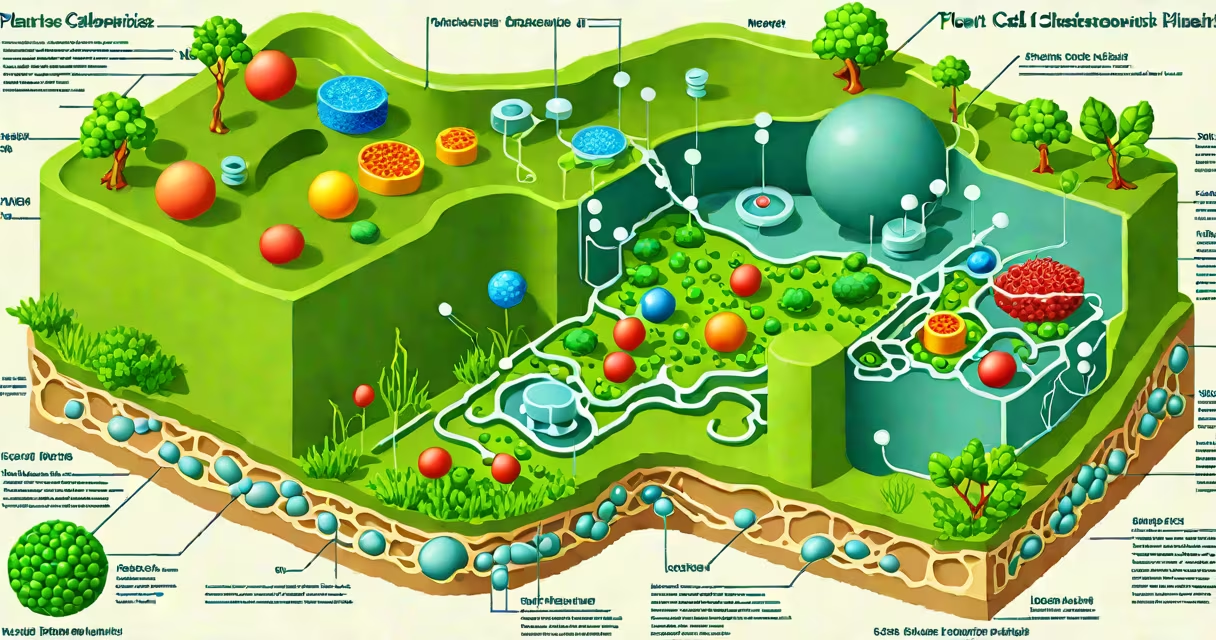
Plant cell characteristics refer to the structural and functional traits unique to plant cells, including a rigid cell wall, chloroplasts for photosynthesis, and a large central vacuole that maintains turgor pressure. These features enable plants to grow upright, produce their own food, and regulate water balance.
Plant cells are eukaryotic, meaning they have membrane-bound organelles and a defined nucleus. Unlike animal cells, they possess several specialized structures that support autotrophic growth and environmental resilience. The presence of a cell wall made of cellulose provides mechanical strength, while chloroplasts house chlorophyll and conduct photosynthesis. A single large central vacuole occupies up to 90% of the cell's volume, storing water, ions, and metabolic waste.
These characteristics allow plants to thrive in diverse environments. For example, the cell wall prevents bursting under high internal pressure, a common issue in aquatic or moist habitats. Chloroplasts convert sunlight into glucose, forming the base of most terrestrial food chains. The central vacuole regulates osmotic balance, enabling plants to remain rigid even in dry conditions.
The cell wall is a defining trait of plant cells. Composed primarily of cellulose fibers arranged in microfibrils, it forms a tough, porous layer outside the plasma membrane. This structure resists compression and protects against pathogens. Cellulose synthesis occurs at the plasma membrane via enzyme complexes called rosette terminal complexes, which assemble glucose units into β-1,4-glucan chains.
Chloroplasts are double-membrane organelles containing thylakoid stacks called grana. Within the thylakoid lumen, light energy splits water into oxygen, protons, and electrons during photosystem II. The resulting ATP and NADPH fuel carbon fixation in the Calvin cycle, which occurs in the stroma-the fluid-filled space surrounding the grana. A single leaf mesophyll cell may contain 20-50 chloroplasts, each capable of producing hundreds of ATP molecules per minute under optimal light.
The central vacuole is not just a storage unit-it actively shapes cell behavior. It maintains turgor pressure by accumulating potassium ions and water through aquaporin channels and proton pumps. When turgor rises, the cell wall stretches elastically, pushing the plasma membrane outward. This process enables stem elongation and leaf expansion. In wilted plants, vacuolar pressure drops below 0.5 MPa, causing visible drooping.
While both plant and animal cells are eukaryotic, they differ in structure and function. Plant cells lack centrioles, which are essential for organizing microtubules during mitosis in animals. Instead, plant cells form a phragmoplast-a structure made of microtubules and vesicles-that guides cell plate formation during cytokinesis.
| Feature | Plant Cells | Animal Cells |
|---|---|---|
| Cell Wall | Present (cellulose) | Absent |
| Chloroplasts | Present | Absent |
| Central Vacuole | Large, single | Small, multiple |
| Centrioles | Absent | Present |
| Shape | Rectangular due to cell wall | Round or irregular |
One common misconception is that plant cells are static. In reality, they exhibit changing movement. Cytoplasmic streaming-driven by myosin motors along actin filaments-transports nutrients and organelles. In Chara algae, this flow can reach speeds of 10 μm/sec, ensuring efficient distribution in long cells.
Each characteristic serves a specific purpose in plant survival. The cell wall's rigidity allows plants to grow tall without collapsing. Without it, trees could not exceed 10 meters in height, limiting forest canopy development. Research from the University of California, Davis shows that mutations in cellulose synthase genes reduce cell wall thickness by up to 60%, leading to stunted growth and increased susceptibility to fungal invasion.
Chloroplasts are hubs for hormone synthesis. They produce abscisic acid precursors involved in stomatal closure during drought. A study published in *Nature Plants* (2021) found that under water stress, chloroplasts release reactive oxygen species that trigger signaling cascades, reducing transpiration by 40% within 30 minutes.
The central vacuole plays a role beyond storage. It contains hydrolytic enzymes that degrade macromolecules during senescence. In aging leaves, vacuolar proteases break down proteins into amino acids, which are then remobilized to developing tissues. This recycling mechanism conserves nitrogen and supports seed production.
Consider a leaf cell from a tomato plant (*Solanum lycopersicum*) exposed to full sunlight. The cell measures approximately 50 micrometers in diameter. Its outer boundary is a cell wall 200 nanometers thick, composed of 90% cellulose and 10% hemicellulose. Inside, the plasma membrane encloses a cytoplasm filled with mitochondria, ribosomes, and a network of endoplasmic reticulum.
Within the cytoplasm, 35 chloroplasts are distributed near the cell periphery to maximize light capture. Each chloroplast contains 100 grana stacks, with 100,000 chlorophyll molecules per stack. During peak sunlight, the cell fixes 12 molecules of CO₂ per second via RuBisCO, producing glucose at a rate of 1.8 × 10⁻¹⁵ moles per minute.
Meanwhile, the central vacuole holds 45 picoliters of solution with a pH of 5.2. It accumulates potassium ions at 150 mM concentration, creating an osmotic gradient that draws in 2.3 × 10⁶ water molecules per second. This influx increases turgor pressure to 0.8 MPa, stiffening the cell and preventing collapse.
This integrated system demonstrates how plant cell characteristics work together. The cell wall resists internal pressure, chloroplasts generate energy, and the vacuole manages water balance-all enabling the plant to survive and grow.