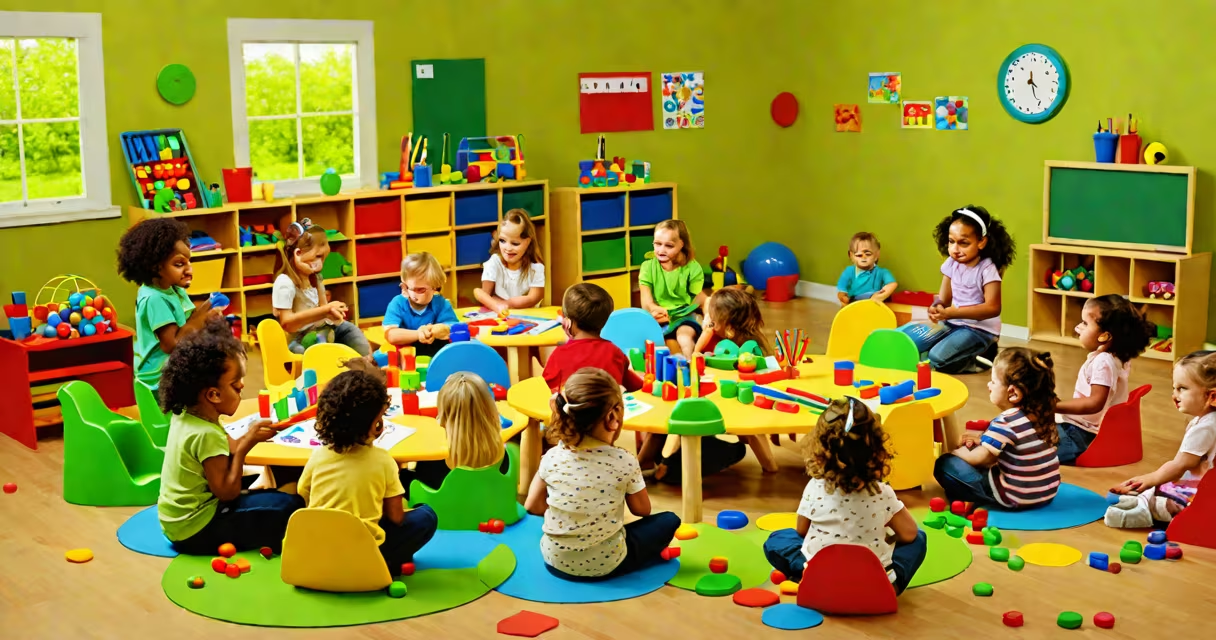
Preschool goals and objectives are specific, observable, and measurable developmental targets designed for children aged 3 to 5, covering cognitive, physical, emotional, and social domains. They form the foundation of structured early learning programs and guide educators in assessing progress.
These goals are not vague aspirations like "be happy" or "learn to share." Instead, they describe what a child should be able to do by a certain stage. For example, a goal may state that a child will identify basic shapes, while an objective specifies that the child will correctly name five common shapes during a classroom activity.
They are derived from national standards such as those from the National Association for the Education of Young Children (NAEYC) and the Head Start Child Development and Early Learning Structure. These frameworks emphasize age-appropriate expectations based on research in child psychology and neuroscience.
Each goal addresses a core area of development: cognitive, language, physical, emotional, and social. Objectives break down each goal into small, achievable steps that teachers can observe and document. This structure allows consistent tracking and individualized support.
For instance, a cognitive goal might be "develop problem-solving skills." An associated objective could be "solve simple puzzles with four pieces within 10 minutes, using visual cues." Teachers assess this by timing the child's performance during free play or guided activity.
Objectives are written to be observable and measurable. Avoiding subjective terms like "show interest" or "try hard," they use verbs like "name," "sort," "demonstrate," or "complete." This precision ensures accurate evaluation and fair comparison across classrooms and regions.
Preschool goals and objectives fall into five major developmental domains. Each domain includes measurable outcomes aligned with typical developmental trajectories.
| Domain | Sample Goal | Specific Objective |
|---|---|---|
| Cognitive | Understand cause-and-effect relationships | Explain why a ball rolls down a ramp using simple language |
| Language & Literacy | Develop expressive communication | Retell a story using three key events and appropriate gestures |
| Physical Development | Improve fine motor control | Use scissors to cut along a curved line without breaking the paper |
| Social-Emotional | Manage emotions during conflict | Use a calm-down strategy (e.g., deep breaths) when frustrated during group time |
| Approaches to Learning | Engage in sustained attention | Participate in a 15-minute circle activity without leaving the mat |
These objectives are not meant to label children. Instead, they inform instruction. A teacher noticing a child struggles with sorting objects by color might introduce a matching game during morning circle to reinforce the skill.
Research from the University of California, Berkeley's Center for Child and Family Policy confirms that structured goals improve long-term academic readiness. Children who meet age-specific objectives in preschool are 30% more likely to read at grade level by third grade, according to longitudinal data from the National Institute for Early Education Research (NIEER).
Many people confuse goals with broad intentions. A goal like "become a good student" lacks specificity and cannot be assessed. Preschool goals and objectives must be precise enough to verify whether they've been met.
A frequent error is treating objectives as rigid requirements. They are benchmarks, not pass/fail tests. A child who doesn't name all five shapes in a week still makes progress. Teachers adjust activities based on ongoing observation, not a single assessment.
Another misconception is that goals apply uniformly across all children. Development varies widely. A child with delayed speech may achieve a language objective through sign language or picture cards. The objective remains valid; the path to achievement differs.
I once observed a preschool class where a child with autism struggled to join group games. The teacher didn't abandon the social-emotional goal. Instead, she introduced a visual schedule and peer buddy system. Within six weeks, the child initiated interactions using a hand signal. The objective was met-not by changing the standard, but by adapting the method.
Preschool goals and objectives ensure consistency across classrooms and schools. They allow administrators to compare program quality and allocate resources effectively. They also give parents clear insights into their child's progress.
When a parent asks, "Is my child keeping up?" a teacher can respond with evidence: "Your child can count to ten, match colors, and take turns during storytelling-three objectives from the literacy and math domain." This replaces vague reassurance with concrete feedback.
They also inform policy. States like California and New York require public preschool programs to align with statewide frameworks based on these goals. Programs that don't meet minimum standards risk losing funding.
Goals and objectives are not static. They evolve with new research. The NAEYC updated its guidelines in 2023 to include digital literacy basics-such as identifying safe websites and understanding online privacy-reflecting changes in how young children interact with technology.
Goals set the direction; objectives define the steps. A goal says, "Children will understand numbers." An objective states, "Children will count aloud from 1 to 10 using finger counting."
Goals are broader and often long-term. Objectives are narrow and short-term. You can have multiple objectives under one goal. For example, the goal "develop spatial awareness" may include objectives like "build towers with blocks that stand upright" or "describe the position of toys using 'on,' 'under,' and 'next to.'"
Understanding this distinction prevents misapplication. A school that only sets goals without defining objectives risks creating unmeasurable programs. Conversely, focusing only on objectives without overarching goals leads to fragmented learning.
Preschool goals and objectives are not administrative checkboxes. They are living tools that reflect children's real-world experiences and potential. When implemented well, they turn early education into a predictable, responsive, and deeply personal process.