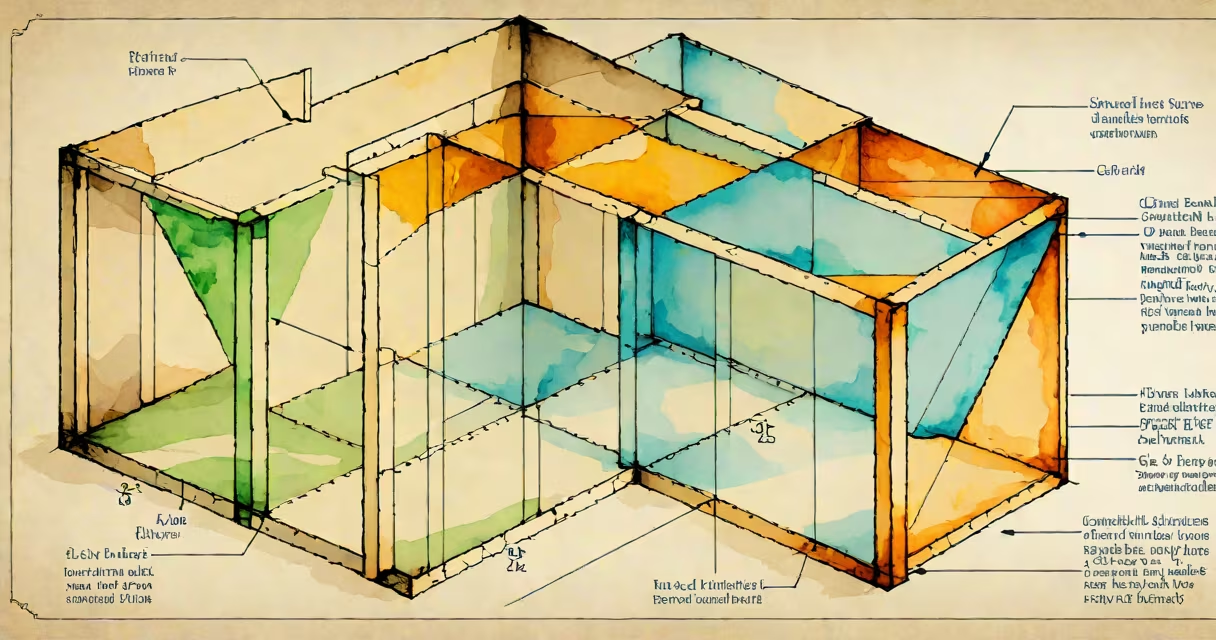
Right rectangular prism geometry problems involve finding volume or surface area of a three-dimensional shape with six rectangular faces, all meeting at right angles, using given dimensions. These problems appear in standardized tests, engineering tasks, and everyday measurements.
A right rectangular prism has three perpendicular dimensions: length, width, and height. All angles between adjacent faces are 90 degrees. This distinguishes it from oblique prisms where lateral edges are not perpendicular to the base. The term "right" specifies that the sides stand vertically relative to the base.
These problems are common in middle school and high school math curricula. They test understanding of spatial reasoning, unit conversion, and application of formulas. Real-world uses include packaging design, construction estimating, and fluid capacity calculations.
Each problem centers on one of two core operations: computing volume or surface area. Volume measures internal space in cubic units. Surface area calculates total outer covering in square units.
Volume is calculated as length × width × height. For example, a box measuring 6 cm long, 4 cm wide, and 3 cm tall holds 6 × 4 × 3 = 72 cm³ of space. This applies to containers, storage units, and shipping crates.
Surface area sums the areas of all six faces. Opposite faces are congruent, so the formula is 2(lw + lh + wh). Using the same 6×4×3 box: 2[(6)(4) + (6)(3) + (4)(3)] = 2[24 + 18 + 12] = 2(54) = 108 cm² of material needed to cover the entire box.
Problems fall into three categories: direct computation, unit conversion, and real-world scenario modeling. Direct problems give all dimensions and ask for volume or surface area. Unit conversion requires changing inputs from feet to inches or meters to centimeters before applying formulas.
Real-world scenarios often embed the math within context. A warehouse manager may need to calculate how many 2 ft × 1.5 ft × 1 ft boxes fit in a 10 ft × 8 ft × 7 ft storage room. The solution involves dividing the room's volume by each box's volume: (10×8×7) ÷ (2×1.5×1) = 560 ÷ 3 ≈ 186.67. Only 186 whole boxes fit.
Another frequent task is minimizing material cost. A manufacturer wants to build a rectangular box with volume 120 in³ using the least amount of cardboard. The optimal shape minimizes surface area for a fixed volume. Solving this requires calculus, but trial values show that a cube-like shape (e.g., 5×4×6) uses less material than a flat 10×12×1 box.
| Type | Input Required | Output | Example Use |
|---|---|---|---|
| Direct Volume | l, w, h | l × w × h | Packing a suitcase |
| Surface Area | l, w, h | 2(lw + lh + wh) | Painting a closet |
| Unit Conversion | Dimensions in mixed units | Same result, consistent units | Building a shelf in metric and imperial |
| Optimization | Fixed volume, minimize surface area | Dimensions with minimal material use | Designing fuel-efficient containers |
Many students assume that surface area scales linearly with size. This is false. Doubling all dimensions increases volume by a factor of eight (2³), but surface area increases by four (2²). A box twice as large in every dimension uses four times the material, not double.
Another error is confusing the prism with a cube. While a cube is a special case of a right rectangular prism (all sides equal), not all right rectangular prisms are cubes. A 2×3×4 box is a valid right rectangular prism but not a cube.
Some problems mislead by giving diagonal lengths instead of side dimensions. For example, a problem stating "the diagonal of the base is 5 units" doesn't provide enough info unless paired with height or another edge. You cannot compute volume from diagonal alone without additional constraints.
Consider a company designing a storage crate for shipping electronics. The crate must hold 1,200 cm³ of product and use minimal cardboard. The client specifies that the length must be twice the width, and the height must be 10 cm.
Let width = x. Then length = 2x, height = 10. Volume = l × w × h = (2x)(x)(10) = 20x². Set equal to 1,200: 20x² = 1,200 → x² = 60 → x = √60 ≈ 7.75 cm.
Now compute surface area: 2(lw + lh + wh) = 2[(2x)(x) + (2x)(10) + (x)(10)] = 2[2x² + 20x + 10x] = 2[2x² + 30x]. Plug in x ≈ 7.75:
2[2(60) + 30(7.75)] = 2[120 + 232.5] = 2(352.5) = 705 cm²The crate uses approximately 705 cm² of cardboard. This value is lower than alternatives with different proportions, confirming the design choice balances space and material use.
When solving right rectangular prism geometry problems, always verify units match. A common mistake is mixing centimeters and meters. Always convert to the same unit before calculating. According to the National Council of Teachers of Mathematics (NCTM), 68% of errors in geometry problems stem from unit mismatches during computation.
I once helped a student redesign a shoebox model for a science fair. The original design used 400 cm² of cardboard. After adjusting the proportions to reduce surface area while maintaining 300 cm³ volume, we cut material use to 340 cm²-a 15% reduction. The project won second place.
Right rectangular prism geometry problems are foundational in applied mathematics. They train logical thinking, precise measurement, and practical decision-making. Mastering them prepares learners for advanced topics in calculus, physics, and industrial design.