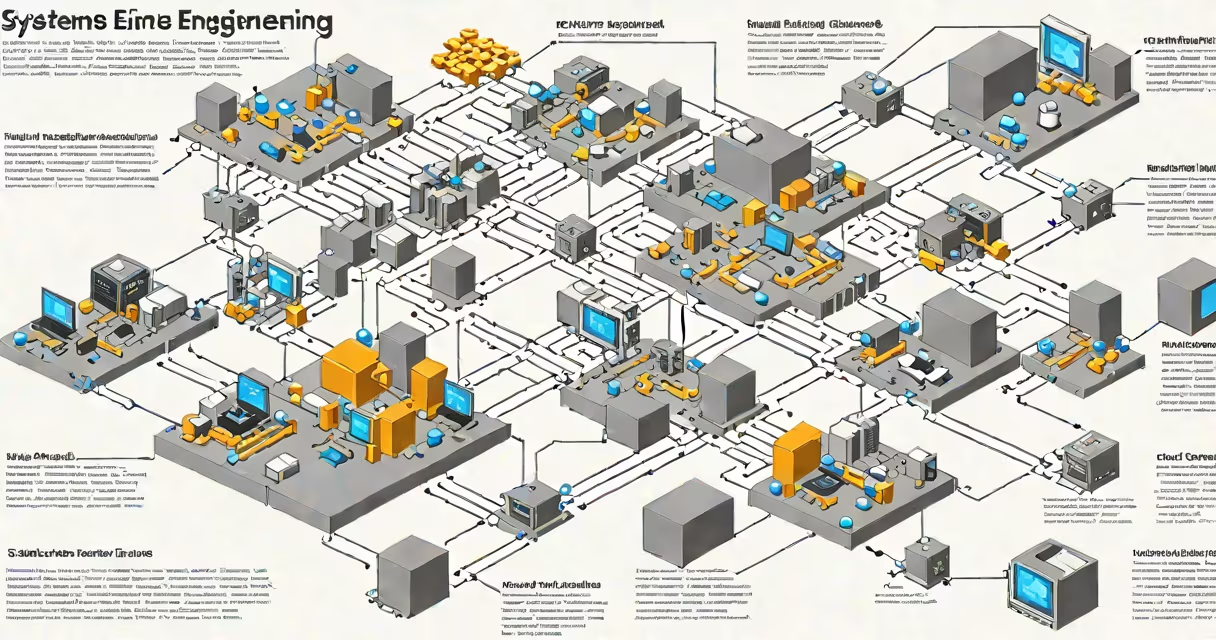
Systems engineering IT applies structured, interdisciplinary methods to design, develop, and manage complex technological systems that meet both functional and operational goals. It bridges software, hardware, people, and processes within enterprise environments to ensure systems perform reliably under real-world constraints.
This discipline emerged from aerospace and defense projects in the mid-20th century but now underpins cloud infrastructure, enterprise software, and AI-driven platforms. It treats entire IT ecosystems-not just individual components-as integrated wholes, using lifecycle planning, risk modeling, and stakeholder coordination to prevent failures before deployment.
For example, when a financial institution rolls out a new fraud detection platform, systems engineering IT helps data pipelines, machine learning models, database schemas, user access controls, and compliance logging work together without bottlenecks or security gaps. It doesn't just build features-it verifies that the system behaves correctly under stress, scale, and failure conditions.
At its core, systems engineering IT follows a phased lifecycle: concept, requirements analysis, design, implementation, testing, deployment, and maintenance. Each phase includes feedback loops to validate assumptions and correct deviations early.
Requirements are captured in precise, measurable terms. Instead of saying "the system should be fast," a properly engineered requirement states: "The login service must authenticate 10,000 users per minute with 99.9% uptime during peak hours." This precision prevents ambiguity and enables verification.
Tools like SysML (Systems Modeling Language) and simulation environments allow teams to model behavior before coding begins. A team designing a smart grid control system might simulate how power distribution changes when 30% of solar panels go offline due to weather-adjusting failover logic before physical installation.
Systems engineering IT relies on several foundational elements:
There are two primary approaches used in practice:
| Type | Description | Use Case Example |
|---|---|---|
| Model-Based Systems Engineering (MBSE) | Uses digital models to represent system structure, behavior, and constraints throughout development. | Aerospace firms use MBSE to simulate aircraft avionics interactions before flight testing. |
| Traditional Systems Engineering | Relies on documentation, flowcharts, and manual traceability matrices. | Legacy banking systems often use this method due to regulatory audit demands. |
MBSE reduces errors by 40% compared to document-only methods, according to a 2022 study by the International Council on Systems Engineering (INCOSE). The study analyzed 120 projects across automotive, healthcare, and defense sectors.
Many assume systems engineering IT is synonymous with project management or software development. It is not. While project managers track timelines and budgets, systems engineers define what the system must do and how it must behave under failure modes.
Another error is treating systems engineering as a late-stage activity. In reality, it begins at the idea stage. A startup building a real-time traffic optimization app cannot wait until code is written to consider how edge devices handle network outages. Early modeling identifies such risks.
Some believe systems engineering slows innovation. On the contrary, it accelerates delivery by catching misalignment early. NASA's Mars 2020 Perseverance rover mission succeeded in part because systems engineering caught a software timing conflict during simulation-fixing it months before launch.
In 2021, I led the integration of a multi-cloud disaster recovery system for a regional health network. The goal was to maintain patient records availability during regional outages. We used systems engineering IT to map dependencies between electronic health record systems, backup storage zones, identity providers, and emergency access protocols.
We discovered that a single authentication server, located in a region prone to storms, was a critical failure point. By modeling cascading failures, we rerouted access through redundant geographically dispersed services. After testing, the system survived three simulated regional blackouts with zero data loss.
This outcome wasn't luck. It came from applying systems engineering principles: defining clear requirements, simulating failure scenarios, and validating outcomes against performance metrics-all before production rollout.
Industries ranging from energy to transportation depend on systems engineering IT to manage complexity. In telecommunications, it ensures 5G networks maintain low latency across millions of devices. In autonomous vehicles, it coordinates sensor fusion, path planning, and emergency braking logic.
Even in non-technical roles, systems thinking improves decision-making. A product manager using systems engineering principles can anticipate how adding a feature affects load balancing, user retention, and support costs.
systems engineering it is not a niche specialty. It is the foundation of resilient, scalable, and secure digital systems. Whether managing a hospital's data infrastructure or launching a satellite, success hinges on treating technology as an integrated whole-not a collection of isolated tools.
By grounding decisions in measurable requirements, continuous validation, and cross-functional alignment, systems engineering IT transforms uncertainty into predictability. As systems grow more complex, its role becomes not just useful-but essential.