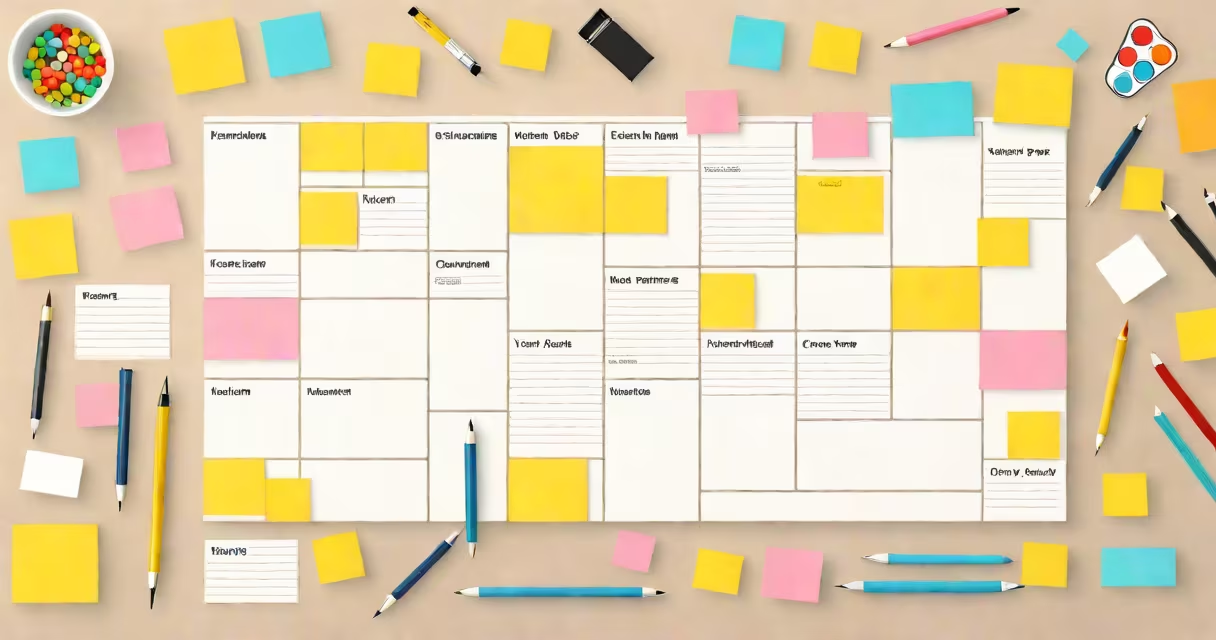
The business model canvas is a visual structure that maps out the nine essential elements of a business: customer segments, value propositions, channels, customer relationships, revenue streams, key resources, key activities, key partnerships, and cost structure. It enables teams to design, challenge, and pivot their business strategy in a single page.
Developed by Alexander Osterwalder and Yves Pigneur in their 2010 book *Business Model Generation*, the canvas replaces lengthy business plans with a changing, collaborative layout. It's used by startups, corporations, and nonprofits to align stakeholders around a shared understanding of how a business operates and generates value.
Each element is represented as a box on a grid. Teams fill in each box based on research, interviews, and prototyping. The result is a living document that evolves as assumptions are tested. A well-fleshed-out canvas doesn't guarantee success-but it makes failure visible faster.
The canvas functions as a shared mental model. Instead of relying on narrative documents, teams use the canvas to ask targeted questions: Who are we serving? What problem do we solve? How do we make money?
For example, a SaaS startup building project management software might define its customer segments as small to mid-sized creative agencies. Its value proposition centers on reducing meeting time through automated task tracking. Revenue comes from monthly subscriptions via direct sales and online checkout. Cost structure includes cloud hosting, developer salaries, and marketing spend.
When all boxes are filled, the team reviews for consistency. If the value proposition targets freelancers but the channels are enterprise sales reps, the model is misaligned. This early detection prevents wasted effort on features no one wants.
The canvas consists of nine interdependent blocks. Each plays a role in defining a sustainable business model.
| Component | Description | Real-World Example |
|---|---|---|
| Customer Segments | Who are the specific groups needing your solution? | Netflix targets households with streaming habits, not individual movie viewers. |
| Value Proposition | What unique benefit does your product or service deliver? | Spotify offers ad-free music with personalized playlists, solving discovery fatigue. |
| Channels | How do you reach customers and deliver value? | Apple sells iPhones through retail stores, its website, and carrier partners. |
| Customer Relationships | How do you maintain engagement and loyalty? | Amazon uses automated recommendations and Prime membership perks to retain users. |
| Revenue Streams | How does the business earn income? | Uber charges riders per trip and takes a commission from drivers. |
| Key Resources | What assets are essential to operations? | Starbucks relies on trained baristas, store locations, and proprietary coffee blends. |
| Key Activities | What actions drive value creation? | Netflix produces original series and licenses content to attract subscribers. |
| Key Partnerships | Which external entities support your model? | Walmart partners with local farmers to source fresh produce for its stores. |
| Cost Structure | What are the major expenses? | SpaceX spends heavily on rocket development and launch infrastructure. |
A common mistake is assuming that all components must be equally developed. In reality, some businesses operate with minimal cost structures. For example, a freelance graphic designer may have low key resources-just a laptop and design software-but high key activities focused on client acquisition and creative work.
Another non-obvious insight: the canvas is not a static plan. It's a hypothesis-testing tool. When a startup discovers that its initial customer segment doesn't respond to the value proposition, it can revise the canvas and test again. This iterative process reduces risk compared to launching with a full-scale product.
People often mistake the business model canvas for a business plan. They're not interchangeable. A business plan details financial projections, market analysis, and operational timelines over three to five years. The canvas focuses on structural logic: how the business connects value creation to revenue.
Also, the canvas is not a replacement for customer research. It's a way to organize findings. Without validated customer interviews, the boxes remain guesses. Osterwalder emphasizes that "the canvas is only as good as the data behind it."
Some assume the canvas must be filled completely before moving forward. That's incorrect. Start with the most uncertain elements-like customer segments or value propositions-and validate them first. Iteration is built into the method.
I once facilitated a workshop with a nonprofit aiming to reduce food waste in urban areas. Their initial canvas listed "local residents" as the customer segment. After field visits, they discovered that community kitchens were the actual decision-makers. Revising the canvas led to a redesigned outreach strategy and a 40% increase in donations within six weeks.
The canvas excels in early-stage ideation, product-market fit testing, and cross-functional alignment. It's especially useful in agile environments where teams need to rapidly prototype and adjust.
For larger organizations, the canvas can be applied at multiple levels. A company might create one for the business, another for a new product line, and a third for a regional market. This layered approach reveals gaps in scalability or resource allocation.
When working with complex ecosystems, such as healthcare or education, teams sometimes split the canvas into two parts: one for the customer-facing model and another for the internal operational model. This avoids conflating user needs with backend processes.
If you're evaluating different types of business structures, the three types of business-product-based, service-based, and platform-based-can help categorize your model. A platform business like Airbnb uses the canvas differently than a product-based firm like Apple, because its value depends on network effects and trust between users.
The business model canvas isn't about perfection. It's about clarity. When a team can explain the model in under two minutes using the canvas, they've achieved alignment. That's the real measure of success.