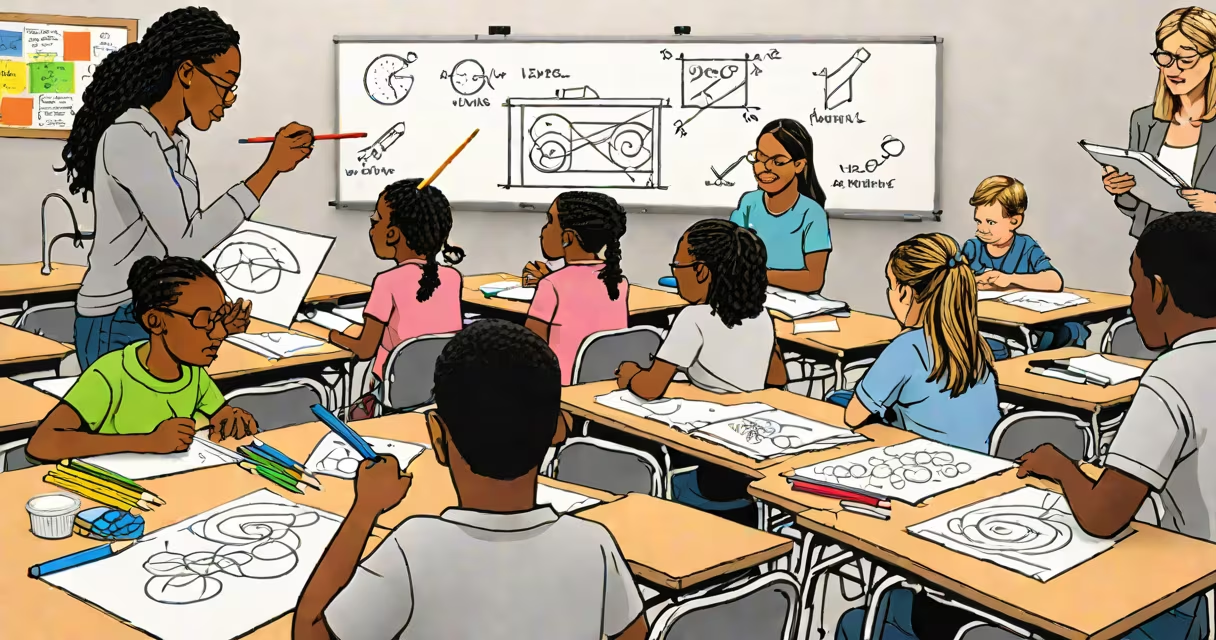
Universal Design for Learning (UDL) strategies in the classroom are evidence-based instructional approaches that proactively remove barriers to learning by offering multiple means of representation, expression, and engagement. These strategies ensure all students-regardless of ability, background, or learning preference-can access and succeed in rigorous academic content.
UDL is grounded in neuroscience and cognitive psychology. Research from the Center for Applied Special Technology (CAST), the organization that developed UDL, shows that learners process information through three primary brain networks: recognition (how we perceive), strategic (how we plan and act), and affective (how we engage and motivate). UDL strategies address each network intentionally, reducing reliance on single methods that may exclude some learners.
For example, a teacher presenting a unit on the American Revolution might show a 3-minute animated video (representation), allow students to write a journal entry, create a comic strip, or record a podcast (expression), and let them choose whether to work alone, in pairs, or in small groups (engagement). This flexibility helps a student with dyslexia, a gifted learner needing challenge, and an English language learner can all access the same content meaningfully.
UDL operates on three core principles: multiple means of representation, multiple means of action and expression, and multiple means of engagement. These are not optional add-ons-they are structural components of effective lesson design.
Representation involves presenting content in various formats. A science lesson on photosynthesis might include labeled diagrams, a short interactive simulation, audio narration, and a tactile model made from clay and pipe cleaners. Students who struggle with reading can follow along via audio; those who learn visually benefit from color-coded diagrams; kinesthetic learners manipulate the model.
Action and expression allow students to demonstrate understanding in ways that match their strengths. Instead of requiring a written essay, a teacher might offer choices such as building a diorama, delivering a 2-minute oral presentation, or creating a digital slideshow with embedded voiceover. This reduces performance anxiety and allows authentic assessment of deeper understanding.
Engagement focuses on sustaining interest and motivation. A teacher might begin a math unit with a real-world problem-"How much will it cost to build a fence around our school garden?"-and let students choose roles: researcher, calculator, designer, presenter. This taps into intrinsic motivation and builds ownership over learning.
The following table outlines common UDL strategies grouped by principle, with real classroom applications.
| Principle | Strategy Type | Concrete Classroom Application |
|---|---|---|
| Representation | Multiple media formats | Show a historical event through a documentary clip, a timeline graphic, and a primary source letter. |
| Language supports | Provide vocabulary lists with images and audio pronunciation for ELL students. | |
| Text simplification | Use tools like Read&Write to show key ideas and define complex terms in simpler language. | |
| Expression | Choice of output format | Let students submit a project as a video, poster, speech, or written report. |
| Assistive tech integration | Allow use of speech-to-text software for students with writing difficulties. | |
| Peer collaboration | Assign group roles (note-taker, timekeeper, presenter) to distribute responsibility. | |
| Engagement | Choice in topics | Let students select a research topic from a list aligned with curriculum goals. |
| Interest-based tasks | Connect lessons to current events or student hobbies (e.g., analyze climate change through music lyrics). | |
| Feedback loops | Use quick exit tickets or digital polls to adjust pacing based on student understanding. |
A 2022 study published in *Learning Disabilities Research & Practice* found that classrooms implementing UDL saw a 27% increase in student participation among students with identified learning disabilities compared to traditional instruction. The study emphasized that success came not from adding extra resources, but from redesigning the structure of lessons to anticipate diversity from the start.
UDL is often mistaken for differentiation, but the two differ in intent and timing. Differentiation adjusts instruction after identifying student needs-often during or after a lesson. UDL designs learning experiences upfront to be accessible to all, reducing the need for last-minute accommodations.
Another misconception is that UDL requires extensive technology. While tools like screen readers, captioning software, and interactive whiteboards improve implementation, UDL can be applied with low-tech solutions. For example, a teacher might use printed sentence stems, colored index cards for sorting, or physical manipulatives to represent abstract concepts.
UDL is not a one-size-fits-all template. It's a structure for decision-making. A teacher doesn't "apply" UDL like a recipe. Instead, they ask: "Who might struggle with this task? How can I offer alternatives without lowering rigor?" This mindset shift is critical.
In a sixth-grade class studying ratios, the teacher begins with a real-world scenario: "The recipe for trail mix calls for 2 parts nuts to 3 parts dried fruit. How many cups of each do we need for 10 cups total?"
Representation: The teacher displays the ratio as a visual bar model, a table of values, and a short animation showing mixing. Students can choose which format to use first.
Expression: Students solve the problem using any method: drawing a diagram, writing equations, using fraction tiles, or explaining verbally to a peer. They then present their solution in a format of choice.
Engagement: The teacher offers options: work independently, pair with a peer, or join a small group discussing strategies. Students can take breaks using a fidget tool or move to a standing desk if needed.
Afterward, the teacher uses a quick digital poll to assess understanding. 85% of students responded correctly. The remaining 15% were invited to a brief small-group review session. No student was left behind due to rigid delivery methods.
This lesson illustrates how UDL strategies in the classroom prevent exclusion before it happens. The teacher didn't wait to see who struggled-she built flexibility into the design.
UDL complements other frameworks like assessment strategies in the classroom and SEL strategies in the classroom. When assessments are designed with multiple response formats (e.g., multiple-choice, short answer, oral explanation), they measure actual understanding rather than test-taking skill. This alignment improves validity and fairness.
Similarly, SEL strategies-such as teaching emotional regulation, perspective-taking, and collaborative problem-solving-improve the affective network central to UDL. A student who feels safe and valued is more likely to persist through challenging tasks. Teachers can integrate SEL by setting norms, using reflective journal prompts, or including team-building activities before group projects.
When combined, UDL, assessment strategies in the classroom, and SEL strategies form a cohesive system. One teacher reported that after integrating all three, her classroom culture improved. "Students weren't just learning content," she said. "They were learning how to learn-and how to support each other."
Implementing UDL strategies in the classroom is not about perfection. It's about intentionality. Start small: add one alternative format to a lesson, offer a choice in how students respond, or survey students on preferred learning styles. Over time, these changes compound into lasting inclusivity.
As CAST emphasizes, "UDL is not about fixing students-it's about redesigning learning environments to meet human diversity."