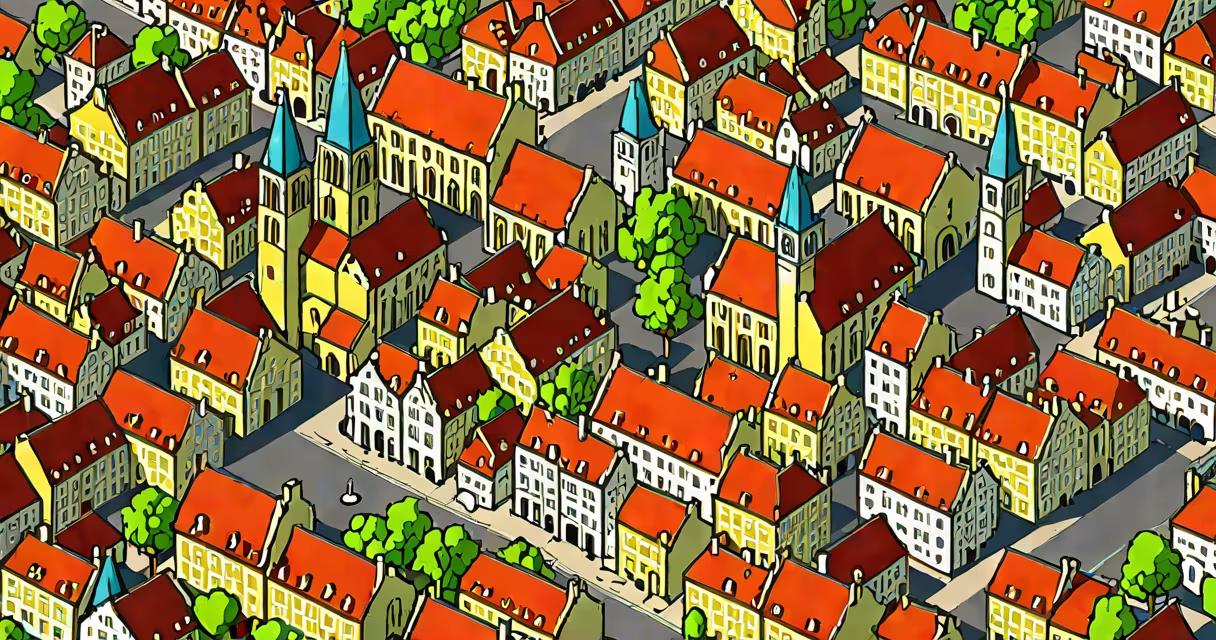
Ville de Hem is a commune in the Nord department of northern France, located approximately 12 kilometers northeast of Lille. It is a small urban center with a population of around 16,000 residents, notable for its preserved medieval core, historic churches, and industrial heritage linked to the region's textile past.
The town's name derives from Old French "hem," meaning "edge" or "border," reflecting its position near the historical frontier between Flanders and France. Today, Hem retains architectural features from the 13th to 18th centuries, including half-timbered houses, stone gateways, and the 13th-century Church of Saint-Martin, which features a Romanesque nave and Gothic choir.
As a former hub of textile manufacturing during the 19th and early 20th centuries, Hem's economy was shaped by cotton and wool production. The decline of heavy industry in the 1970s led to urban renewal projects, including the redevelopment of the former factory district into residential and commercial zones. This transformation helped preserve the town's identity while integrating modern infrastructure.
Hem functions as a local administrative center within the arrondissement of Lille and the canton of Hem. It hosts municipal services, public libraries, schools, and healthcare facilities. The town also serves as a transit node on regional rail lines connecting Lille to Cambrai and Valenciennes.
Cultural life centers around the annual Festival du Cinéma Français, held each September in the town hall square. The event showcases independent French films and attracts visitors from nearby cities. Local festivals also show traditional music, crafts, and regional cuisine such as potjevleesch (a meat stew) and galettes de blé noir (buckwheat pancakes).
Transportation access includes the A2 motorway, which runs within 5 kilometers of the town, and regional bus routes operated by Transports en Commun de la Métropole Européenne de Lille (TCM). The nearest railway station is Lille-Flandres, 15 minutes away by train.
The historic heart of ville de hem lies within a compact area bounded by Rue de la République, Rue des Écoles, and the River Scarpe. Most buildings date from the 15th to 18th centuries, constructed using local limestone and timber framing. The town's layout reflects medieval planning principles, with narrow alleys and irregular street patterns designed for defense and community cohesion.
Key structures include:
Urban development since the 1980s has focused on preserving heritage while expanding green spaces. The town maintains over 200 hectares of parks and gardens, including Parc de la Gare and Jardin des Plantes, both featuring native flora and walking trails.
Some visitors confuse ville de hem with the larger city of Lille, located just 12 kilometers away. While Hem is part of the Lille metropolitan area, it is distinct in governance, history, and character. Unlike Lille's grand boulevards and modern skyline, Hem emphasizes quiet neighborhoods, local shops, and low-density housing.
A frequent error is assuming Hem is a tourist destination comparable to destinations like Montreux or Avignon. It is not a major international attraction. Instead, it appeals to travelers seeking authentic French provincial life, history buffs, and those exploring the cultural geography of northern France.
Another misconception is that Hem lacks modern amenities. In reality, the town has high-speed internet coverage, a 24-hour pharmacy, and multiple grocery chains. Public Wi-Fi is available in the central library and town square.
On a typical Saturday in autumn, a visitor arrives at 9:00 AM via regional train from Lille. They walk through the historic center, passing the Church of Saint-Martin, where a choir rehearses in the nave. By 10:30 AM, they are at Les Halles Market, buying fresh camembert from a vendor in a blue apron and a loaf of sourdough bread from a baker whose family has run the shop since 1947.
At noon, they visit the Musée de la Vie Locale, housed in a former textile mill. The exhibit displays looms from the 1800s, worker diaries, and photographs of labor strikes in 1936. Admission is free, and the museum offers guided tours in French and English.
By 3:00 PM, the visitor walks along the Scarpe River, observing kingfishers and ducks. They stop at Café du Pont, a café with outdoor seating, where they drink a coffee and read a local newspaper. The entire day costs under €15 in total, including transport and food.
Visitors can choose from several experience levels based on interest and time:
| Type | Focus | Duration | Best For |
|---|---|---|---|
| Heritage Walk | Medieval architecture, churches, town walls | 2 hours | First-time visitors, history enthusiasts |
| Market & Food Tour | Local producers, seasonal ingredients, cooking demos | 3.5 hours | Families, foodies, culinary travelers |
| Industrial Heritage Route | Former mills, factory sites, worker housing | 4 hours | Students, researchers, social historians |
Each route is marked with numbered signs and available in a downloadable PDF from the official tourism website. Maps are updated annually by the municipal council.
During World War II, Hem hosted a clandestine network that transmitted intelligence to British forces. The resistance cell, known as "Réseau de l'Ouest," operated from a bakery on Rue des Écoles. Records show that over 120 Allied agents passed through the town undetected between 1941 and 1944.
Today, a plaque at the site commemorates the network's activities. The location is not listed on most tourist maps, but a small exhibition at the town hall provides context. This detail is often overlooked because Hem's wartime role was not widely documented in national histories.
I visited Hem in October 2022 during a research trip on rural French towns. I stayed in a guesthouse near the river and walked the full heritage trail. The silence of the church courtyard at dawn, broken only by distant bells, remains one of the clearest memories of my time in northern France.
Ville de hem is a living example of how small French towns balance tradition and modernity. Its enduring charm lies not in spectacle, but in quiet continuity - daily life unfolding beneath ancient eaves and stone arches.