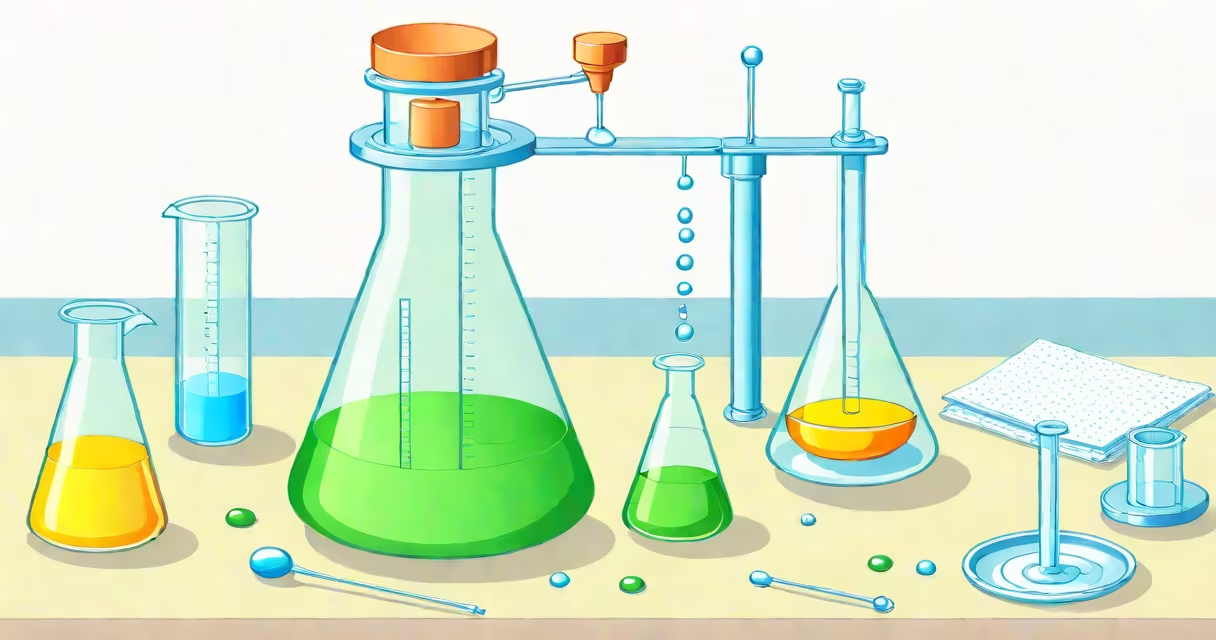
Acid base titration is a laboratory technique that measures the concentration of an acid or base by reacting it with a solution of known concentration until neutralization occurs. This endpoint is detected visually or electronically, allowing precise calculation of the unknown concentration.
The process relies on a controlled addition of a titrant-usually a strong acid or base-to a solution containing the analyte. When the moles of titrant equal the moles of analyte, the reaction reaches the equivalence point. A pH indicator or pH meter signals this moment, often showing a sharp color change or voltage shift.
For example, adding 0.1 M NaOH from a burette to 25 mL of HCl of unknown concentration requires 22.5 mL of NaOH to reach the endpoint. Using the formula M₁V₁ = M₂V₂, the HCl concentration is calculated as (0.1 mol/L × 0.0225 L) / 0.025 L = 0.09 M. This method is widely used in quality control, environmental testing, and pharmaceutical analysis.
A titration begins with a known volume of analyte placed in a flask. A burette holds the titrant-typically a standardized solution with a precisely known molarity. The titrant is added drop by drop while stirring, until the reaction reaches completion.
Neutralization reactions follow the pattern: H⁺ + OH⁻ → H₂O. For instance, when HCl reacts with NaOH, the products are water and sodium chloride. The reaction proceeds until all H⁺ ions from the acid are consumed by OH⁻ ions from the base.
At the equivalence point, stoichiometric balance is achieved. However, the pH at this point depends on the strength of the acid and base involved. A strong acid-strong base titration yields a neutral pH (around 7), while weak acid-strong base titrations result in slightly basic pH values due to hydrolysis of the conjugate base.
Each titration uses specific tools and materials. The burette delivers the titrant with precision-typically calibrated in 0.1 mL increments. The Erlenmeyer flask minimizes splashing during mixing. A magnetic stirrer ensures uniform distribution of reactants.
Common indicators include phenolphthalein (colorless below pH 8.2, pink above), methyl orange (red below pH 3.1, yellow above), and bromothymol blue (yellow below pH 6.0, blue above). Choosing the right indicator is critical-the color change must occur near the equivalence point.
| Type | Acid Strength | Base Strength | Equivalence Point pH | Recommended Indicator |
|---|---|---|---|---|
| Strong acid - strong base | Strong | Strong | ~7.0 | Phenolphthalein |
| Weak acid - strong base | Weak | Strong | 8.5-10.5 | Phenolphthalein |
| Strong acid - weak base | Strong | Weak | 3.5-5.5 | Methyl red |
The choice of indicator is not arbitrary. Phenolphthalein fails in weak acid-strong base titrations if the endpoint is missed because the pH rise is gradual. Conversely, methyl orange gives false results in strong acid-strong base titrations due to its early color shift.
Acid base titration is essential in clinical laboratories. Blood serum samples are titrated to measure bicarbonate levels, which indicate metabolic acidosis or alkalosis. A normal bicarbonate level is 22-28 mmol/L; deviations signal respiratory or renal issues.
In food science, titration determines acidity in wine. The tartaric acid content affects flavor and preservation. A typical wine sample requires 12.3 mL of 0.05 M NaOH to reach the endpoint. The acidity is reported as grams of tartaric acid per 100 mL-commonly between 5 and 12 g/100 mL.
Environmental labs use titration to assess water hardness. Calcium and magnesium ions form complexes with EDTA, but acid titration measures total alkalinity. High alkalinity buffers against pH changes, protecting aquatic life. Values above 200 mg/L CaCO₃ indicate high buffering capacity.
Many assume the endpoint and equivalence point are identical. They are not. The equivalence point is the theoretical moment of complete reaction. The endpoint is when the indicator changes color-a practical observation. The difference between them is the titration error.
For example, in a weak acid-strong base titration, the pH rises slowly near the equivalence point. If phenolphthalein is used, the color change may lag slightly behind the actual equivalence point. This leads to a small overestimation of titrant volume-up to 0.1 mL in a 25 mL titration. Repeating the test multiple times reduces this bias.
Another mistake is assuming all titrations require indicators. Automated titrators use pH sensors to detect the inflection point on a titration curve. These systems eliminate human error and are used in industrial settings where speed and consistency matter.
I once ran a titration in a university lab using a manual burette and phenolphthalein. After three trials, the volumes varied by ±0.2 mL. Switching to a digital titrator reduced variation to ±0.02 mL. The difference was clear: automation improves reproducibility.
When interpreting results, remember that acid base titration is not limited to aqueous solutions. Non-aqueous titrations exist-for example, using glacial acetic acid as solvent for weak bases. These are less common but important in pharmaceutical formulation.
Finally, the term "standard solution" refers to a solution with accurately known concentration. Preparing one involves dissolving a primary standard-like potassium hydrogen phthalate (KHP)-to high purity. KHP is ideal because it is stable, non-hygroscopic, and has a high molecular weight, reducing weighing errors.
Acid base titration remains a core analytical method. Its accuracy, simplicity, and low equipment cost make it indispensable in education, industry, and research. Whether measuring blood pH or checking wine acidity, the technique delivers reliable results when executed carefully.