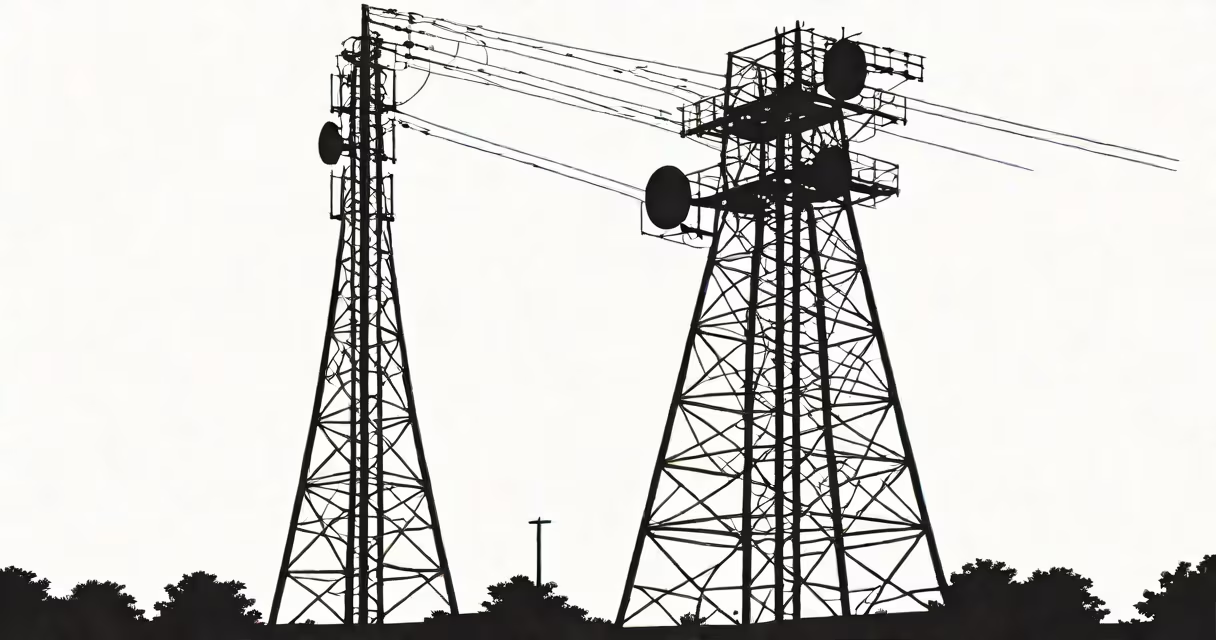
Cell phone towers are tall structures equipped with antennas and electronic equipment that transmit and receive radio signals to connect mobile devices to a cellular network. They form the core of wireless communication, enabling voice calls, texts, and data transfer across cities and rural areas.
Each tower serves a geographic area called a "cell," dividing the region into manageable segments to prevent signal overlap and ensure efficient bandwidth use. Signals travel between phones and towers using radio waves in licensed frequency bands, typically between 600 MHz and 3.5 GHz. These frequencies balance range and data capacity based on terrain and user density.
The system relies on a network of interconnected towers, each linked via fiber-optic or microwave backhaul to a central switching hub. This allows smooth handoffs as users move between cells, maintaining uninterrupted service during travel. Without this infrastructure, mobile connectivity would not function beyond short-range Bluetooth or Wi-Fi.
When a smartphone sends a call or data request, it transmits a low-power radio signal to the nearest cell tower. The tower receives the signal, processes it through baseband units, and routes it through a backhaul connection to a core network. From there, the signal reaches its destination-another phone, a server, or a landline-via wired or wireless paths.
Towers operate on a principle called frequency reuse. A single frequency band is reused in non-adjacent cells to maximize spectrum efficiency. For example, a 7-cell pattern repeats every seven towers, minimizing interference. This design allows high-capacity urban networks while preserving signal quality in dense environments.
Modern towers support multiple generations of cellular technology. A single tower may host equipment for 4G LTE, 5G NR, and even legacy 3G systems. Each uses different frequency bands and modulation techniques. 5G, for instance, leverages millimeter wave (mmWave) bands above 24 GHz for ultra-high speeds but requires shorter distances due to signal absorption by buildings and rain.
Cell phone towers consist of several physical and electronic elements. The primary structural component is a steel lattice or monopole mast, usually 30 to 100 meters tall. Height increases line-of-sight coverage and reduces signal obstruction from terrain and buildings.
Antennas are mounted at the top of the tower. They come in directional panels, often grouped in sets of three to cover 120-degree sectors. Each antenna handles a specific frequency band and polarization (vertical or horizontal). Multiple antennas allow simultaneous handling of voice, data, and signaling traffic.
Inside the tower's base station shelter, equipment includes transceivers, power supplies, cooling systems, and network interface modules. These components manage signal amplification, filtering, and error correction. Modern systems integrate software-defined radio (SDR) platforms that dynamically adjust parameters based on load and interference levels.
| Type | Height Range | Use Case | Frequency Band |
|---|---|---|---|
| Lattice Tower | 30-100 m | Urban and suburban coverage | 700 MHz - 2.5 GHz |
| Monopole | 15-50 m | Rural and highway zones | 600 MHz - 1.9 GHz |
| Small Cell (Outdoor) | 3-10 m | Dense urban hotspots | 2.5 GHz - 3.5 GHz (5G) |
| Roof-Mounted Antenna | Integrated into buildings | Indoor and indoor-outdoor hybrid | 1.7 GHz - 2.1 GHz |
Small cells are increasingly deployed in cities to boost 5G performance. These compact units, often installed on lampposts or building facades, provide localized coverage with lower power and reduced interference. They complement macro towers by filling dead zones and increasing network capacity during peak usage.
Network operators deploy towers based on population density, traffic demand, and terrain. Urban areas require higher tower density-typically one tower per 1-2 square kilometers-to handle high user volume. Rural regions may have towers spaced 10-20 km apart, relying on higher transmit power and taller masts for extended reach.
Site selection involves environmental assessments, zoning approvals, and community consultations. Towers must comply with FCC regulations on RF exposure limits. The maximum permissible exposure (MPE) for public areas is set at 0.5 mW/cm² for frequencies below 3 GHz, according to the Federal Communications Commission (FCC).
A common misconception is that cell towers emit harmful radiation. Radiofrequency energy from towers is non-ionizing and far below safety thresholds. The World Health Organization (WHO) states that current evidence shows no established health effects from exposure to low-level RF fields, citing decades of research including the INTERPHONE study and ongoing monitoring programs.
Many people mistake small cells for traditional towers. While both transmit signals, small cells are lower-powered, shorter-range units designed for high-density areas. They don't require large towers or extensive permits. A small cell on a streetlight pole covers less than 100 meters, compared to a macro tower's 1-5 km radius.
Another confusion is equating tower height with signal strength. A taller tower improves line-of-sight but doesn't guarantee better reception. Signal quality depends on antenna direction, frequency, and nearby obstructions. A well-placed 20-meter monopole in a valley can outperform a 100-meter tower blocked by hills.
During a storm, users often report dropped calls and slow data. This is not caused by the tower failing-it's due to increased path loss and atmospheric attenuation. Rain absorbs mmWave signals, reducing 5G range by up to 30% in heavy showers. Networks automatically switch devices to lower-frequency bands to maintain connectivity.
In 2023, Chicago's city government partnered with major carriers to deploy 5G small cells along 12th Street. The goal was to improve downtown connectivity for businesses and tourists. Over 40 small cells were installed on existing infrastructure-lampposts and utility poles-avoiding new construction permits.
Each unit operated at 3.5 GHz with beamforming antennas that focused signals toward pedestrians and vehicles. Data throughput averaged 320 Mbps during peak hours, compared to 45 Mbps on 4G. Network latency dropped to 12 ms, supporting real-time applications like AR navigation and remote surgery simulations.
Residents reported fewer dropped calls and faster app loading times. However, some expressed concern about visual clutter. The city responded by requiring camouflage designs and color-matching to surrounding structures. This balanced technical goals with aesthetic standards.
Cell phone towers are not just metal structures-they are changing nodes in a global communication web. Their design, placement, and evolution reflect advances in physics, engineering, and policy. As 5G expands and future 6G research begins, these towers will continue adapting to meet rising demands for speed, reliability, and coverage.