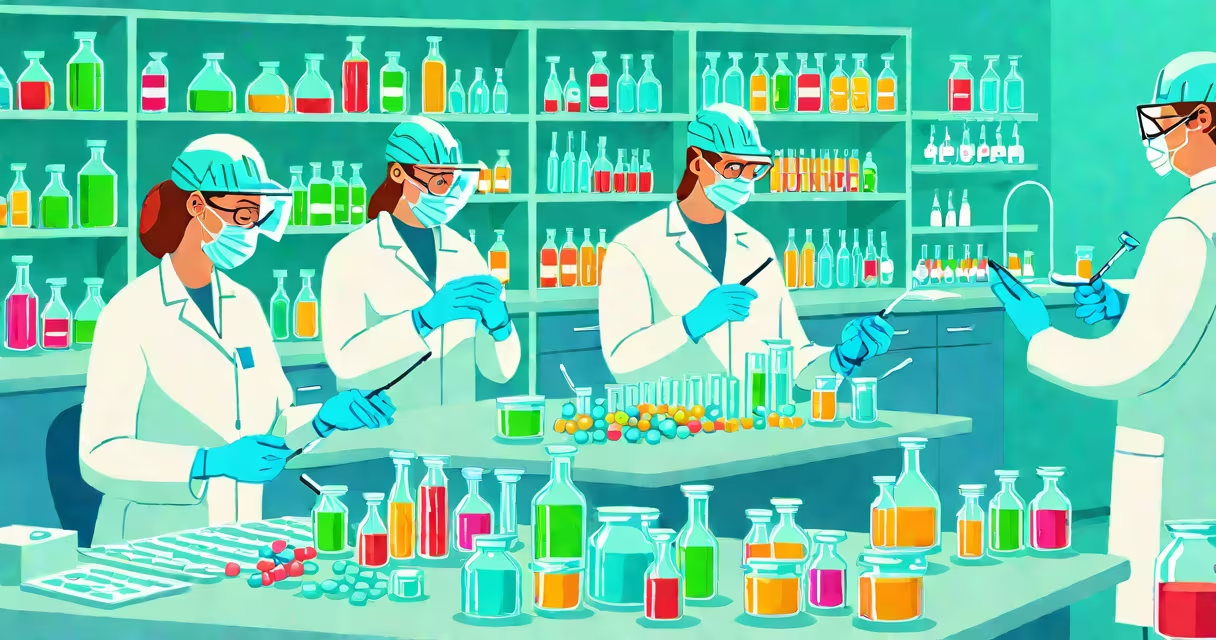
Pharmaceutical companies are private or public entities that research, develop, manufacture, and market prescription drugs to prevent, diagnose, or treat medical conditions. They operate under strict regulatory frameworks and require years of testing before a drug reaches patients.
These organizations combine scientific research, clinical trials, and large-scale manufacturing to bring medicines to market. Most major pharmaceutical companies have global operations, maintain extensive patent portfolios, and rely heavily on intellectual property rights to protect their investments.
The industry includes both large multinational corporations and smaller biotechnology firms focused on niche therapies. All must comply with regulations set by agencies such as the U.S. Food and Drug Administration (FDA) and the European Medicines Agency (EMA).
Drug development begins with identifying a biological target linked to a disease-such as a protein involved in cancer cell growth. Scientists then screen thousands of compounds to find potential candidates that interact with the target. This phase, known as discovery, often takes five to ten years and costs hundreds of millions of dollars.
Once a promising compound emerges, it enters preclinical testing using animal models and lab cultures. If results show safety and efficacy, the company files an Investigational New Drug (IND) application with the FDA. Only after approval can human testing begin.
Clinical trials happen in three phases. Phase I tests safety in small groups of healthy volunteers. Phase II evaluates effectiveness and side effects in patients with the condition. Phase III involves thousands of participants to confirm benefits and monitor rare adverse events. A successful trial leads to a New Drug Application (NDA) submission.
Not all pharmaceutical companies are the same. Their size, focus, and business model differ.
| Type | Focus | Example | Development Timeline |
|---|---|---|---|
| Large Pharma | Blockbuster drugs, chronic disease treatments | Pfizer, Johnson & Johnson | 10-15 years |
| Biotech Firms | Gene therapy, monoclonal antibodies, targeted oncology | Moderna, CRISPR Therapeutics | 7-12 years |
| Generic Manufacturers | Low-cost versions of expired-patent drugs | Teva Pharmaceuticals, Mylan | 1-3 years |
Large pharmaceutical companies typically have diversified pipelines and strong sales teams. Biotech firms often partner with larger firms to fund late-stage trials and commercialization. Generic manufacturers enter markets after patents expire, offering lower prices but reduced profit margins.
Every new drug must undergo rigorous evaluation by national regulators. In the U.S., the FDA requires evidence of safety and effectiveness before approving a drug. Approval is based on data from clinical trials, not just theoretical promise.
For example, the FDA approved the mRNA-based Pfizer-BioNTech COVID-19 vaccine in December 2020 after reviewing data from over 43,000 participants in Phase III trials. The vaccine demonstrated 95% efficacy and acceptable safety profiles, leading to emergency use authorization and eventual full approval.
A common misconception is that pharmaceutical companies prioritize profits over patient health. While revenue generation is essential for reinvestment, most companies publish clinical trial results through databases like ClinicalTrials.gov. Transparency is enforced by institutional review boards and federal reporting requirements.
Many people assume all pharmaceutical companies create drugs from scratch. In reality, nearly half of new drugs are modifications of existing molecules-known as "me-too" drugs-designed to improve tolerability or dosing frequency rather than introduce novel mechanisms.
Another misunderstanding is that pharmaceutical companies control pricing unilaterally. In the U.S., Medicare cannot negotiate drug prices directly, which allows companies to set high list prices. However, insurers and pharmacy benefit managers (PBMs) negotiate rebates and discounts, reducing net prices for many patients.
For instance, insulin prices in the U.S. remain high despite being discovered over a century ago. But in countries like Canada and Germany, government price negotiations have kept annual insulin costs below $100 per year, compared to average U.S. out-of-pocket costs exceeding $1,000.
I once observed a hospital pharmacy team reviewing formulary changes during a budget meeting. A new hepatitis C treatment reduced viral load in 99% of patients within 8 weeks. Despite its high upfront cost ($60,000 per course), the hospital adopted it because long-term savings from preventing liver transplants outweighed initial expenses. This illustrates how value-based decision-making shapes drug adoption.
Pharmaceutical companies represent a significant portion of the S&P 500 and are frequently included in diversified investment portfolios. Investors analyze factors like pipeline strength, patent expiration dates, and regulatory risk when evaluating stocks.
If you're considering investing in healthcare stocks, look beyond brand recognition. Focus on R&D spending ratios, success rates in late-stage trials, and management's track record in going through regulatory hurdles.
Some investors also explore emerging sectors like gene editing or AI-driven drug discovery. For example, companies using machine learning to predict molecular interactions have cut early-phase screening time from months to days. These innovations may reshape drug development timelines in the next decade.
Pharmaceutical companies are complex organizations that develop life-saving medications through science, regulation, and investment. They are not monolithic-they include giants, innovators, and generic producers serving different roles in global health. Understanding their structure, processes, and impact helps clarify their role in medicine and healthcare economics.