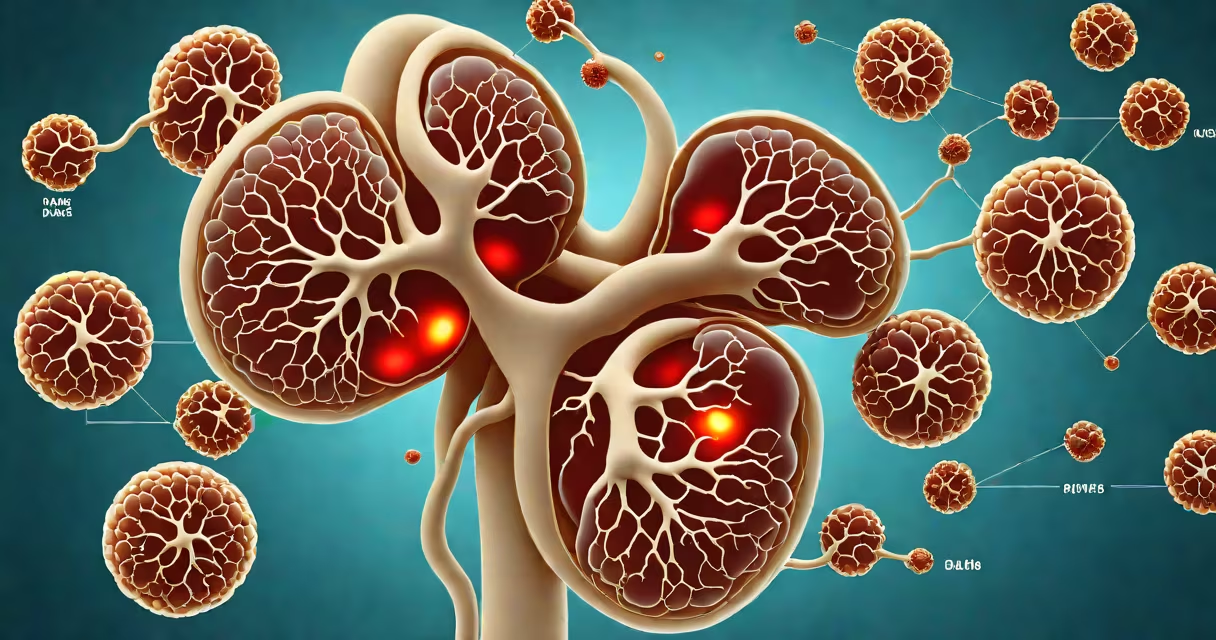
Polycystic kidney disease (PKD) causes fluid-filled cysts to grow in both kidneys, gradually replacing healthy tissue and impairing function. These cysts develop slowly over decades and often remain asymptomatic until advanced stages.
PKD is inherited in two primary forms: autosomal dominant PKD (ADPKD), which accounts for 90% of cases and typically presents in adulthood, and autosomal recessive PKD (ARPKD), which appears in infancy or childhood. The most common early symptom is persistent flank pain due to enlarged kidneys pressing on surrounding tissues. High blood pressure frequently develops before significant kidney damage is detectable, making it a key early indicator.
Other physical signs include hematuria (blood in urine), frequent urination, and recurrent urinary tract infections. As kidney function declines, fatigue, swelling in the legs and ankles, and nausea may appear. Without treatment, PKD can progress to end-stage renal disease requiring dialysis or transplantation.
Cysts begin forming during fetal development or early life but grow slowly. Most people with ADPKD do not notice symptoms until their 30s or 40s. By age 60, about 50% of affected individuals have reduced kidney function, and 10-15% require dialysis or transplant.
The progression varies widely. Some people maintain stable kidney function into old age, while others experience rapid decline. Cyst growth correlates with increasing kidney volume, measured via ultrasound or MRI. A study published in the Journal of the American Society of Nephrology found that patients with kidney volumes exceeding 1,500 mL had a higher risk of reaching end-stage renal disease within 10 years.
Flank pain is often described as dull, aching, or sharp, localized to one or both sides of the lower back. It may worsen with movement or prolonged standing. Pain can result from cyst rupture, hemorrhage, or stretching of the renal capsule. Severe episodes may require emergency care.
High blood pressure occurs in over 60% of ADPKD patients by age 30. It results from cyst-induced compression of renal arteries, triggering renin release and vasoconstriction. Early detection and management reduce the risk of stroke and heart failure.
Hematuria affects approximately 30% of individuals with PKD. Microscopic hematuria is detected in routine urinalysis. Gross hematuria-visible blood in urine-occurs when cysts bleed into the urinary tract. This can mimic kidney stones or infection but is more likely in those with a family history of PKD.
Urinary frequency and nocturia (waking at night to urinate) stem from impaired kidney concentration ability. As cysts replace functional nephrons, the kidneys lose efficiency in concentrating urine, leading to increased volume and frequency.
Swelling (edema) in the lower extremities signals declining glomerular filtration rate (GFR). Fluid retention occurs when the kidneys fail to excrete excess sodium and water. This is a late sign indicating moderate to severe kidney impairment.
| Symptom | Prevalence in ADPKD | Typical Onset Age | Underlying Cause |
|---|---|---|---|
| High blood pressure | 60-70% | 30s | Renal artery compression, renin-angiotensin activation |
| Flank pain | 40-50% | 40s | Cyst expansion, renal capsule stretch |
| Hematuria | 25-35% | 30s-50s | Cyst hemorrhage or rupture |
| Nocturia | 30-40% | 40s+ | Impaired urine concentration |
PKD symptoms overlap with other kidney disorders, including chronic kidney disease (CKD), kidney stones, and glomerulonephritis. However, key differences exist. Unlike kidney stones, which cause sudden, colicky pain, PKD pain is typically constant and bilateral. Stone-related pain often radiates to the groin and is associated with nausea and vomiting.
Chronic kidney disease from diabetes or hypertension usually progresses slowly but lacks the characteristic bilateral cysts seen in PKD. Diagnosis relies on imaging: ultrasound or CT scan reveals numerous cysts in both kidneys. In contrast, diabetic nephropathy shows diffuse thickening of the glomeruli, not discrete cysts.
A common misconception is that PKD always causes visible swelling or fatigue early on. In reality, many patients remain asymptomatic for years. The National Kidney Foundation notes that up to 40% of people with ADPKD have normal kidney function at diagnosis. This delays treatment initiation and increases long-term complications.
I once reviewed a case where a 42-year-old man presented with mild flank discomfort and elevated blood pressure. Initial tests showed microscopic hematuria. Family history revealed his father died of kidney failure at 65. An abdominal ultrasound confirmed bilateral cysts. He was diagnosed with ADPKD at stage 2, with GFR still above 60 mL/min/1.73m². Early intervention with antihypertensives slowed progression.
Individuals with a family history of PKD should undergo screening even without symptoms. Ultrasound is the first-line test. A single large cyst in one kidney suggests another condition. True PKD shows multiple cysts in both kidneys, often with a family pattern.
Red flags include persistent flank pain, uncontrolled high blood pressure, or recurring hematuria. These warrant referral to a nephrologist. Genetic testing is available for confirmation, especially in young adults with unclear imaging findings.
Understanding what are the symptoms of PKD enables earlier diagnosis and better outcomes. Recognizing subtle signs like early hypertension or incidental hematuria allows timely monitoring and intervention. With current treatments, many patients live into their 70s and 80s with manageable symptoms.