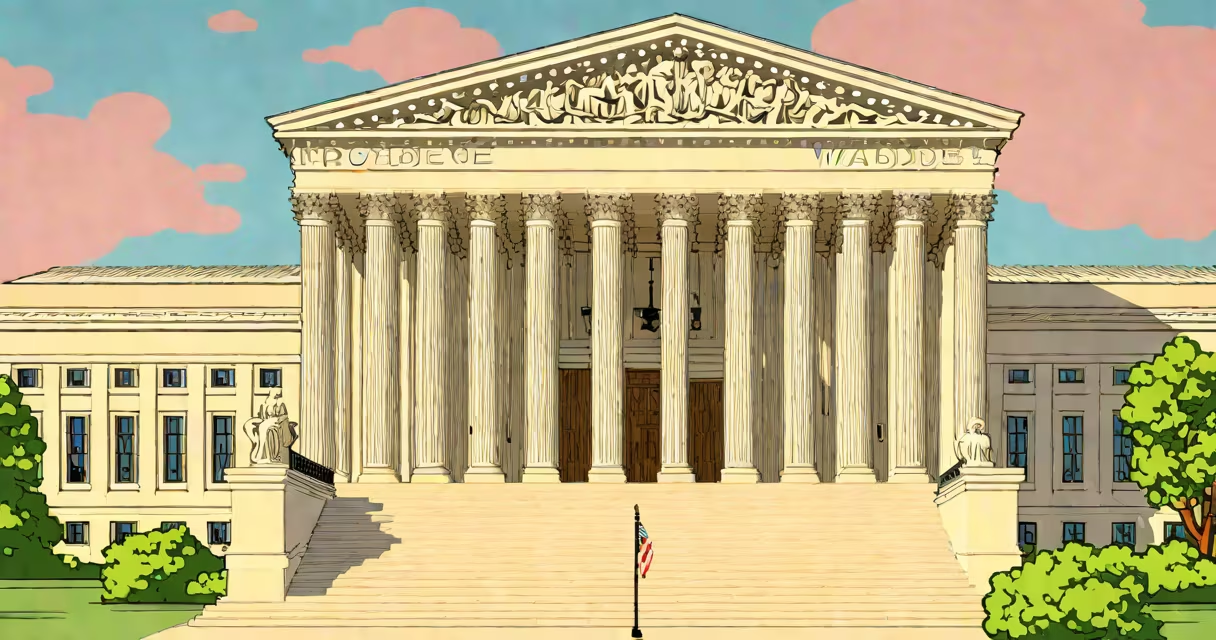
Roe v Wade (1973) is a landmark U.S. Supreme Court decision that recognized a woman's constitutional right to terminate a pregnancy during the first trimester, based on the right to privacy under the Fourteenth Amendment. The ruling invalidated state laws banning abortion and set a precedent that shaped reproductive rights for nearly 50 years.
The case originated when Norma McCorvey, using the pseudonym "Jane Roe," challenged Texas's strict abortion laws. She argued that the state's ban violated her right to privacy. The Court ruled 7-2 in favor of McCorvey, establishing that states could not prohibit abortions in the first trimester. After viability-typically around 24 weeks-states could regulate or ban abortions to protect fetal life, provided exceptions existed for the mother's health and life.
This decision was grounded in the concept of substantive due process, which holds that certain fundamental rights exist beyond those explicitly listed in the Constitution. The Court found that the right to privacy extended to a woman's choice to have an abortion, though it did not define the right as absolute. The ruling applied only to state laws restricting abortion and left room for federal and state regulation in later stages of pregnancy.
Roe v Wade created a trimester structure to balance a woman's rights against state interests in protecting potential life. During the first trimester, states could not interfere with a woman's decision to end a pregnancy. In the second trimester, states could impose regulations related to maternal health. By the third trimester, states could ban abortion unless necessary to save the mother's life or health.
The structure was designed to reflect medical realities. Early pregnancy involves minimal risk to the mother, while later stages involve greater physical and emotional consequences. The Court acknowledged that viability-the point at which a fetus can survive outside the womb-was the critical threshold for state regulation. Advances in neonatal care pushed viability earlier, from 28 weeks in 1973 to approximately 24 weeks by the 2000s.
States responded by passing laws targeting late-term procedures, such as bans on dilation and evacuation (D&E) after 20 weeks. These laws were often challenged in court, with the Supreme Court upholding some restrictions under the "undue burden" standard established in Planned Parenthood v Casey (1992).
Roe v Wade rested on two core legal principles: the right to privacy and the doctrine of substantive due process. The Court interpreted the Due Process Clause of the Fourteenth Amendment-not just procedural fairness, but the protection of fundamental liberties. The justices concluded that personal decisions about reproduction fell within this protected domain.
The decision drew from earlier rulings, including Griswold v Connecticut (1965), which affirmed a married couple's right to use contraception. That case established that privacy rights extend to intimate decisions, laying groundwork for Roe. The Court in Roe cited Griswold as precedent, stating that the right to privacy was broad enough to include choices about childbearing.
However, the opinion did not rely solely on privacy. It also referenced the evolving understanding of liberty and autonomy in American jurisprudence. The justices emphasized that the Constitution protects individual freedom in matters of personal identity and bodily integrity, especially when those freedoms affect deeply private choices.
| Trimester | State Regulation Authority | Medical Context |
|---|---|---|
| First (0-12 weeks) | None | Fetal viability not reached; low risk to mother |
| Second (13-24 weeks) | Limited, for maternal health | Increased risk; fetal development accelerates |
| Third (>24 weeks) | Can ban, except to preserve life/health | Viability achieved; ethical and medical weight shifts |
Roe v Wade became the foundation for abortion access across the United States. Between 1973 and 2022, over 60 million abortions occurred in the U.S., with most performed legally under Roe's structure. The decision influenced state legislation, judicial interpretations, and public health policies related to reproductive care.
After Roe, states enacted varying levels of abortion regulation. Some passed targeted regulation of abortion providers (TRAP) laws, requiring clinics to meet hospital-like standards. These laws were often struck down as placing an undue burden on access. For example, in 2016, the Supreme Court ruled in Whole Woman's Health v Hellerstedt that Texas's TRAP laws violated the constitutional right to abortion.
Despite the ruling, access remained uneven. Rural areas often lacked providers, and financial barriers persisted. In 2014, the CDC reported that 92% of U.S. counties had no clinic offering abortion services. This disparity meant that even with legal rights, many women faced practical obstacles to care.
A widespread misunderstanding is that Roe v Wade legalized abortion nationwide. The decision did not create a universal right-it limited state power to ban early abortions. It did not require states to fund abortions or mandate coverage through insurance. Medicaid funding for abortion remains restricted in most states, except in cases of rape, incest, or life endangerment.
Another error is assuming the ruling protected all forms of abortion equally. The decision focused on elective termination in early pregnancy. Late-term procedures, particularly after viability, remain subject to stricter scrutiny. The Court in Planned Parenthood v Casey reaffirmed that states may regulate late-term abortions if they do not impose an "undue burden" on access.
Roe did not address the rights of minors. State laws often require parental consent or judicial bypass for minors seeking abortions. These requirements were upheld in Bellotti v Baird (1979), where the Court ruled that minors could obtain abortions with court approval if they demonstrated maturity or if the procedure was in their best interest.
In June 2022, the Supreme Court overturned Roe v Wade in Dobbs v Jackson Women's Health Organization. The majority opinion, authored by Justice Samuel Alito, stated that the Constitution does not confer a right to abortion. The decision returned authority to regulate abortion to individual states.
Following Dobbs, 14 states enacted near-total bans on abortion, while others expanded access. As of 2024, 19 states have laws restricting abortion after 15 weeks, and 10 states allow abortion only in cases of severe fetal abnormalities or maternal health emergencies. The patchwork of state laws has led to significant disparities in access, with patients traveling across state lines for care.
For example, in 2023, a woman in Texas traveled 1,200 miles to receive an abortion after a fetal anomaly was detected at 22 weeks. Her case highlighted the real-world impact of state-level restrictions. Meanwhile, states like California and New York have codified abortion rights into law, ensuring access regardless of federal changes.
When the Court issued Roe, it was a response to a specific legal challenge. The decision was not a declaration of moral or social policy but a constitutional interpretation. The reversal in Dobbs reflects a shift in judicial philosophy-one that prioritizes originalism and textualism over precedent and evolving societal norms.
I observed the immediate aftermath of the Dobbs decision in a clinic in Mississippi. Within days, the facility closed despite being licensed and staffed by certified providers. Patients who had planned appointments were redirected to neighboring states. One patient, a 23-year-old teacher, canceled her appointment after learning she would need to travel 400 miles to reach a provider. Her story illustrates how legal change translates into tangible barriers to care.
Consider a 28-year-old woman in Indiana who discovered a fatal fetal condition at 26 weeks. Under Indiana law, she could not obtain an abortion after 20 weeks. She underwent a medically induced labor at 28 weeks, resulting in a stillbirth. Her case exemplifies the human cost of restrictive laws and the absence of a federal right to abortion.
Understanding what Roe v Wade means requires recognizing both its historical significance and its current irrelevance. The decision shaped reproductive rights for decades, but its legacy now exists in the legal battles over state laws and the movement of patients across borders. The right to choose is no longer guaranteed by the Constitution-but it remains central to debates over autonomy, health, and equality.