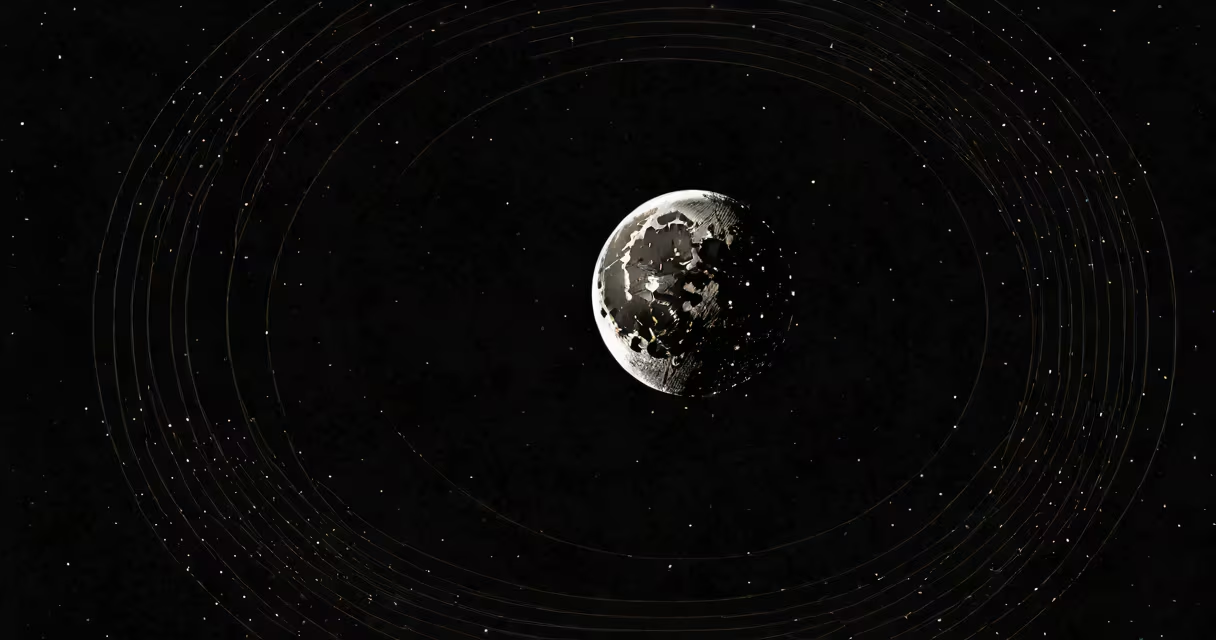
The new moon marks the start of a lunar cycle, occurring when the Moon is positioned between Earth and the Sun, rendering it invisible from Earth due to lack of reflected sunlight. This phase signifies renewal, quiet introspection, and the seeding of new intentions.
During the new moon, the Moon's illuminated side faces away from Earth, creating a period of invisibility. This absence is not emptiness-it's a time of internal gathering. Ancient cultures across Mesopotamia, Mesoamerica, and the Mediterranean observed this phase as sacred, often marking it with rituals to honor the unseen forces shaping life.
Modern astrology and spiritual practice continue this tradition. The new moon is seen as a cosmic reset button. It's not about immediate results-it's about planting seeds. You set goals, reflect on values, and prepare mentally for the month ahead. The energy is subtle, not loud, making it ideal for journaling, meditation, or silent intention-setting.
Astronomically, the new moon occurs when the Moon's orbital position aligns with the Sun relative to Earth. This alignment happens roughly every 29.5 days-the length of a synodic month. At this point, the Moon is in conjunction with the Sun, meaning both celestial bodies share the same ecliptic longitude.
Because the Moon reflects sunlight, its dark side faces Earth during this phase. No direct illumination reaches our planet, so the Moon appears invisible. This is not a solar eclipse-eclipses require precise alignment and occur only when the Moon crosses the ecliptic plane at the right moment.
After the new moon, the Moon begins to wax. A sliver becomes visible in the western sky shortly after sunset. This gradual return mirrors the slow emergence of ideas, plans, and emotional clarity. The waxing phase builds momentum toward the full moon, which occurs around 14 days later.
Different traditions interpret the new moon through unique lenses. In Hinduism, the new moon (Amavasya) is a day of fasting and ancestor worship. It's believed that ancestral spirits are most accessible during this time. In Islam, the sighting of the new moon determines the start of each lunar month, including Ramadan and Eid al-Fitr.
Western esoteric systems like astrology assign zodiac signs to new moons. For example, a new moon in Aries may inspire bold action and personal assertion. A new moon in Cancer might focus attention on home, family, and emotional safety. These placements influence how energy manifests during the month.
| Culture/Tradition | Interpretation | Practices |
|---|---|---|
| Hinduism | Time for honoring ancestors | Fasting, offering food, prayer at riverbanks |
| Islam | Start of lunar months | Sighting the crescent moon to begin Ramadan |
| Wicca & Modern Paganism | Seed planting, intention setting | Meditation, ritual circles, journaling |
| Traditional Chinese | Beginning of lunar calendar months | Family gatherings, ancestral offerings |
One common misunderstanding is equating the new moon with "nothingness." In reality, it's fertile ground. The darkness allows space for growth. As the poet Rumi wrote, "The wound is the place where the light enters." The new moon is that wound-open, receptive, waiting.
Many people mistake the new moon for a lunar eclipse. They're entirely different. A lunar eclipse occurs during a full moon when Earth passes between the Sun and Moon, casting a shadow. A new moon is not an eclipse-it's simply the Moon's position blocking sunlight from reaching Earth-facing surfaces.
Another error is assuming the new moon brings immediate change. It doesn't. The energy is preparatory. Think of it like planting a seed. You don't see roots or shoots overnight. But the groundwork is laid. According to NASA's Solar System Exploration site, the Moon's orbit averages 384,400 km from Earth, and its phases are predictable using mathematical models based on orbital mechanics.
Some spiritual guides claim you must perform rituals every new moon. That's not required. Consistency matters more than ritual formality. Whether you write a single sentence in a notebook or light a candle, the act of intention matters more than the method.
In March 2024, the new moon occurred on March 10 at 11:04 UTC. It was in the sign of Pisces, a water sign associated with intuition, dreams, and compassion. A person using this phase for personal planning might write:
"I commit to listening more deeply this month. I will pause before responding in conversations. I will notice my emotions without judgment. I will explore creative writing as a way to process feelings."
This intention is not about achieving results-it's about shifting focus. Over the next 29.5 days, as the Moon waxes, the person may notice increased empathy, better communication, or new ideas emerging. The outcome isn't guaranteed, but the alignment of mindset with lunar timing creates a structure for growth.
I've used this method for six years. During a difficult period in 2020, I wrote: "I am learning to trust my body's signals." I didn't expect healing-but over the following weeks, I began noticing patterns in fatigue, mood, and diet. By the time of the next new moon, I had reduced anxiety-related habits and improved sleep. The Moon didn't fix me. But it gave me a rhythm to track progress.
Observing the Moon's cycle connects us to ancient rhythms. The new moon isn't just a date on a calendar-it's a signal to pause, reflect, and begin anew. Its true power lies not in spectacle, but in stillness.