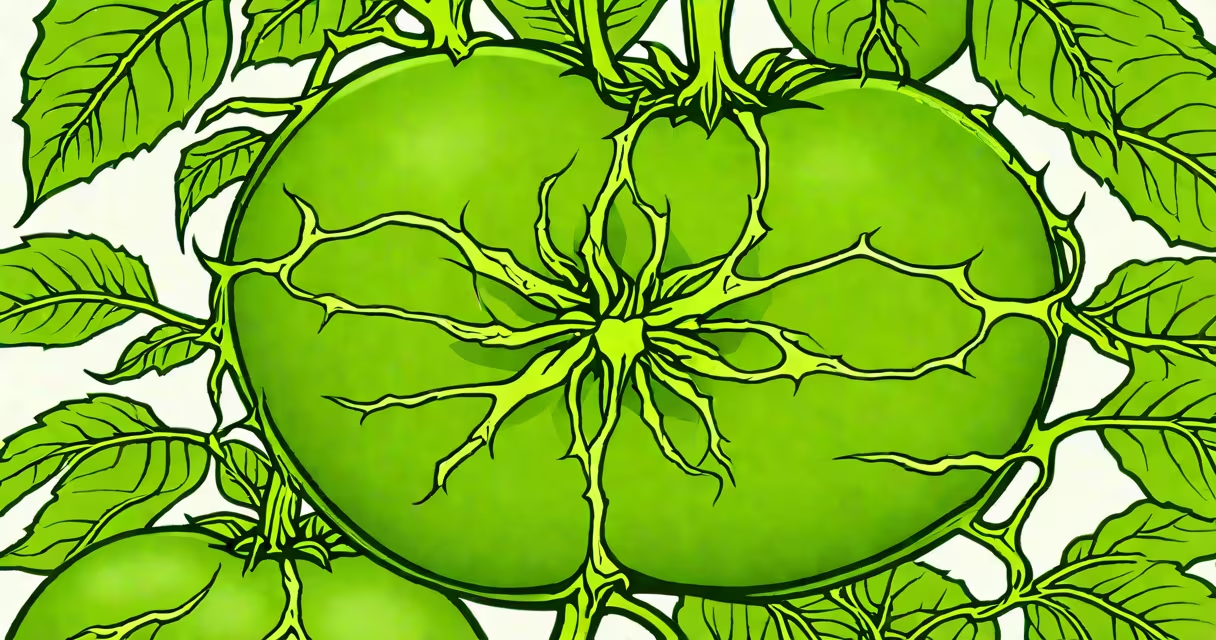
A plant stem is the central axis of a plant that supports leaves, flowers, and fruits while transporting water, minerals, and sugars between roots and shoots. It forms the structural structure of most vascular plants and enables upward growth toward sunlight.
Stems emerge from the shoot apical meristem and develop through cell division and elongation. They house vascular tissues-xylem and phloem-that move resources throughout the plant. Stems may be herbaceous (soft and green) or woody (rigid and bark-covered), depending on species and life cycle.
Stems grow in response to environmental cues such as light (phototropism), gravity (gravitropism), and touch (thigmomorphogenesis). Their internal organization varies: monocots have scattered vascular bundles, while dicots arrange them in a ring around the pith.
Plant stems function as conduits and structural elements. Water absorbed by roots travels upward through xylem vessels, which are dead cells with thick, lignified walls that resist collapse under tension. This process relies on transpiration pull-the evaporation of water from leaf surfaces creates negative pressure that draws water up from the soil.
Sugars produced during photosynthesis in leaves move downward through phloem sieve tubes. These living cells transport organic compounds to growing areas, storage organs like tubers, or reproductive structures. Phloem transport occurs via pressure flow, driven by osmotic gradients created by sugar loading and unloading.
Stems also store food and water. Succulents like *Euphorbia obesa* have thick, fleshy stems that hold moisture during drought. Some stems, such as those in potatoes (*Solanum tuberosum*), form modified underground structures called tubers that serve as energy reserves.
Stems vary widely in form and function. The following table outlines major categories based on growth habit and modification:
| Type | Characteristics | Examples |
|---|---|---|
| Herbaceous | Soft, green, temporary growth; die back annually | Corn, sunflower, basil |
| Woody | Rigid, lignified; persist for multiple years | Oak tree, rose bush, pine |
| Modified | Adapted for storage, defense, or reproduction | Potato (tuber), cactus (cladode), strawberry (stolon) |
| Underground | Subterranean; often lack chlorophyll | Onion bulb, ginger rhizome |
Nodes are points along the stem where leaves attach. Internodes are the segments between nodes. The arrangement of leaves at nodes-opposite, alternate, or whorled-varies by species and influences light capture efficiency. For example, *Impatiens walleriana* displays opposite leaf pairs, maximizing light exposure in shaded understory habitats.
Stems may also exhibit specialized features. Thorns in *Rosa rugosa* are modified stems that deter herbivores. In *Cactaceae*, flattened stems replace leaves entirely to reduce water loss in arid environments.
Many assume that all stems are upright and green. This is incorrect. Underground stems like rhizomes and tubers are important for vegetative propagation and nutrient storage. A potato is not a root-it's a modified stem with nodes and buds capable of forming new plants.
Another misconception is that stems only support growth. In reality, they participate in photosynthesis. Green stems in *Chenopodium quinoa* contribute to carbohydrate production, especially in young plants where leaf area is limited.
According to the *Encyclopedia of Plant Anatomy* (Springer, 2017), stem anatomy is highly adaptive. For instance, the stem of *Pandanus* species develops prop roots and aerial roots that stabilize the plant in unstable soils, demonstrating how stems integrate with other systems for survival.
In a 2020 study published in *Plant Physiology*, researchers measured stem hydraulic conductivity in 12 species of desert shrubs. They found that *Larrea tridentata* (creosote bush) maintains high xylem efficiency even under prolonged drought, thanks to dense, narrow vessel elements that resist embolism formation.
I observed this firsthand while collecting samples in the Mojave Desert. When I cut a cross-section of a creosote stem, the xylem appeared dark and tightly packed-visible evidence of evolutionary adaptation to extreme dryness.
For gardeners, understanding stem structure aids in pruning decisions. Removing a stem below a node encourages branching because auxin concentration drops, releasing lateral buds from inhibition. This principle applies to shaping fruit trees and training ornamental vines.
When assessing plant health, stem integrity matters. A split or soft stem indicates disease or pest infestation. Early detection allows timely intervention-such as removing affected parts before rot spreads.
While stems are essential for plant architecture, they differ from roots and leaves in origin and function. Roots anchor plants and absorb water and ions; leaves perform most photosynthesis. Stems bridge these systems.
For those exploring plant biology further, offloading plant stem concepts into computational models reveals patterns in growth dynamics and resource allocation, offering insights into both botany and algorithmic design.
Understanding what a plant stem is involves recognizing its dual role: physical support and internal transport. Its diversity reflects adaptation across ecosystems-from rainforests to deserts-and underscores the complexity of plant life.