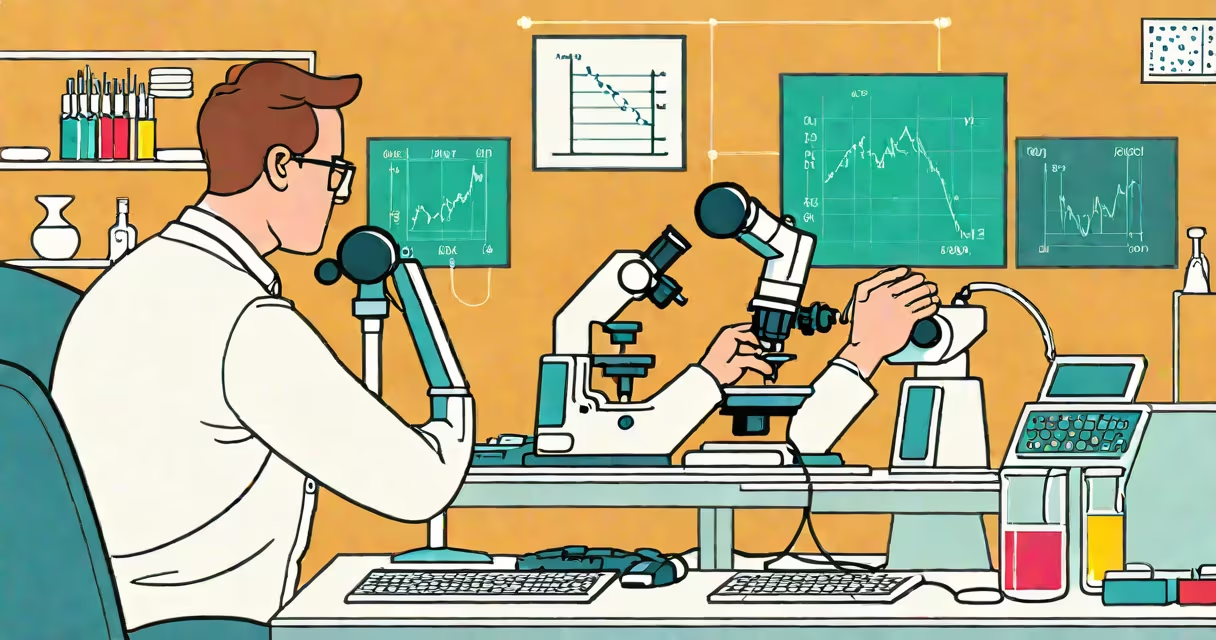
Analytical chemistry is the branch of science focused on identifying what substances are present in a sample and determining how much of each is there. It combines principles from physical, organic, and inorganic chemistry with instrumentation and data analysis to deliver precise results. This field underpins everything from detecting contaminants in drinking water to verifying the purity of pharmaceuticals.
At its core, analytical chemistry answers two fundamental questions: "What is in this sample?" (qualitative analysis) and "How much of it is there?" (quantitative analysis). These answers come through systematic procedures involving sampling, preparation, measurement, and interpretation. Modern analytical chemists rely on tools like mass spectrometers, gas chromatographs, and nuclear magnetic resonance (NMR) machines to detect trace levels of compounds - often down to parts per billion.
The discipline traces its roots to the 18th century, when chemists began developing methods to measure composition accurately. Today, it's essential in industries ranging from food safety to forensic science. For example, when a blood test reveals elevated glucose levels, it's analytical chemistry that ensures the measurement is accurate and reproducible. According to the American Chemical Society, over 60% of laboratory jobs in life sciences involve some form of analytical testing.
Every analytical process begins with a well-defined question. Is a medication free of impurities? Is a soil sample contaminated with lead? The analyst selects a method based on the analyte (substance being measured), matrix (sample environment), required sensitivity, and available equipment. The process then follows a sequence: sample collection, preparation, analysis, and result validation.
Sample preparation is critical. A raw urine sample cannot be injected directly into a mass spectrometer. It must be filtered, diluted, and sometimes derivatized to improve detection. Even small errors in this step can skew results. For instance, incomplete extraction of a pesticide from a fruit peel may lead to false negatives during food safety screening.
Once prepared, the sample enters the instrument. A liquid chromatograph separates components based on their affinity to a stationary phase. As each compound elutes, a detector records its presence. Data from thousands of measurements are processed using algorithms to generate a chromatogram - a graph showing peaks corresponding to individual compounds. Analysts identify substances by comparing retention times and spectral patterns to known standards.
Several major categories define the tools used in analytical chemistry. Each serves different purposes depending on the nature of the sample and the required precision.
| Method | Best For | Example Application | Limitations |
|---|---|---|---|
| Gas Chromatography-Mass Spectrometry (GC-MS) | Volatiles, organics | Detecting THC in hair samples for drug testing | Requires vaporizable compounds; not ideal for large biomolecules |
| High-Performance Liquid Chromatography (HPLC) | Polar or thermally unstable compounds | Measuring insulin concentration in patient serum | Slower than GC; requires high-pressure pumps |
| Atomic Absorption Spectroscopy (AAS) | Metal ions in solution | Testing for arsenic in groundwater near mining sites | Limited to single-element analysis; low throughput |
| Nuclear Magnetic Resonance (NMR) | Molecular structure elucidation | Confirming the identity of a newly synthesized drug candidate | Expensive; requires isotopically enriched samples for some applications |
Each technique has trade-offs between speed, cost, sensitivity, and complexity. For example, while NMR provides detailed structural information, it demands highly trained operators and expensive hardware. In contrast, colorimetric assays - which rely on visible color changes - are quick and cheap but less accurate for complex mixtures.
A lesser-known fact: many analytical methods were developed during World War II for military purposes. GC-MS was initially used to analyze fuel composition and detect explosives. After the war, these tools were adapted for civilian use in forensics and environmental monitoring. This history explains why some labs still use legacy protocols despite newer alternatives.
Many people assume analytical chemistry is synonymous with lab work involving beakers and pipettes. While hands-on tasks exist, modern analytical chem is heavily automated and data-driven. A typical day involves validating software algorithms, calibrating instruments, and interpreting statistical outputs - not just mixing solutions.
Some also mistake analytical chemistry for quality control. While QC uses analytical methods, it focuses on pass/fail checks during manufacturing. Analytical chem goes further - it investigates root causes of deviation, validates new methods, and supports regulatory submissions. For example, when a batch of vaccine fails potency testing, analytical chemists determine whether degradation occurred due to storage conditions or formulation flaws.
In 2008, Chinese infant formula was contaminated with melamine, a toxic industrial compound added to falsely inflate protein content readings. Standard tests measured nitrogen levels, assuming higher nitrogen meant more protein. Melamine contains nitrogen, so it tricked the system.
Standard Kjeldahl testing failed because it couldn't distinguish between nitrogen from proteins and nitrogen from melamine. Analytical chemists stepped in using LC-MS/MS - a tandem mass spectrometry method capable of separating and identifying melamine at concentrations below 1 ppm. This test became the gold standard for food safety globally.
After the scandal, regulators worldwide adopted stricter analytical protocols. The U.S. FDA now mandates multi-method screening for adulterants in dairy products. Without advanced analytical techniques, such contamination might go undetected until widespread harm occurs.
My own experience confirms this: during a summer internship at a food testing lab, I helped validate a new HPLC method for detecting acrylamide in fried potatoes. We ran over 120 samples, compared results against certified reference materials, and adjusted column temperature and flow rate to reduce baseline noise. The final method achieved a detection limit of 0.1 μg/kg - far below the EU safety threshold of 1.0 μg/kg.
What is analytical chem? It's the science of making precise, reliable measurements of chemical composition. From ensuring clean water to developing life-saving drugs, it delivers evidence-based insights that protect public health and advance innovation. Its methods are rigorous, its standards high, and its impact measurable. Whether in a hospital, factory, or research institute, analytical chemistry remains indispensable.