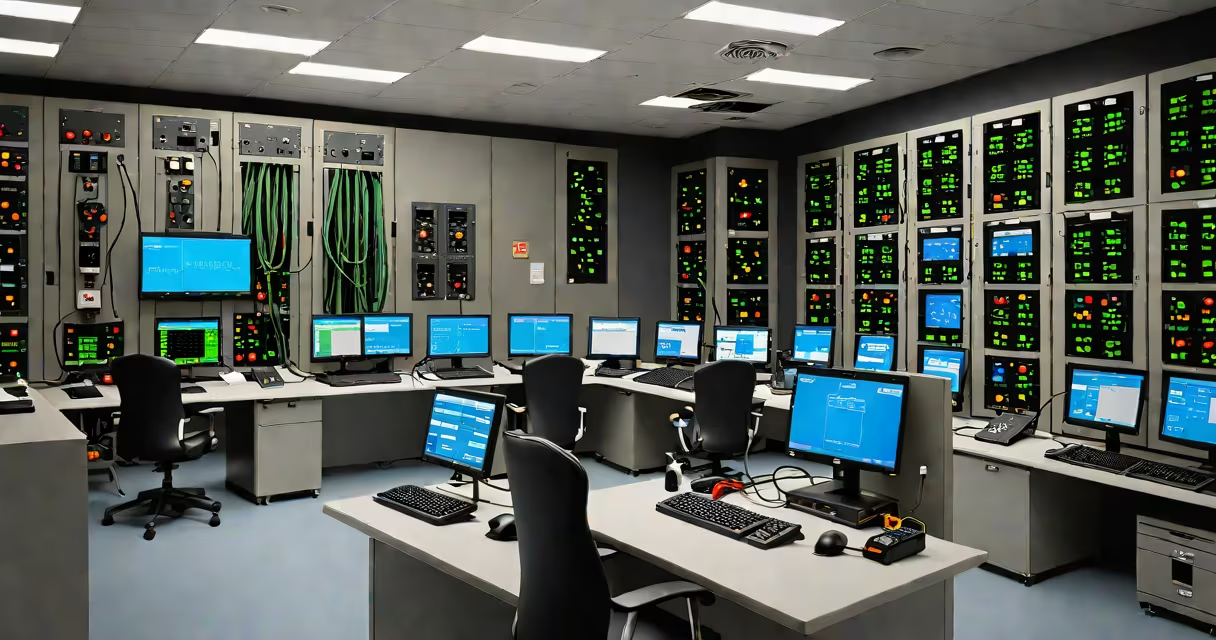
IEC 61850 is an international standard developed by the International Electrotechnical Commission that defines communication protocols, data models, and configuration methods for intelligent electronic devices (IEDs) in electrical power substations. It enables smooth interoperability between protection, control, and monitoring systems from multiple vendors, replacing proprietary interfaces with a unified structure based on Ethernet and standardized data structures.
The standard was first published in 2003 and has since evolved through multiple editions, with the latest version released in 2023. It supports both real-time control and non-real-time monitoring functions within a single network infrastructure. Its core purpose is to reduce integration complexity, improve system reliability, and enable faster commissioning of digital substations.
IEC 61850 operates on a layered architecture that separates application logic from communication transport. Devices implement a common data model using the Abstract Communication Service Interface (ACSI), which defines how data is accessed and manipulated regardless of the underlying network protocol.
Data exchange happens via two primary mechanisms: Sampled Values (SV) for high-speed analog measurements like current and voltage, and Generic Object-Oriented Substation Event (GOOSE) messages for fast, time-critical control signals such as circuit breaker trips. These messages are transmitted over Ethernet networks with guaranteed timing accuracy, often synchronized using IEEE 1588 Precision Time Protocol (PTP).
For example, when a fault occurs on a transmission line, a protective relay detects the abnormal current and sends a GOOSE command to trip the circuit breaker within 4 milliseconds. This event is logged in the substation's event recorder and may trigger remote alarms or automatic reconfiguration of the grid. All these actions are coordinated through IEC 61850-compliant messaging.
At the heart of IEC 61850 is the concept of a Substation Configuration Language (SCL), an XML-based format used to describe device behavior, network topology, and communication parameters. SCL files define the Logical Nodes (LNs) that represent functional units within a device-such as protection functions, metering, or control circuits-and map them to specific data objects.
Each logical node follows a naming convention: for instance, XCBR represents a circuit breaker, XSWI stands for a switchgear element, and PTRC denotes a protection relay. These identifiers allow engineers to build consistent configurations across different manufacturers' equipment. A single SCL file can define an entire substation's communication setup, including VLAN assignments, IP addresses, and multicast groups.
| Component | Purpose | Example Use Case |
|---|---|---|
| GOOSE | Fast, deterministic signaling for protection and control | Circuit breaker trip command during a line fault |
| Sampled Values (SV) | High-resolution analog data streaming | Real-time phasor measurement for stability analysis |
| SCL Files | Configuration and interoperability specification | Importing settings into a new relay from vendor A into a system with devices from vendor B |
IEC 61850 is now the de facto standard for new digital substations worldwide. Utilities in North America, Europe, Asia, and Australia have adopted it for both new installations and retrofits of existing facilities. Major projects include the U.S. Department of Energy's Grid Modernization Initiative and the European Network of Transmission System Operators for Electricity (ENTSO-E) smart grid programs.
Its adoption reduces lifecycle costs by simplifying maintenance, enabling remote diagnostics, and supporting predictive analytics. For example, a utility in Germany reported a 30% reduction in commissioning time for new substations after switching to IEC 61850-based engineering tools. Another study by the IEEE Power & Energy Society found that IEC 61850-compliant systems had 40% fewer configuration errors compared to legacy systems.
Despite its benefits, implementation requires careful planning. Engineers must validate network performance under peak load conditions, ensure proper segmentation of traffic, and enforce strict cybersecurity policies. The standard includes security profiles, but many utilities still rely on physical separation and access controls due to concerns about cyber threats to critical infrastructure.
One widespread misunderstanding is that IEC 61850 is solely about Ethernet networking. While it uses Ethernet as the transport layer, its value lies in the semantic structure of data-not just the speed of transmission. Two devices speaking the same protocol can still fail to interoperate if their data models aren't aligned.
Another misconception is that IEC 61850 eliminates the need for custom integration. In reality, it reduces integration effort but doesn't eliminate it. Configuration differences between vendors' implementations-especially around timing, redundancy, and error handling-still require testing and validation. A project in Ontario encountered delays because one manufacturer's GOOSE timeout setting differed from the expected 10ms window, causing false tripping during testing.
A lesser-known fact is that IEC 61850 supports backward compatibility through profile-based subsets. For example, IEC 61850-9-2 is a subset optimized for sampled values over Ethernet, while IEC 61850-8-1 defines the mapping of ACSI services onto MMS (Manufacturing Message Specification). These profiles allow phased rollouts and coexistence with older systems.
Consider a 115 kV substation with two incoming lines, one transformer, and two outgoing feeders. The goal is to integrate protective relays, circuit breakers, and a supervisory control and data acquisition (SCADA) system using IEC 61850.
This process typically takes 2-3 days for a medium-sized substation using automated tools. Without IEC 61850, the same task would require manual wiring diagrams, custom scripts, and extensive field testing.
During my work on a 230 kV substation upgrade in Texas, we used IEC 61850 to integrate three different relay brands-Siemens, ABB, and Schneider Electric-into a single control system. After importing the SCL files and validating the GOOSE and SV flows, we achieved full functionality with no hardware modifications. The project completed six weeks ahead of schedule.
IEC 61850 continues to evolve with new editions addressing cloud integration, edge computing, and enhanced cybersecurity. As grids grow smarter and more interconnected, this standard remains essential for building resilient, scalable, and secure power systems.