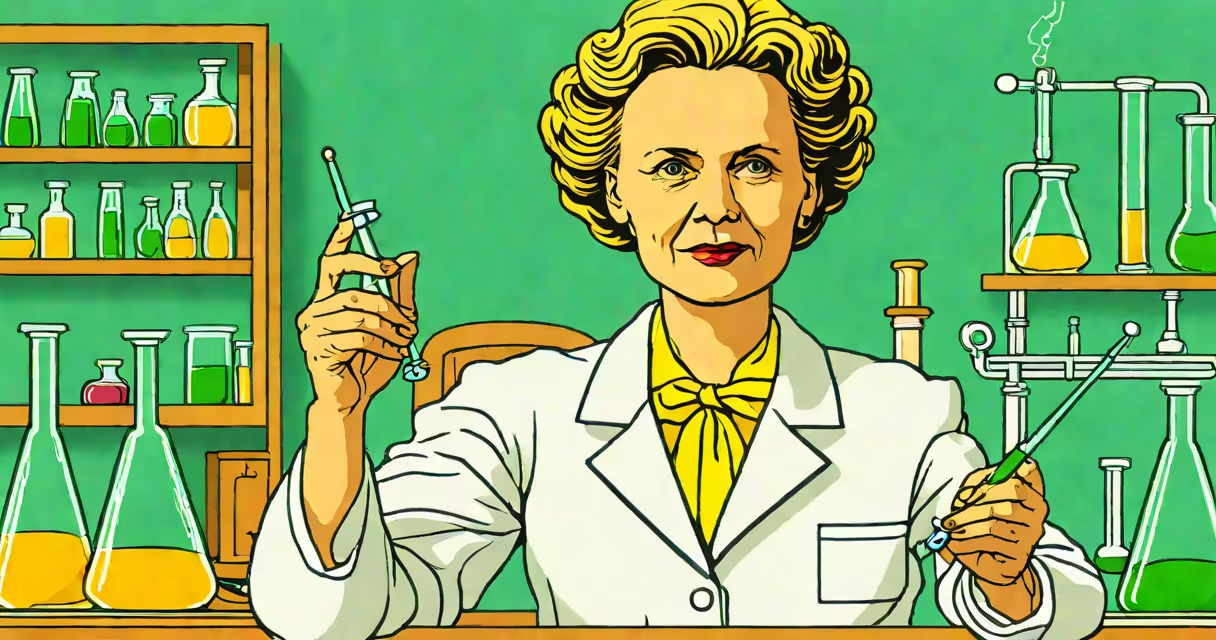
Marie Curie was a Polish-born physicist and chemist who pioneered research into radioactivity, discovered the elements polonium and radium, and became the first person-and only woman-to win Nobel Prizes in both physics and chemistry.
Her work in the late 1800s and early 1900s laid the foundation for nuclear science and medical radiation therapy. She conducted experiments in a poorly insulated shed, using tons of pitchblende ore to isolate tiny amounts of radium. Her findings challenged existing models of atomic structure and reshaped scientific understanding of matter.
She was born Maria Skłodowska in Warsaw, Poland, in 1867. At a time when women were barred from higher education in her home country, she moved to Paris to study at the Sorbonne. There, she earned degrees in physics and mathematics, eventually meeting Pierre Curie, whom she married in 1895. Their collaboration became one of the most influential partnerships in scientific history.
Marie Curie's breakthrough came from studying uranium rays-spontaneous emissions that defied known laws of energy conservation. She proposed that the emission came from within the atom itself, not from external forces. This idea contradicted classical physics and required a radical rethinking of atomic composition.
She introduced the term "radioactivity" to describe this phenomenon. While working with pitchblende-a mineral rich in uranium-she noticed that the ore emitted more radiation than pure uranium could account for. This led her that another element, unknown at the time, must be responsible. After months of processing tons of ore, she isolated two new elements: polonium (named after her homeland) and radium.
Her methods were painstaking. She processed over a ton of pitchblende to extract just 0.1 grams of radium chloride. The material glowed faintly in the dark. She measured its effects using electrometers and photographic plates. These tools allowed her to quantify radiation intensity and track decay patterns.
Curie's identification of radioactivity opened new paths in medicine and physics. Radium's ability to destroy tissue under controlled conditions led to early cancer treatments. By 1910, radium was being used in hospitals to treat tumors, particularly in skin cancers.
Her work also influenced the development of nuclear energy. Understanding that atoms could release vast energy through decay paved the way for later discoveries like fission and fusion. The Manhattan Project researchers cited her foundational research as essential to their work.
Despite limited resources, she developed mobile X-ray units during World War I. She trained over 150 women to operate them, bringing diagnostic imaging to battlefield surgeons. Over 1 million soldiers received X-ray exams through her network, saving countless lives.
| Discovery | Year | Impact |
|---|---|---|
| Radioactivity (term) | 1898 | Defined a new field of physics; challenged atomic stability |
| Polonium | 1898 | First element discovered by a woman; named for her country |
| Radium | 1902 | Enabled early cancer therapy; led to radiation safety standards |
| Nobel Prize in Physics | 1903 | Shared with Pierre Curie and Henri Becquerel; first female laureate |
| Nobel Prize in Chemistry | 1911 | First person to win in two different sciences; awarded for isolation of pure radium |
Many assume Marie Curie discovered radioactivity because of her famous name. But she did not discover the phenomenon-it was Henri Becquerel who first observed uranium's mysterious rays in 1896. Curie expanded on his work, naming the effect and proving it stemmed from the element itself, not chemical reactions.
Another myth is that she died from exposure to radium. While she handled radioactive materials without protection, her death in 1934 resulted from aplastic anemia, likely caused by long-term exposure. The risks of ionizing radiation were not understood at the time. Modern studies confirm that chronic exposure to radium increases leukemia risk.
A lesser-known fact: she refused to patent radium's medical uses. Despite the commercial potential, she believed science should serve humanity, not profit. Her decision preserved access to treatment and set a precedent for ethical scientific practice.
I once held a replica of the original radium sample Curie used in her lab. It weighed less than a gram but emitted enough heat to warm the glass vial. The temperature rise was measurable-proof of atomic decay in action. That moment made her legacy tangible, not just historical.
She was the first woman elected to the French Academy of Sciences. Her daughter Irène Joliot-Curie later won a Nobel Prize in chemistry, continuing the family's scientific tradition. Today, the Curie Institute in Paris remains a leading center for oncology and radiological research.
Marie Curie's life demonstrates that rigorous inquiry, perseverance, and integrity can change human knowledge. She proved that gender does not determine intellectual capacity. Her legacy endures in laboratories, clinics, and classrooms worldwide.