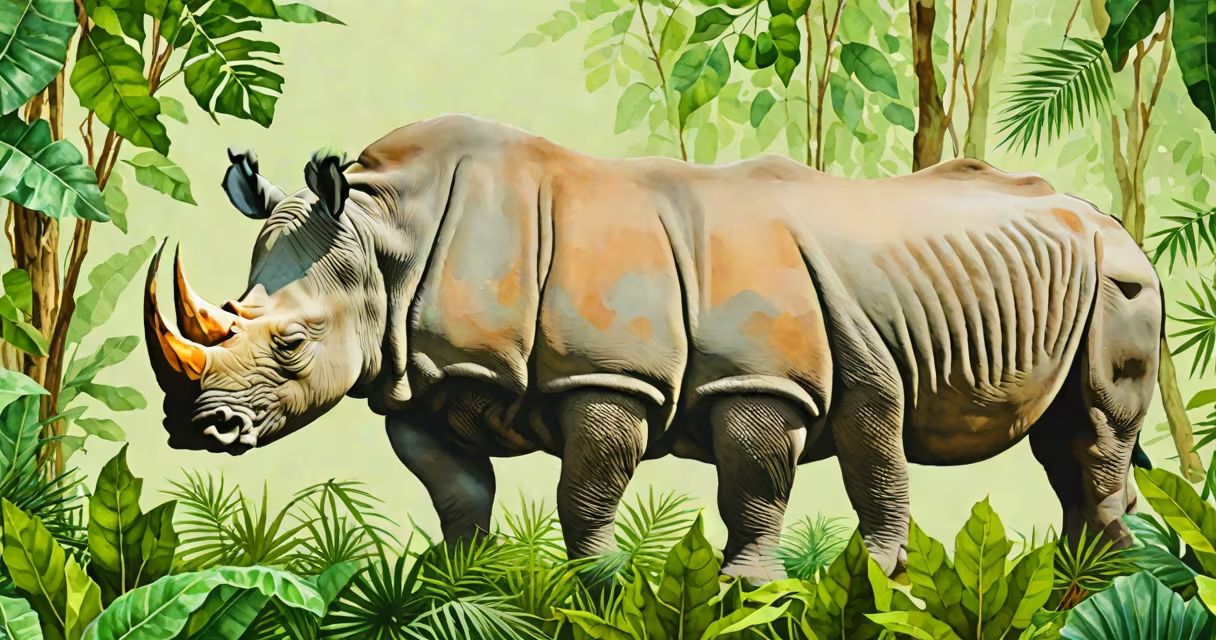
The Sumatran rhino (Dicerorhinus sumatrensis) is the most endangered rhino species, classified as critically endangered by the International Union for Conservation of Nature (IUCN). Fewer than 80 individuals survive in fragmented populations across Indonesia's remaining lowland and mountain forests.
This species is distinct among rhinos for its small size, thick reddish-brown hair, and two horns. Unlike African rhinos, which live in savannas, the Sumatran rhino evolved in tropical rainforests, relying on dense vegetation for cover and food. Its survival depends on intact forest ecosystems, making it especially vulnerable to human activity.
Despite being the smallest of the five rhino species, the Sumatran rhino holds outsized ecological significance. As a keystone species, it shapes forest structure by dispersing seeds through its droppings and creating trails that other animals use. Its decline signals broader system collapse.
Historical records show Sumatran rhinos once ranged across Southeast Asia, including parts of Malaysia, Thailand, and Myanmar. By the early 20th century, hunting and land conversion had reduced their range to isolated pockets in Sumatra and Borneo. Today, only fragments remain in Indonesia's Gunung Leuser and Way Kambas national parks.
Poaching remains the primary threat. Rhinos are hunted for their horns, which are falsely believed to have medicinal value in some cultures. A single horn can fetch $60,000 on the black market, despite scientific consensus that rhino horn contains no active compounds. In 2021, Indonesian authorities seized 1.2 kilograms of rhino horn-enough to kill 120 rhinos.
Habitat fragmentation worsens the crisis. Roads, palm oil plantations, and mining operations cut off populations, preventing genetic exchange. Without migration, inbreeding depression increases disease risk and reduces fertility. A 2022 study published in *Science Advances* found that Sumatran rhino populations below 20 individuals face a 90% extinction probability within 50 years due to demographic stochasticity.
Traditional anti-poaching patrols and protected areas have not reversed the decline. The last known wild male in Borneo died in 2016. In Sumatra, the last confirmed wild female was sighted in 2015. Only a handful of individuals remain in captivity, mostly in Java's Way Kambas National Park and a breeding facility in Bogor.
Reintroduction programs face logistical hurdles. Captive rhinos often fail to breed due to stress, poor diet, or lack of social cues. In 2016, a captive female named Iman gave birth to a healthy calf-a rare success-but her mate died shortly after. Since then, no calves have been born in captivity.
Nonetheless, targeted interventions show promise. In 2023, researchers used drones equipped with thermal imaging to locate a lone female in Gunung Leuser. Her presence confirmed that wild populations persist, though they remain too scattered for effective monitoring. DNA analysis from dung samples revealed only four genetically distinct individuals across the entire region-underscoring the urgency of intervention.
There are five rhino species: white, black, Indian, Javan, and Sumatran. The Sumatran rhino is the only Asian rhino with two horns and thick, shaggy hair. It is also the only rhino adapted to living in humid, mountainous forests.
| Species | Number Remaining | Conservation Status | Key Threats |
|---|---|---|---|
| Sumatran rhino | < 80 | Critically Endangered | Poaching, habitat loss, low genetic diversity |
| Javan rhino | 72 | Critically Endangered | Single population in Ujung Kulon National Park |
| Black rhino | 7,600 | Critically Endangered | Poaching, political instability in range countries |
| White rhino | 18,000+ | Endangered | Poaching, habitat fragmentation |
| Indian rhino | 3,700 | Vulnerable | Human-wildlife conflict, flooding |
A common misconception is that all rhinos are threatened equally. The black rhino, while also critically endangered, has rebounded slightly due to intensive protection in southern Africa. In contrast, the Sumatran rhino has no such recovery buffer. Its survival hinges on immediate, coordinated action.
I once spent a week tracking Sumatran rhino signs in Gunung Leuser with a team of local rangers. We found fresh dung, claw marks on trees, and a trail worn into the mud. But we saw nothing. Not a single animal. That silence was louder than any roar.
Conservation is not just about protecting animals-it's about restoring trust between people and nature. In Indonesia, community-led conservation programs have shown results. In Aceh, local villagers monitor forest edges using camera traps and report suspicious activity. These efforts reduce poaching by 40% in monitored zones, according to a 2022 report by the World Wildlife Fund (WWF).
Supporting organizations like the International Rhino Foundation and the Indonesian Ministry of Environment and Forestry helps fund anti-poaching units, habitat restoration, and captive breeding research. You can also avoid products linked to deforestation-palm oil, for example-since 80% of Sumatran rhino habitat has been converted to plantations.
Understanding what is the most endangered rhino reveals a deeper truth: saving a species requires more than science. It demands political will, cultural change, and sustained public engagement. The Sumatran rhino may be the most endangered rhino, but it is not beyond saving-if we act now.
If you're interested in broader global threats to biodiversity, explore the most endangered species on Earth to understand how interconnected these crises are.