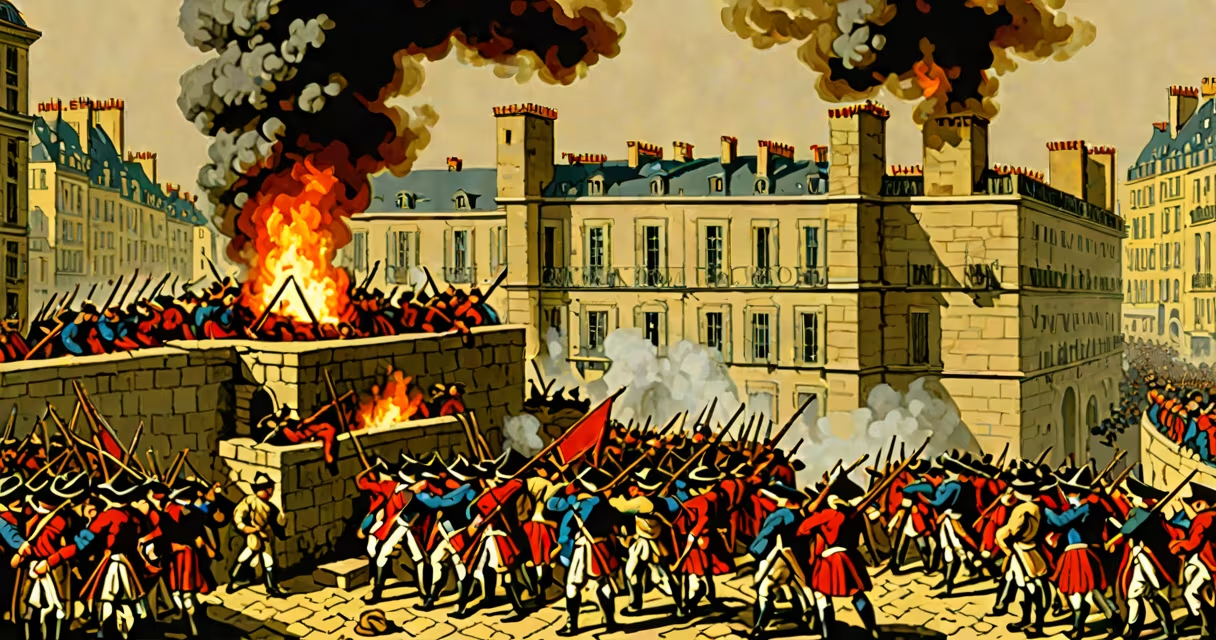
The French Revolution began in 1789, a year marked by the storming of the Bastille on July 14, the adoption of the Declaration of the Rights of Man and of the Citizen, and the abolition of feudal privileges. It ended in 1799 with Napoleon Bonaparte's coup d'état, reshaping France's political and social structure.
France in 1789 was ruled by King Louis XVI under an absolute monarchy. The Third Estate-commoners, artisans, and peasants-had little political power despite making up 98% of the population. Economic strain from war debts, poor harvests, and rising bread prices fueled unrest. The Estates-General convened in May 1789, but disputes over voting rights led the Third Estate to declare itself the National Assembly, asserting popular sovereignty.
On July 14, 1789, a mob stormed the Bastille, a royal fortress and prison symbolizing tyranny. This act became a national holiday, commemorated annually as Bastille Day. The National Assembly then passed the Declaration of the Rights of Man and of the Citizen, enshrining liberty, equality, and fraternity as foundational principles. These events signaled the collapse of monarchical authority and the birth of revolutionary governance.
The French Revolution unfolded in distinct stages, each marked by shifting power dynamics and ideological shifts.
| Phase | Years | Key Events |
|---|---|---|
| Reign of Terror | 1793-1794 | Execution of Louis XVI (January 1793), mass executions under Robespierre's rule, peak of radical Jacobin control |
| Directory | 1795-1799 | Establishment of a five-member executive council, economic instability, military coups |
| Napoleonic Rise | 1799 | Napoleon Bonaparte seized power via coup d'état, ending revolutionary government |
The Reign of Terror, led by Maximilien Robespierre and the Committee of Public Safety, saw over 16,000 people executed by guillotine, including Queen Marie Antoinette. The Revolutionary Tribunal targeted perceived enemies of the Republic. After Robespierre's execution in July 1794, public sentiment shifted toward moderation, leading to the creation of the Directory-a weak executive body that failed to stabilize the nation.
Napoleon Bonaparte, a rising military commander, capitalized on the Directory's failures. In November 1799, he staged a coup, dissolving the legislature and establishing a new constitution. His rise marked the end of the revolutionary period and the beginning of imperial rule.
Revolutionary upheaval stemmed from systemic failures in governance, economy, and social hierarchy. France's national debt reached 2 billion livres by 1789-nearly 10 times annual state revenue-due to costly wars, including support for the American Revolution. The monarchy's inability to reform taxation led to fiscal crisis.
Social inequality was stark. The clergy and nobility (First and Second Estates) held vast land and exemptions from taxes. The Third Estate paid nearly all direct taxes yet had no voice in decision-making. Enlightenment thinkers like Rousseau and Voltaire criticized divine-right monarchy and promoted ideas of human rights and popular sovereignty.
A 1788 drought caused grain shortages, driving bread prices up by 60%. With inflation eroding wages, urban workers and peasants faced starvation. Protests erupted in cities like Lyon and Marseilles before spreading nationwide. The convening of the Estates-General in May 1789 exposed the imbalance-each estate had one vote regardless of size, giving the privileged classes veto power.
Many assume the French Revolution was a single event. In reality, it spanned ten years and included multiple governments: the National Assembly, the Legislative Assembly, the National Convention, the Directory, and finally Napoleon's Consulate. The revolution did not end with the execution of Louis XVI-it evolved through competing factions and ideologies.
Another myth is that the revolution was purely violent. While violence escalated during the Reign of Terror, early phases focused on legal and constitutional change. The Declaration of the Rights of Man and of the Citizen drew from the U.S. Declaration of Independence and the Virginia Declaration of Rights, emphasizing universal rights over divine or hereditary authority.
Some believe the revolution was solely driven by the masses. But key figures like Mirabeau, Lafayette, and Robespierre were members of the elite who advocated reform. The revolution was both a popular uprising and a struggle among intellectual and political elites.
On July 14, 1789, a crowd of 7,000 Parisians marched on the Bastille, a fortress used as a prison and armory. They demanded arms and gunpowder to defend the city. Governor de La Bastille refused entry. After hours of standoff, the mob breached the gates using explosives and captured the prison. They freed the seven prisoners inside-four forgers, two political dissidents, and one nobleman accused of insanity.
The fall of the Bastille became a symbolic act of resistance. Its destruction was celebrated across France. Today, July 14 remains France's national day, marked by military parades, fireworks, and public festivities. The event exemplifies how a physical site became a political icon overnight.
I witnessed the scale of this symbolism firsthand during a visit to the Musée de la Révolution Française in Vizille. A reconstructed model of the Bastille shows the precise angles of attack and the sequence of breaches. The museum displays original documents, including a letter from a revolutionary guard describing the chaos of the assault.
The French Revolution inspired democratic movements worldwide. The Haitian Revolution (1791-1804) was directly influenced by French revolutionary ideals, leading to the first Black republic. In Latin America, Simón Bolívar cited the French Revolution as a model for independence from Spain.
Modern concepts like secularism, citizenship rights, and public education originated in post-revolutionary France. The Napoleonic Code, enacted in 1804, codified many revolutionary principles into law-equality before the law, property rights, and religious freedom.
According to the BBC History, "The French Revolution transformed Europe's political field and laid the foundation for modern democracy." The British Museum notes that the revolution "redefined the relationship between state and citizen, replacing divine right with popular consent."
Understanding when the French Revolution began-1789-is essential to tracing its impact. The revolution did not emerge overnight. It was the culmination of decades of economic strain, intellectual ferment, and social tension. Its legacy persists in constitutional law, civil rights, and national identity across continents.