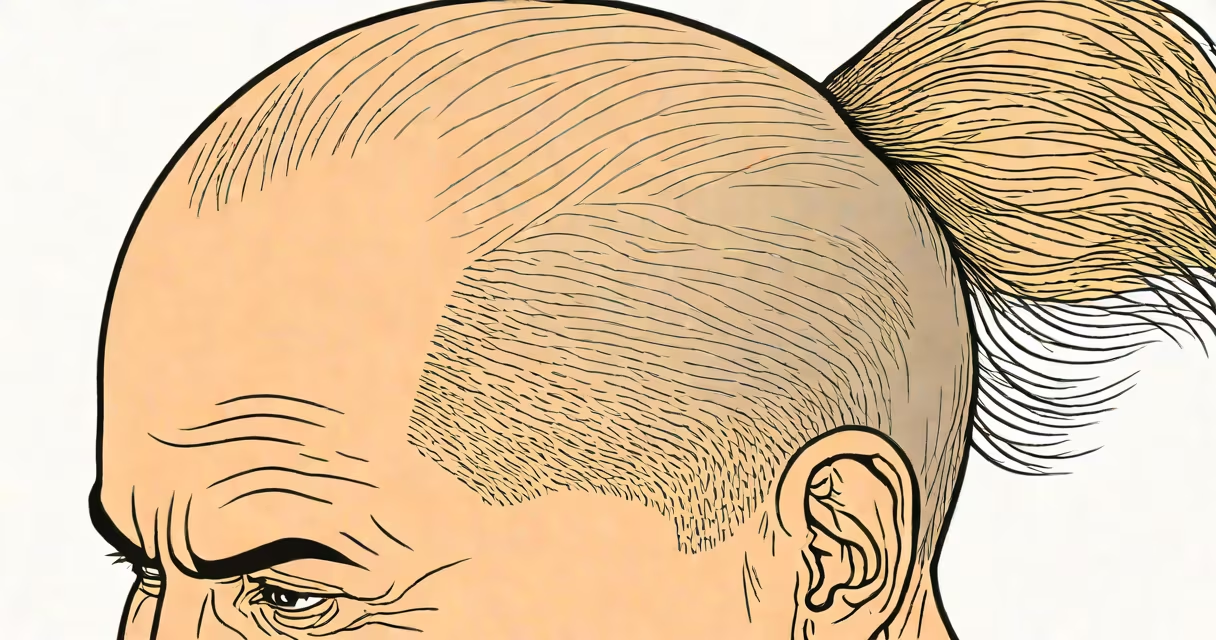
Male baldness, clinically known as androgenetic alopecia, results from a combination of inherited genetic sensitivity to dihydrotestosterone (DHT) and progressive hair follicle miniaturization. This condition affects approximately 50% of men by age 50, with onset typically beginning in the late teens or early twenties.
DHT is a metabolite of testosterone formed by the enzyme 5-alpha-reductase. In genetically predisposed individuals, DHT binds to androgen receptors in scalp hair follicles, triggering a process called follicular miniaturization. Over time, this reduces the size and lifespan of terminal hair follicles, leading to progressively finer, shorter hairs until the follicle becomes dormant and stops producing visible hair.
The most common pattern is a receding hairline and thinning at the crown, forming an M-shaped or horseshoe pattern. This distribution follows the density of androgen receptors in the scalp-highest in the frontal and vertex regions, lower in the occipital area. The reason this pattern emerges is due to regional differences in receptor expression, not uniform hormone exposure.
Androgenetic alopecia is polygenic, meaning multiple genes contribute to susceptibility. The AR gene on the X chromosome encodes the androgen receptor. Men inherit one X chromosome from their mother, making maternal family history a stronger predictor than paternal. A man with a father who is bald may still avoid significant hair loss if his mother's side lacks the risk alleles.
Studies show that men with specific single nucleotide polymorphisms (SNPs) in the AR gene have higher receptor affinity for DHT. A 2017 genome-wide association study published in *Nature Communications* identified over 200 loci associated with male pattern baldness, confirming its complex inheritance. Even among identical twins, concordance rates are around 60%, indicating environmental modifiers exist.
Environmental factors such as stress, poor nutrition, and certain medications can accelerate hair loss but do not initiate it independently. For example, chemotherapy drugs cause temporary telogen effluvium-a shedding phase-but do not lead to permanent baldness unless the individual already has genetic susceptibility.
When DHT binds to the androgen receptor in a susceptible follicle, it activates intracellular signaling pathways that shorten the anagen (growth) phase of the hair cycle. Normally, anagen lasts 2-6 years. In affected follicles, it can drop to less than one year. As cycles shorten, each regrowth phase produces thinner, weaker hairs.
Eventually, the follicle enters a state of prolonged catagen (regression) and telogen (resting) phases. The follicle shrinks to a dermal papilla that can no longer support a visible hair shaft. Histological analysis shows these follicles resemble vellus (fine, unpigmented) hairs, even though they were once terminal.
A 2021 study in *The Journal of Investigative Dermatology* demonstrated that DHT increases expression of Wnt inhibitors in dermal papilla cells. Since Wnt signaling is essential for follicle stem cell activation, suppressing it halts regeneration. This provides a molecular explanation for why hair loss is irreversible without intervention.
Male baldness is not caused by frequent shampooing, hat-wearing, or poor hygiene. These myths persist despite evidence from dermatology journals. A 2019 review in *Dermatologic Clinics* confirmed that daily washing does not affect hair loss progression.
Another widespread error is equating baldness with aging. While hair thinning often begins in adulthood, it is not a normal consequence of getting older. Men in their 20s with severe hair loss are not "aging prematurely"-they are expressing a genetic trait. Age merely allows time for the phenotype to manifest fully.
Some assume that if a man's father is bald, he will inevitably lose all his hair. That's incorrect. Penetrance varies widely. A man with a strong family history may retain a full head of hair into old age, while others with minimal family history experience early-onset thinning. The variability stems from modifier genes and epigenetic regulation.
Consider a 28-year-old man with a family history of baldness. His father began losing hair at 30, and his maternal grandfather was completely bald by 45. At age 28, he notices a receding hairline and increased shedding during showers. He uses the Norwood scale to assess progression: stage 3.5 indicates early vertex thinning.
He consults a dermatologist who confirms androgenetic alopecia via trichoscopy. The exam reveals short, fine hairs and increased follicular dropout in the frontal region. Blood tests rule out thyroid dysfunction and iron deficiency-anemia is a known cause of diffuse hair loss but not patterned baldness.
His treatment plan includes topical minoxidil 5% twice daily and oral finasteride 1 mg daily. Finasteride inhibits 5-alpha-reductase, reducing DHT levels by ~70%. After six months, he reports reduced shedding and improved hair density in the crown. A follow-up trichoscopy shows thicker terminal hairs and decreased miniaturized follicles.
| Factor | Role in Male Baldness | Evidence Level |
|---|---|---|
| Genetic sensitivity (AR gene) | Primary driver; determines DHT response | High (GWAS, twin studies) |
| DHT concentration | Directly triggers follicle miniaturization | High (in vitro and animal models) |
| Stress or illness | Can trigger temporary shedding but not permanent baldness | Moderate (clinical observations) |
| Shampooing frequency | No causal link; may increase perceived shedding | Low (misconception) |
One non-obvious fact: DHT does not cause hair loss in all body areas. Armpit, beard, and chest follicles remain responsive to androgens and grow coarser under DHT influence. This contrast underscores that the issue lies in follicle-specific sensitivity-not systemic hormone levels.
I once observed a patient with congenital adrenal hyperplasia who had elevated DHT but did not develop male pattern baldness. His scalp follicles lacked sufficient androgen receptor density. This case illustrates that DHT presence alone is insufficient-genetic context determines outcome.
Understanding the root cause of male baldness enables informed decisions about treatment. Early intervention slows progression. Options include FDA-approved drugs like finasteride and minoxidil, which work by modulating DHT or stimulating follicular activity. However, these require consistent use-effects reverse upon discontinuation.