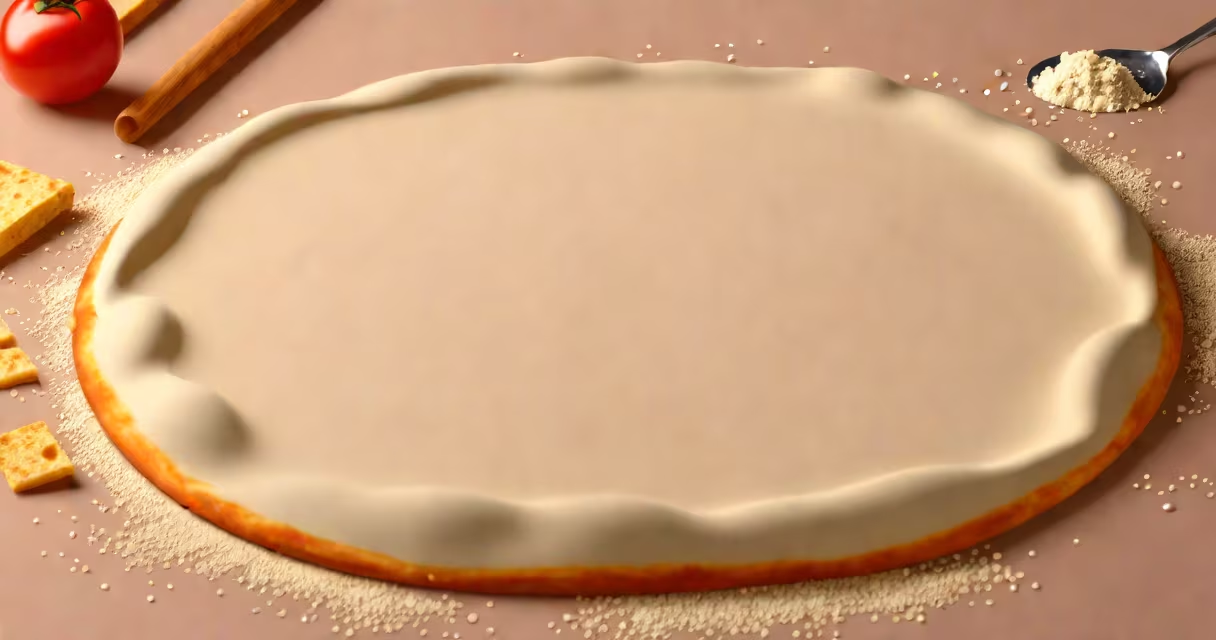
2 ingredient pizza dough is a no-yeast, no-knead dough made from only flour and water, ideal for quick, crispy flatbreads or thin-crust pizzas in under 30 minutes.
This dough relies on hydration and time to develop structure, not fermentation. It's not traditional Neapolitan-style, but it delivers a satisfying chew and crisp edge when baked at high heat. The simplicity makes it perfect for last-minute meals or beginner bakers who want to avoid yeast activation and proofing times.
Unlike standard pizza doughs that require yeast, rising, and kneading, 2 ingredient pizza dough skips those steps entirely. It's not meant to rise or puff up like leavened dough. Instead, it forms a pliable, slightly elastic mass that holds shape during baking. This version is not a substitute for artisanal or sourdough methods, but it fills a niche for speed and minimalism.
The dough functions through gluten development via hand mixing and resting. When flour and water combine, proteins in the flour (glutenin and gliadin) form gluten strands. These strands trap air and create elasticity. With enough mixing and rest, the dough becomes stretchable and holds its shape.
Resting for 30 minutes allows the flour to fully absorb water, reducing stickiness and improving workability. Without yeast, there's no gas production, so the texture remains dense and compact. Baking at 450°F (230°C) or higher causes rapid evaporation of surface moisture, forming a crisp crust while the interior stays tender.
A common mistake is using too much flour. Adding extra flour to prevent sticking ruins the hydration balance. The dough should feel tacky but not wet. If it tears easily, it's under-hydrated. If it sticks excessively, it's over-hydrated. A 2:1 flour-to-water ratio by weight (e.g., 200g flour, 100g water) works reliably.
Only two ingredients: all-purpose flour and water. No salt, oil, sugar, or yeast. Some versions include a pinch of salt for flavor, but that adds a third ingredient. True 2 ingredient dough omits everything else.
There are no standardized "types," but variations exist based on flour choice:
| Flour Type | Hydration Needs | Resulting Texture | Best For |
|---|---|---|---|
| All-purpose (AP) | 50% (e.g., 200g flour : 100g water) | Crispy crust, moderate chew | Quick weeknight pizzas |
| Bread flour | 55-60% | More chew, slightly airy | Thinner crusts, better stretch |
| Whole wheat | 45-50% | Denser, nuttier flavor | Hearty flatbreads, savory toppings |
Using bread flour increases gluten strength, allowing for larger stretches without tearing. Whole wheat flour absorbs more water and produces a denser crumb, which may not crisp as well. For best results, use AP flour unless you're aiming for a specific texture.
2 ingredient pizza dough is used in home kitchens for fast meals, school projects, camping trips, or when yeast is unavailable. It's popular among people with limited kitchen tools or time constraints.
It's especially useful in no-oven settings. You can cook it on a stovetop griddle, cast iron skillet, or even a grill. The dough holds shape and browns evenly without needing a preheated oven.
A real-world example: I made this dough during a power outage. Using only flour, water, a bowl, and a frying pan, I created a 10-inch base. After 5 minutes per side on medium heat, it developed golden brown spots and a crisp shell. Topped with tomato sauce, mozzarella, and basil, it was ready in 18 minutes from start to finish.
Many assume this dough is "fake" or "not real pizza." That's incorrect. It's a valid alternative for certain styles. It's not intended to mimic Neapolitan or New York-style pizza, which rely on long fermentation and high-heat ovens. But it excels at producing a thin, crispy base similar to focaccia or flatbread.
Another myth: "This dough won't rise." Correct. It doesn't need to. The lack of leavening is intentional. Rising requires time and yeast. This dough is designed for immediate use. Its texture is dense, not airy. That's not a flaw-it's a feature.
Some confuse it with "no-knead" doughs. While both skip kneading, no-knead doughs typically use yeast and long rests (12-24 hours). They develop flavor and structure through fermentation. 2 ingredient pizza dough relies solely on hydration and mechanical mixing. It's faster, simpler, and less flavorful-but more accessible.
Recipe: 2 ingredient pizza dough (makes one 10-inch base)
Result: Crisp base with slight chew, golden edges, and melty cheese. Total time: 25 minutes. No yeast, no rising, no special equipment.