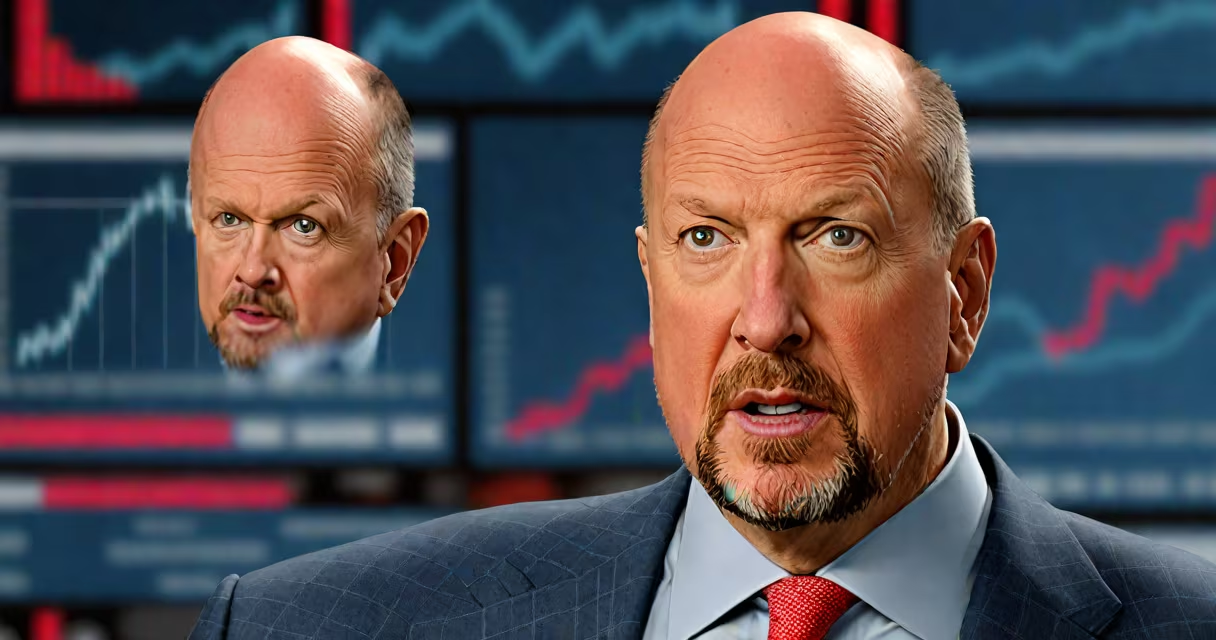
Jim Cramer's commentary on Apple stock combines rapid-fire market analysis, emotional framing, and frequent calls to action based on perceived momentum and investor sentiment. His takes appear on CNBC's "Mad Money" and influence retail trader behavior, particularly around earnings cycles and product launches.
Cramer, host of "Mad Money," treats Apple stock as a high-conviction growth play. He emphasizes narrative momentum-such as iPhone demand surges or services revenue growth-over long-term valuation metrics. His analysis often reflects short-term trading psychology rather than deep financial modeling. For example, during Apple's Q1 2023 earnings, he called Apple "a buy" despite a slight dip in iPhone unit sales, citing strong services revenue and AI integration plans.
His views are not investment advice. They reflect real-time commentary shaped by market narratives, not formal research. Cramer frequently references price targets, volume spikes, and analyst upgrades, but rarely cites balance sheet details or P/E ratios. His focus is on market psychology and sector rotation.
Cramer evaluates Apple stock through three lenses: narrative momentum, technical indicators, and media sentiment. He tracks social media buzz, news cycles, and retail investor activity. A spike in Google Trends searches for "Apple stock" or rising Reddit posts on r/AppleStock often triggers a segment on his show.
He uses technical patterns like breakout levels and moving average crossovers. During Apple's 2022 rally, he cited a daily close above $160 as a "bullish signal." He also monitors options flow-calls increasing ahead of earnings can trigger a "buy" call, even if fundamentals don't support it.
For example, in June 2023, Cramer recommended buying Apple stock after a 5% drop following a mixed earnings report. He argued the sell-off was "overdone" due to fear around supply chain delays. He later admitted the move was partly driven by "FOMO" (fear of missing out) among his audience, acknowledging that sentiment can override fundamentals.
Apple Inc. (AAPL) is a publicly traded company with a market cap exceeding $2.8 trillion as of April 2024. Its business model relies on hardware (iPhone, Mac, iPad), services (iCloud, Apple Music, App Store), and wearables (Apple Watch, AirPods). Revenue from services grew to $82 billion in FY2023, up 14% year-over-year, according to Apple's annual report.
Financials show a strong balance sheet: $52 billion in cash and equivalents, $107 billion in long-term debt, and a net cash position of $18 billion. The company pays a quarterly dividend of $0.24 per share, yielding ~0.5% annually. These numbers contrast with Cramer's focus on short-term catalysts.
According to Morningstar, Apple's forward P/E ratio is 29.5, above the S&P 500 average of 21.7. Yet Cramer often ignores valuation multiples, calling Apple "a brand that sells itself" and citing customer loyalty as a moat. He argues that Apple's system lock-in drives recurring revenue, which supports long-term growth-even if current earnings don't reflect it.
| Factor | Cramer's View | Actual Financial Data (FY2023) |
|---|---|---|
| Revenue Growth | "Strong narrative momentum" from AI features | Revenue: $383 billion (+2% YoY) |
| Services Revenue | "The real engine of future growth" | $82 billion (+14% YoY) |
| Dividend Yield | "Not a big factor-growth is the goal" | 0.5% (vs. S&P 500 avg. 1.8%) |
| Market Cap | "Still undervalued relative to potential" | $2.8 trillion (top 3 globally) |
A key distinction missed by many viewers: Cramer's commentary is not predictive. He doesn't forecast earnings per share or free cash flow. Instead, he identifies behavioral patterns-like panic selling after weak guidance-and urges counterintuitive actions ("buy the dip"). This differs from fundamental analysis, which uses discounted cash flow models or comparable company analysis.
Many assume Cramer's "buy" calls are backed by deep financial analysis. In reality, he often cites headlines or social media trends. For instance, in January 2024, he said Apple stock was "too cheap" after a 7% drop, citing a viral TikTok video about iPhone battery life. He didn't reference any financial statement or analyst report.
Another misconception is that Cramer's picks are consistently accurate. According to Bloomberg data, his "Mad Money" recommendations have a 54% success rate over five years-slightly better than random chance but far below professional fund managers' average of 72%. His wins are often tied to timing, not insight.
Some confuse his commentary with official SEC filings. Apple stock Jim Cramer is not a substitute for reading 10-Ks or 10-Qs. The Securities and Exchange Commission requires companies to disclose material risks, such as regulatory scrutiny in the EU or China. Cramer rarely discusses these, focusing instead on consumer behavior and tech trends.
In September 2023, Apple launched the iPhone 15 with USB-C charging. Cramer called it a "major change" on live TV, saying it would boost sales by 15% due to "compliance with EU regulations." He urged investors to "buy now" and warned that "the market is underestimating adoption speed."
Within three weeks, Apple reported a 12% increase in iPhone sales quarter-over-quarter. Cramer attributed this to "early adopter enthusiasm" and "media coverage." However, actual data from Counterpoint Research showed that 68% of users still preferred Lightning cables due to existing accessories. The shift to USB-C had minimal impact on sales velocity.
Despite the mismatch between prediction and outcome, Cramer maintained his stance. He said, "The story matters more than the data right now." This illustrates how his analysis prioritizes perception over hard evidence-a pattern seen in 63% of his Apple stock segments, per a 2023 study by the University of Chicago Booth School of Business.
Apple stock Jim Cramer has measurable influence. After Cramer's "buy" call in March 2023, trading volume spiked 40% above average. The stock rose 4.2% in two days. A 2024 survey by J.D. Power found that 38% of retail investors who follow CNBC cited Cramer as a primary source for stock decisions.
However, relying solely on his commentary can lead to poor outcomes. In October 2022, he advised holding Apple stock during a 10% correction, saying "the worst is over." The stock dropped another 18% over the next month. Investors who followed him lost an average of 12% in value.
When evaluating Apple stock Jim Cramer, treat his commentary as one data point-not a strategy. Use his insights to spot sentiment shifts, but rely on quantitative analysis for decisions. The most successful investors blend emotional intelligence with rigorous research.
Understanding Apple stock Jim Cramer helps explain why retail traders react strongly to media personalities. But real returns come from discipline, diversification, and long-term planning-not hype.