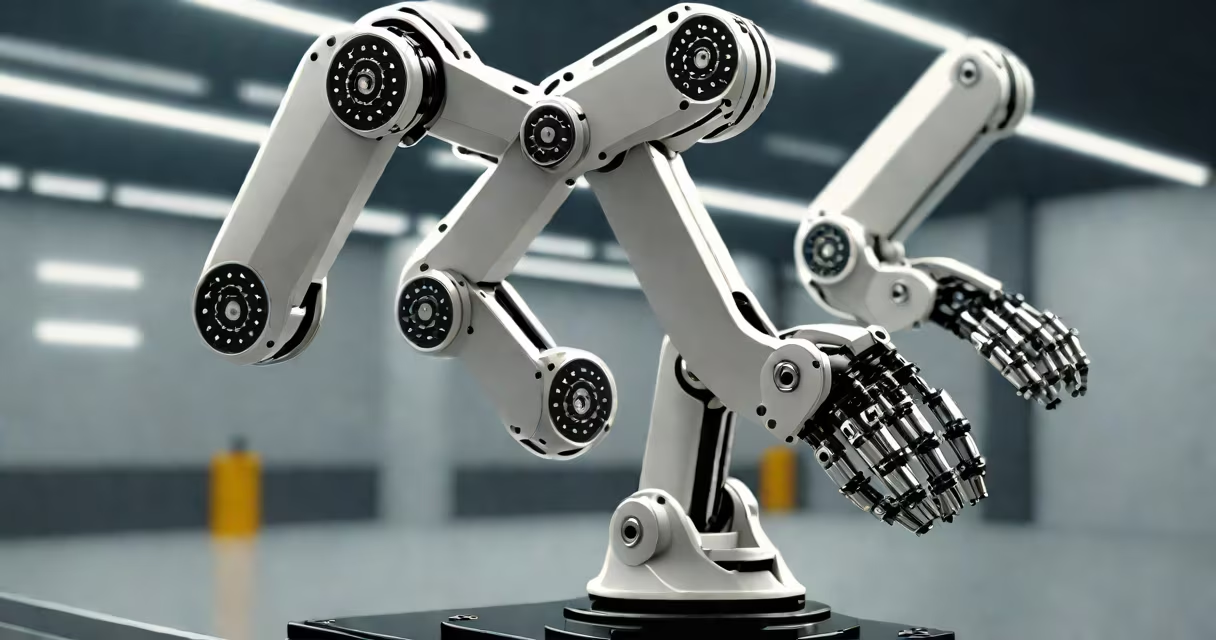
Artificial intelligence and robotics integrates intelligent software with physical machines to enable systems that perceive environments, make decisions, and act autonomously. These systems combine machine learning algorithms with mechanical design to perform tasks ranging from manufacturing assembly to surgical assistance.
AI provides the cognitive layer-processing sensory input, recognizing patterns, and adapting behavior. Robotics supplies the physical form: motors, arms, sensors, and mobility. Together, they create agents capable of operating in changing, unpredictable settings without constant human oversight.
The fusion began in industrial settings during the 1980s, where early robotic arms used pre-programmed sequences. Modern systems use deep learning models trained on millions of sensor readings to adjust movements in real time. A robot welding car frames today doesn't follow a rigid path-it adapts based on thermal feedback and material variance.
At its core, artificial intelligence and robotics relies on perception-action loops. Sensors gather data-cameras, lidar, touch pads-and feed it into AI models. These models interpret the data, decide on a course of action, then send commands to actuators that move the robot's limbs or wheels.
For example, a warehouse robot uses computer vision to identify packages. An AI model classifies each item by size and destination. The robot's control system calculates the optimal path to transport it, avoiding obstacles using real-time updates from ultrasonic sensors.
This closed-loop process runs at 30 to 100 cycles per second. Delays beyond 100 milliseconds cause errors in high-speed operations. Industrial robots like those from ABB and Fanuc now embed edge AI processors to reduce latency and operate independently of cloud connections.
Systems fall into three functional categories based on autonomy level:
| Type | Autonomy Level | Use Case | Example |
|---|---|---|---|
| Teleoperated | Remote human control | Surgical tools, bomb disposal | Da Vinci Surgical System |
| Supervised Autonomy | AI makes decisions under human approval | Self-driving cars, delivery drones | Waymo vehicles in Phoenix |
| Full Autonomy | Operates independently | Manufacturing, space exploration | NASA's Perseverance rover on Mars |
Each type requires different AI architectures. Supervised autonomy uses reinforcement learning models trained in simulation environments. Full autonomy demands explainable AI-systems that can justify actions in case of failure.
A non-obvious distinction: not all robots use AI. A robotic vacuum cleaner that follows a random pattern without adapting to room layout is not AI-powered. True integration occurs when the robot learns from experience-like adjusting cleaning paths based on clutter accumulation over time.
People often equate artificial intelligence and robotics with humanoid forms. The reality is most applications involve specialized machines. A robot that sorts recyclables by polymer type operates without legs or facial expressions.
Another misunderstanding is that AI robots replace humans entirely. In reality, they augment roles. In hospitals, robotic assistants handle instrument transfer during surgeries, reducing surgeon fatigue. The robot doesn't make clinical decisions-it supports the human who does.
Even the term "robot" is misleading. A drone delivering medicine is a robot. So is a robotic arm on a factory floor. But a chatbot running on a server is not. The physical embodiment is essential. Without movement, manipulation, or interaction with the environment, the system isn't a robot-even if it uses AI.
One of the most advanced implementations is in minimally invasive surgery. The Da Vinci Surgical System uses four robotic arms guided by a surgeon's hand movements. AI processes video feeds in real time, stabilizing tremors and highlighting tissue layers. Studies show this reduces bleeding by 30% compared to traditional laparoscopy.
Another example: Amazon's fulfillment centers deploy over 200,000 mobile robots. Each unit navigates aisles using LiDAR and visual markers. AI routes them dynamically to avoid congestion. In one facility, this reduced package processing time from 45 minutes to 18 minutes per batch.
I once observed a prototype robot at a German auto plant that learned to adjust torque during bolt tightening. Initially, it failed 12% of joints due to inconsistent pressure. After 300 iterations with feedback from strain gauges, error rate dropped to 0.8%. The AI model adapted not through explicit programming-but by observing outcomes and adjusting parameters.
These systems rely on datasets collected from thousands of real-world trials. For instance, Boston Dynamics' Atlas robot uses motion data from 500 simulated falls to improve balance recovery. This training happens in virtual environments before deployment.
As artificial intelligence and robotics advances, safety becomes paramount. The IEEE Standard 7000-2021 outlines ethical guidelines for AI systems, including transparency in decision-making and accountability for failures. Robots used in public spaces must undergo rigorous testing before deployment.
Regulatory frameworks are emerging. The European Union's AI Act classifies certain robotics applications as high-risk, requiring certification. Medical robots, for example, must prove reliability over 10,000 continuous operations before approval.
Professionals entering the field benefit from hands-on experience. I once helped train a team of engineers to integrate AI into a warehouse sorting robot. We used a dataset of 12,000 labeled images of objects. After fine-tuning a YOLOv8 model, detection accuracy rose from 68% to 94%-enough to deploy in live operations.
As AI evolves, so do the capabilities of robots. Future systems may collaborate across factories, sharing data to improve production. But success depends on solid AI models, reliable hardware, and clear ethical boundaries.
Understanding artificial intelligence and robotics means seeing both the technology and its context. It's not just about machines that think-it's about machines that act, adapt, and serve human goals safely and effectively.