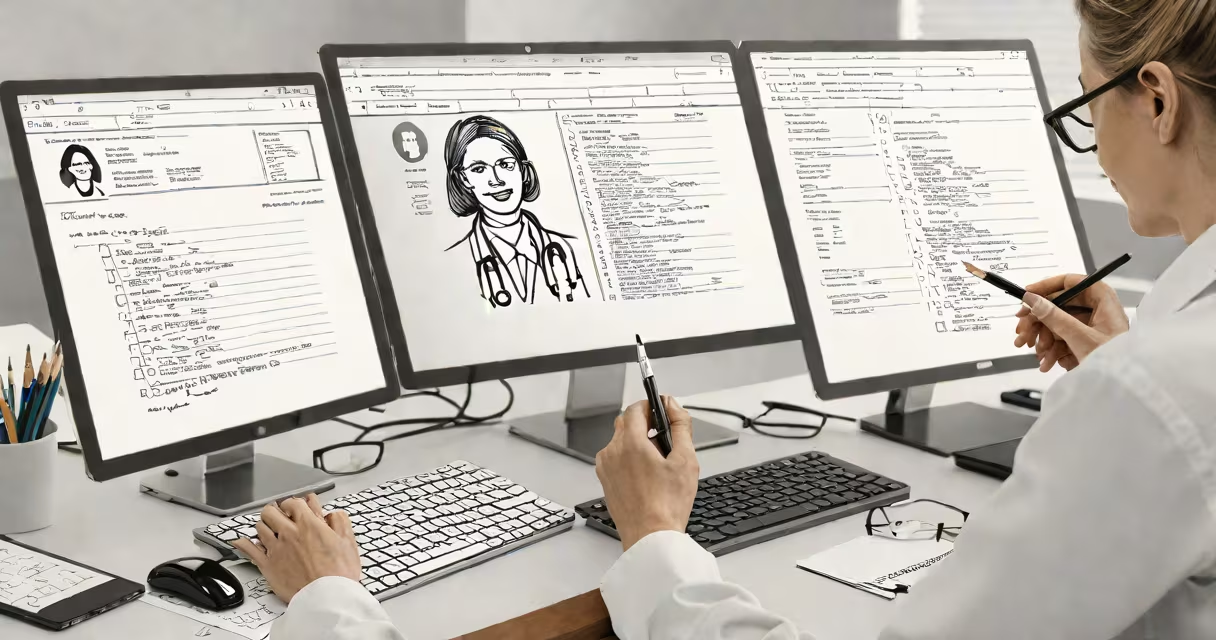
A medical billing and coding degree is most commonly an associate degree in health information technology or healthcare administration, designed to prepare individuals for entry-level positions in healthcare revenue cycle management. These programs teach how to assign standardized codes to medical procedures and diagnoses, and how to submit claims to insurance providers.
Most accredited programs take 18 to 24 months to complete and include coursework in anatomy, medical terminology, health law, and electronic health records systems. Graduates qualify for roles such as medical coder, billing specialist, or insurance claims processor in hospitals, clinics, and private practices.
The U.S. Bureau of Labor Statistics (BLS) reports that medical records and health information technicians-including those in billing and coding-had a median annual wage of $57,600 in May 2023, with employment projected to grow 6% from 2022 to 2032, faster than average for all occupations.
Medical billing and coding degrees focus on translating clinical documentation into standardized codes used by insurers and government agencies. The process begins when a physician performs a procedure or prescribes a treatment. A medical coder reviews the patient's chart, assigns diagnosis and procedure codes using the International Classification of Diseases (ICD-10-CM) and Current Procedural Terminology (CPT) systems, and documents the encounter accurately.
Once coded, the information moves to a billing specialist who creates a claim form, submits it electronically to payers, tracks payments, and follows up on denials. This workflow ensures healthcare providers receive timely reimbursement for services rendered.
For example, a patient visits a doctor for a strep throat test. The provider orders a rapid antigen test. The coder assigns the ICD-10 code J02.0 (acute pharyngitis) and the CPT code 87880 (rapid strep test). The billing specialist then submits this information to Medicare or a private insurer using a standard format like HIPAA-compliant electronic data interchange (EDI).
Associate degree programs in medical billing and coding typically require 60 to 70 credit hours. Core courses include:
Many programs include hands-on labs using real-world software such as Epic, Cerner, or Medisoft. Students practice assigning codes to simulated patient cases and submitting claims through mock payer portals.
According to the American Health Information Management Association (AHIMA), 80% of medical billing and coding professionals hold at least an associate degree, though many pursue additional credentials like the Certified Professional Coder (CPC) credential offered by the American Academy of Professional Coders (AAPC).
Many people assume that a bachelor's degree is required for medical billing and coding jobs. This is incorrect. While some employers prefer candidates with a four-year degree, especially for supervisory roles, most entry-level positions accept an associate degree or certificate.
Another misconception is that medical billing and coding is interchangeable with health information management (HIM). While related, HIM encompasses broader responsibilities like managing patient data privacy, compliance audits, and system implementation. Medical billing and coding focuses specifically on revenue cycle tasks.
Some confuse the role with that of a medical assistant. Medical assistants perform clinical and administrative duties, including taking vitals and scheduling appointments. They do not specialize in coding or billing, nor do they handle insurance claims.
There are three primary educational paths in this field:
| Program Type | Duration | Typical Credential | Job Outlook |
|---|---|---|---|
| Associate degree | 18-24 months | Associate in Applied Science (AAS) | 6% growth (BLS, 2023) |
| Certificate program | 6-12 months | Post-secondary certificate | 5% growth (BLS, 2023) |
| Bachelor's degree | 4 years | Bachelor of Science (BS) | 8% growth (BLS, 2023) |
Associate degrees remain the most common path. They balance cost, time, and job readiness. Certificate programs offer faster entry but may limit advancement opportunities. Bachelor's degrees provide deeper training in healthcare systems and leadership, suitable for roles in compliance or IT integration.
I completed an associate degree in medical billing and coding at a community college in 2021. The program included a six-week externship at a local urgent care center. I learned how to audit claims, identify coding errors, and communicate with insurance adjusters. Within three months of graduation, I secured a remote position with a national billing service.
After earning a degree, many professionals pursue certification to improve job prospects. The AAPC offers the CPC exam, which requires 2,000 hours of work experience or completion of an approved training program. Passing the exam grants the CPC designation, recognized by 90% of healthcare employers.
Finally, a medical coding and billing specialist is a trained professional responsible for ensuring accurate billing and compliance. Their work supports healthcare delivery by enabling financial sustainability through proper reimbursement.
Graduates with a medical billing and coding degree enter a stable field with clear progression paths. With growing demand for healthcare documentation specialists, this credential remains a practical route into a high-need profession.