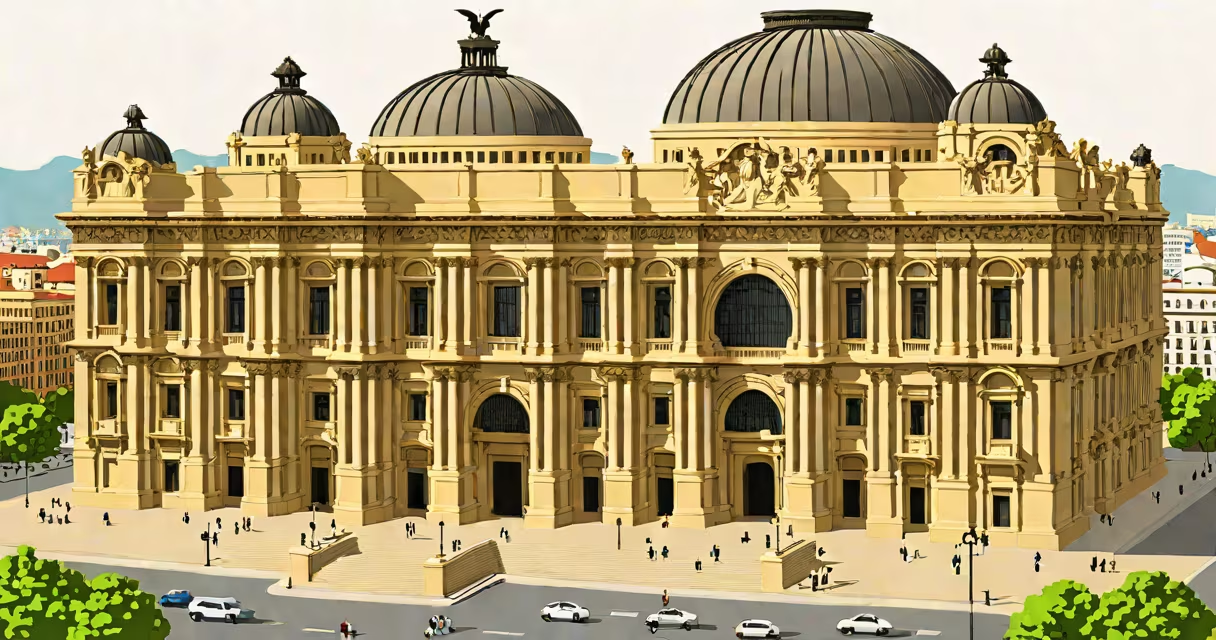
Bellas Artes Mexico City, formally known as Palacio de Bellas Artes, is a neoclassical government building and national art museum located in the historic center of Mexico City. It houses one of the most significant collections of Mexican modernist art, including monumental murals by Diego Rivera, José Clemente Orozco, and David Alfaro Siqueiros.
The complex was constructed between 1904 and 1932, initially intended as a venue for elite exhibitions and performances. Its design reflects a blend of French Beaux-Arts and Spanish colonial influences, with a grand colonnaded portico and sculptural details. After decades of political and artistic upheaval, it became a public institution dedicated to promoting Mexican national identity through visual culture.
Today, Bellas Artes serves as both a museum and a cultural hub. The ground-floor galleries display permanent collections of 19th- and 20th-century Mexican painting and sculpture. The upper levels host rotating exhibitions, lectures, and performances. The building's underground level contains a subterranean walkway lined with murals by Siqueiros, one of the few surviving examples of his large-scale work.
Bellas Artes operates under a dual mandate: preserving national artistic heritage while serving as a living space for contemporary expression. The museum manages two distinct spaces-the main exhibition halls and the outdoor plaza-each with different access policies and programming goals.
Entry to the permanent collection is free during weekday mornings. The museum uses timed entry slots to manage visitor flow, especially during peak seasons. Visitors must pass through security screening before entering. The interior layout follows a radial plan centered on the main rotunda, which features a fresco ceiling painted by Rivera in 1936 depicting the evolution of Mexican civilization.
During major events such as the annual Festival Internacional de Cine de México, the plaza hosts film screenings and live music. These programs are coordinated by the Secretaría de Cultura, which oversees the museum's operations. The institution also partners with international museums to loan artworks, including a 2022 loan of Frida Kahlo's personal sketchbooks from the Museo Nacional de Historia in Mexico City.
The exterior of Bellas Artes is clad in white Italian Carrara marble and local volcanic stone. The façade includes eight sculpted figures representing the arts-music, dance, poetry, and drama-designed by Mexican artist Juan José de la Cruz. These statues were cast in bronze using lost-wax techniques and installed in 1932.
Inside, the building combines classical symmetry with revolutionary content. The main hall's vaulted ceiling measures 24 meters high and spans 50 meters in width. Rivera's fresco covers 1,500 square meters and took 18 months to complete. It depicts scenes from Mesoamerican history, the Spanish conquest, and the Mexican Revolution, ending with a vision of a socialist future.
One lesser-known fact: the building's foundation sits atop a former Aztec ceremonial site. Archaeological excavations in 1931 revealed remnants of a temple dedicated to Tlaloc, the rain god. The museum's architects preserved the site beneath the main floor, and visitors can view fragments of the original stonework through transparent glass panels near the east wing.
Bellas Artes functions as both a museum and a performance venue. Its primary divisions include:
| Type | Function | Examples |
|---|---|---|
| Permanent Collection | Long-term displays of Mexican art from 1850-1950 | Rivera's "Dream of a Sunday Afternoon," Orozco's "The Trench" |
| Temporary Exhibitions | Rotating shows from national and international artists | "Frida Kahlo: The Self-Portraits" (2023), "Afro-Mexican Art in the 20th Century" (2024) |
| Performance Spaces | Stages for theater, dance, and music | Teatro Nacional, Sala de Conciertos |
Visitors often confuse Bellas Artes with the nearby Museo Nacional de Antropología, which focuses on pre-Hispanic artifacts. While both institutions are state-funded and located within walking distance of the Zócalo, they serve different purposes. Bellas Artes emphasizes modern and contemporary visual culture, whereas the National Museum of Anthropology specializes in archaeological findings from Mesoamerica.
A common misconception is that the murals are entirely original. In reality, Rivera's frescoes were restored multiple times due to water damage and pollution. A 2018 conservation project used laser scanning to map each pigment layer, revealing that Rivera altered the composition of "The Creation" twice during the painting process. The restoration team documented these changes in a public database accessible via the museum's website.
Bellas Artes Mexico City is a central node in the country's cultural infrastructure. It receives approximately 1.2 million visitors annually, according to INEGI (Instituto Nacional de Estadística y Geografía). The majority of attendees are domestic tourists, with 38% coming from other Mexican states and 12% from abroad.
Art students from the Universidad Nacional Autónoma de México (UNAM) frequently visit for fieldwork. The museum offers guided tours in Spanish and English tailored to academic groups. During exam periods, the museum hosts free workshops on muralism techniques, using materials similar to those employed by Rivera and Siqueiros.
Many assume Bellas Artes is a private gallery. It is not. The institution is publicly owned and operated by the federal government through the Secretaría de Cultura. Admission to the permanent collection remains free, though special exhibitions may charge a fee.
Another error: people believe the building is only about Mexican art. While its core mission centers on national identity, it also hosts global exhibitions. For example, in 2023, the museum hosted "The Global South: Art and Resistance," featuring works from Nigeria, Colombia, and Vietnam. The show drew 210,000 visitors and was praised by The Guardian for its focus on decolonial narratives.
One non-obvious fact: the museum's rooftop garden is open to the public on weekends. It features native plants such as agave, maguey, and epiphytic orchids. The garden was designed by field architect Patricia Mendoza and includes a small amphitheater for poetry readings. It is one of the few green spaces in central Mexico City accessible without a ticket.
I visited Bellas Artes in October 2022 during a heavy rainstorm. The storm delayed my arrival, but the museum's staff offered free umbrellas at the entrance. I spent three hours exploring the lower-level murals, particularly Siqueiros' "La Marcha de la Humanidad." The lighting in that corridor is dim, and the paint appears to shift color depending on the viewer's angle-a deliberate effect achieved through layered pigments and reflective minerals.
Afterward, I attended a lecture on the politics of muralism led by Dr. Elena Ríos from UNAM. She emphasized that the murals were not just art-they were tools of ideological communication. "Rivera didn't paint to decorate," she said. "He painted to educate. To mobilize. To challenge power." Her words stayed with me long after I left.
bellas artes mexico city is more than a museum-it is a living archive of Mexico's cultural struggle and creative ambition. From its grand façade to its underground murals, it embodies the nation's belief in art as a force for social change. returning to see a new exhibit, the experience is rooted in place, memory, and meaning.