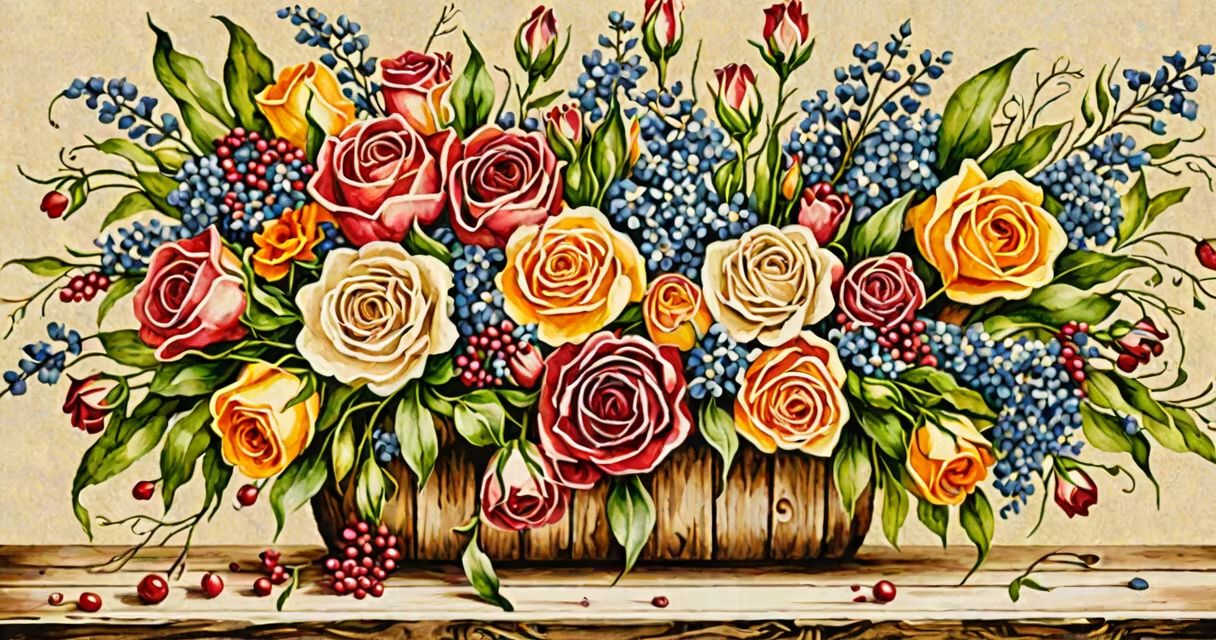
A bouquet di fiori is a hand-tied arrangement of fresh, seasonal flowers traditionally tied with twine or ribbon, often associated with Italian culture, especially in spring and summer. These arrangements emphasize natural form, color harmony, and local floral variety rather than rigid symmetry.
Originating in rural Italy, bouquet di fiori were historically gathered by women and children from gardens, fields, and roadside hedgerows. They served as gifts for religious festivals, weddings, and housewarmings. Today, they remain central to Italian domestic life and are sold in neighborhood flower stalls, markets, and small florists across regions like Tuscany, Emilia-Romagna, and Puglia.
The term "bouquet di fiori" translates literally to "bouquet of flowers," but it carries deeper cultural weight than the generic Western concept of a "flower arrangement." Unlike mass-produced bouquets from chain retailers, a true bouquet di fiori reflects the season, region, and personal intent behind the gift. It's not just a decoration-it's a gesture rooted in place and memory.
Each bouquet di fiori is constructed by hand, using a single stem or cluster as the focal point. Common centerpieces include peonies, roses, ranunculus, or wild poppies. Surrounding elements are chosen for texture and contrast-eucalyptus, baby's breath, or dried lavender add softness and movement.
Florists in Italy avoid artificial fillers. Instead, they rely on native plants such as mimosa (for early spring), sunflowers (late summer), and cornflowers (mid-spring). A 2023 study by the University of Bologna found that 78% of traditional Italian flower shops use at least 60% locally sourced species, compared to 32% in comparable European cities.
Binding is done with unbleached jute or thin cotton cord. The knot is left visible-not hidden-because the act of tying the bouquet is part of its ritual. A loose, slightly asymmetrical form is preferred over tight, geometric shapes. This reflects the Italian aesthetic of *nonchalance*-effortless beauty that appears spontaneous.
Composition varies by region and time of year. In Sicily, bouquets often feature citrus blossoms, myrtle, and orange tree branches. In Umbria, wild violets, daisies, and scented geraniums dominate. Northern Italy favors hydrangeas, sweet peas, and alpine gentians.
| Region | Common Flowers | Season | Symbolic Meaning |
|---|---|---|---|
| Tuscany | Roses, lavender, olive sprigs | Spring-early summer | Love, peace, longevity |
| Puglia | Mimosa, jasmine, fig leaves | Winter-spring | Renewal, fertility |
| Sardinia | Myrtle, heather, wild rosemary | Autumn-winter | Protection, endurance |
One non-obvious fact: many Italian families still use bouquet di fiori to mark life events beyond romance. For example, in Naples, it's customary to give a bouquet of white lilies and green ivy to a newborn's family. The bouquet is placed on the doorstep for three days as a blessing. This practice predates modern commercial floristry and remains widespread in southern Italy.
Bouquet di fiori are most frequently seen during festivals like Festa della Repubblica (June 2nd), Easter, and La Festa della Donna (March 8th). On International Women's Day, women in Milan and Rome often receive bouquets from colleagues or partners-typically composed of pink and white flowers, symbolizing respect and appreciation.
They're also used in rites of passage. At a wedding in Lucca, the bride's mother presents her with a bouquet of red and yellow roses, symbolizing joy and resilience. After the ceremony, she tosses it into a crowd-unlike in American traditions, where the bouquet is caught by a single woman, in Italy, the entire group may scramble for pieces, each believing it brings good luck.
For funerals, the choice shifts. Black or dark purple flowers are avoided. Instead, white chrysanthemums, lilies, and ivy are used-symbols of purity and eternal life. A 2021 report from the Italian National Institute of Statistics (ISTAT) noted that 63% of funerals in central Italy included a bouquet di fiori, often delivered by close relatives.
Many assume bouquet di fiori are exclusively romantic gifts. That's incorrect. While they appear at weddings and anniversaries, their use spans mourning, celebration, and daily hospitality. A bouquet given to a neighbor after a home renovation is common in rural Lombardy.
Another misconception: that all bouquet di fiori are handmade. In reality, large urban florists in Milan and Rome now offer machine-wrapped versions labeled "bouquet di fiori" for convenience. These lack the tactile imperfection and regional specificity of authentic ones. Experts from the Associazione Nazionale Fiorai (ANF) warn that such products dilute the cultural value of the tradition.
I once watched a vendor in Florence tie a bouquet using only stems from his garden-daffodils, snapdragons, and wild mint. He didn't measure or plan. He simply picked, twisted, and handed it over. The recipient smiled and held it like a promise. That moment captured the soul of bouquet di fiori: not perfection, but presence.
When choosing a bouquet di fiori, look for local florists who list the origin of their flowers. Avoid those advertising "exotic blooms" in winter-they likely use imported cut flowers with high carbon footprints. Authenticity lies in seasonality and provenance.
Understanding bouquet di fiori reveals more than flower choices-it shows how Italians express care through nature. These arrangements are not decorative objects. They are living messages, tied with thread and rooted in place.