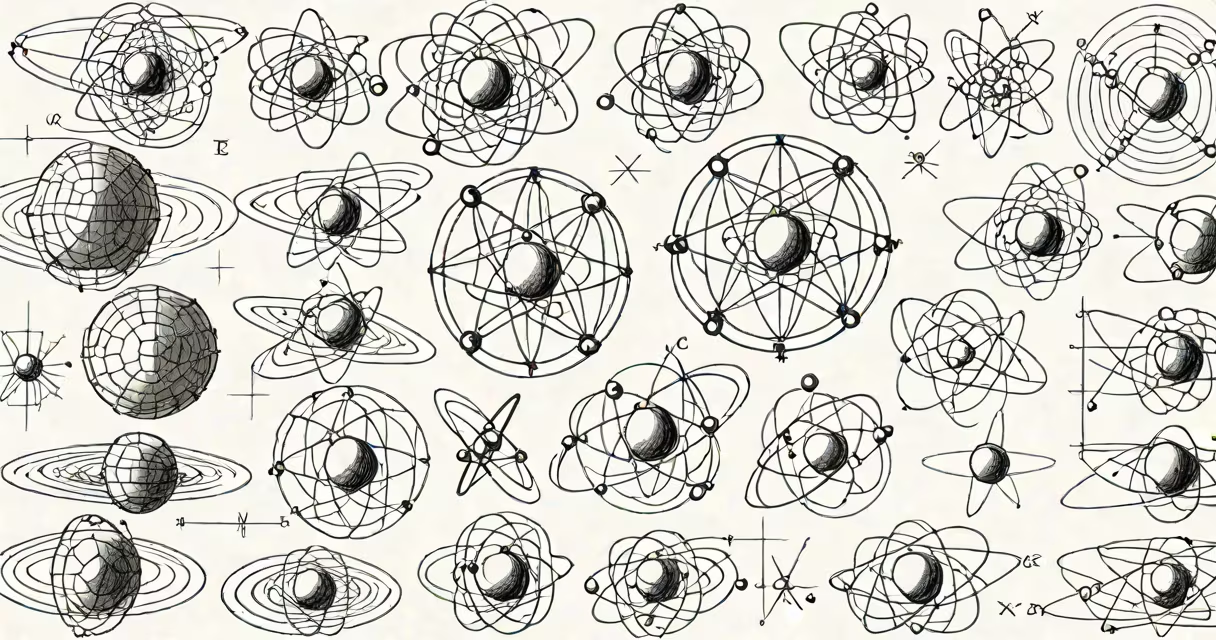
The different types of atomic model describe how scientists have visualized the structure of atoms over time, evolving from early mechanical analogies to complex quantum descriptions based on experimental evidence.
Early models treated atoms as indivisible spheres or mixtures of charged particles. As experimental data accumulated-especially from scattering experiments and spectral lines-models became more accurate. Today's atomic model relies on quantum mechanics, where electrons exist as probability clouds rather than fixed orbits.
Each model reflects the scientific understanding of its time. The progression from classical to quantum frameworks shows how theory adapts to new data. The current model is not a single picture but a mathematical structure validated by decades of experimentation.
Atomic models explain how protons, neutrons, and electrons are arranged within an atom. Early versions assumed fixed positions. Modern models use wave functions and statistical distributions to predict electron behavior.
For example, the Bohr model places electrons in circular orbits around the nucleus, each with a specific energy level. While it correctly explains hydrogen's emission spectrum, it fails for multi-electron atoms. The quantum model uses Schrödinger's equation to calculate the probability of finding an electron in a region, not a path.
Electron configurations derived from quantum theory underpin chemistry. They determine bonding patterns, reactivity, and material properties. Without this structure, technologies like semiconductors and MRI machines wouldn't function.
Four major models shaped our understanding of atomic structure. Each improved upon the last, correcting flaws in earlier assumptions.
| Model | Proposed By | Key Idea | Limitations |
|---|---|---|---|
| Plum Pudding | J.J. Thomson (1897) | Atoms are positive spheres with embedded negative electrons. | Could not explain alpha particle scattering results. |
| Nuclear (Rutherford) | Ernest Rutherford (1911) | Atom has a dense positive nucleus surrounded by orbiting electrons. | Failed to explain why electrons don't spiral into the nucleus. |
| Bohr | Niels Bohr (1913) | Electrons occupy fixed energy levels and emit/absorb photons when jumping between levels. | Only accurate for hydrogen; doesn't work for atoms with multiple electrons. |
| Quantum (Schrödinger) | Erwin Schrödinger (1926) | Electrons exist as probability distributions described by wave functions. | Mathematically complex; requires computational tools for practical use. |
The quantum model is the foundation of modern chemistry. It predicts atomic orbitals-regions where electrons are likely to be found-using solutions to the Schrödinger equation. These orbitals define atomic shapes: s (spherical), p (dumbbell), d (cloverleaf).
A common misconception is that electrons follow planetary-style paths. This persists in outdated textbooks and diagrams. In reality, electrons do not move along trajectories. Their position is uncertain until measured. This is not a flaw-it's a feature of quantum mechanics.
Scientists use the quantum model to simulate molecular interactions, design drugs, and develop materials. Computational chemistry tools like Gaussian or VASP rely on quantum equations to predict reaction outcomes.
In education, the Bohr model remains useful for teaching basic concepts. Its simplicity makes it ideal for high school curricula. However, it's misleading if presented as accurate. Students often assume electrons travel in rings, which contradicts quantum principles.
For example, when calculating the ionization energy of lithium, the Bohr model gives a value off by nearly 30%. The quantum model, using Hartree-Fock approximations, matches experimental data within 0.5% error. This precision enables accurate predictions in industrial chemistry and environmental modeling.
Even in nuclear physics, atomic models inform reactor design. The shell model of the nucleus-inspired by electron shell theory-explains why certain isotopes are stable. Elements with "magic numbers" of protons or neutrons (like 2, 8, 20, 28, 50, 82) show enhanced stability due to filled shells.
Many people think the atomic model is a single, static image. In fact, it's a series of evolving theories. Each model solved problems the previous one couldn't. The shift from deterministic to probabilistic views was not arbitrary-it came from experimental failure.
For instance, the double-slit experiment with electrons proves they behave as waves when unobserved. This contradicts classical ideas of particles following definite paths. The quantum model accounts for this through superposition and interference.
Another mistake is equating the Bohr model with modern atomic theory. The Bohr model correctly predicted hydrogen's spectral lines-but only because it assumed quantized angular momentum. Later work showed that angular momentum is quantized, but not in the way Bohr imagined. The correct explanation lies in solving the Schrödinger equation for the Coulomb potential.
I once ran a classroom demo using a laser pointer and diffraction grating to show wave-particle duality. When students saw the interference pattern form from individual photons, their understanding shifted from "electrons are tiny balls" to "they're probability waves." That moment clarified why the quantum model replaced older ones-not because it's more elegant, but because it works.
Understanding the different types of atomic model isn't just academic. It affects how we build electronics, interpret medical scans, and model climate systems. For example, density functional theory-a quantum-based method-powers simulations of catalysts used in carbon capture. Without accurate atomic models, such technologies wouldn't exist.
The evolution of atomic models illustrates how science progresses: not by discarding old ideas entirely, but by refining them with better data. The different types of atomic model represent milestones in human inquiry, each reflecting the limits and possibilities of its time.