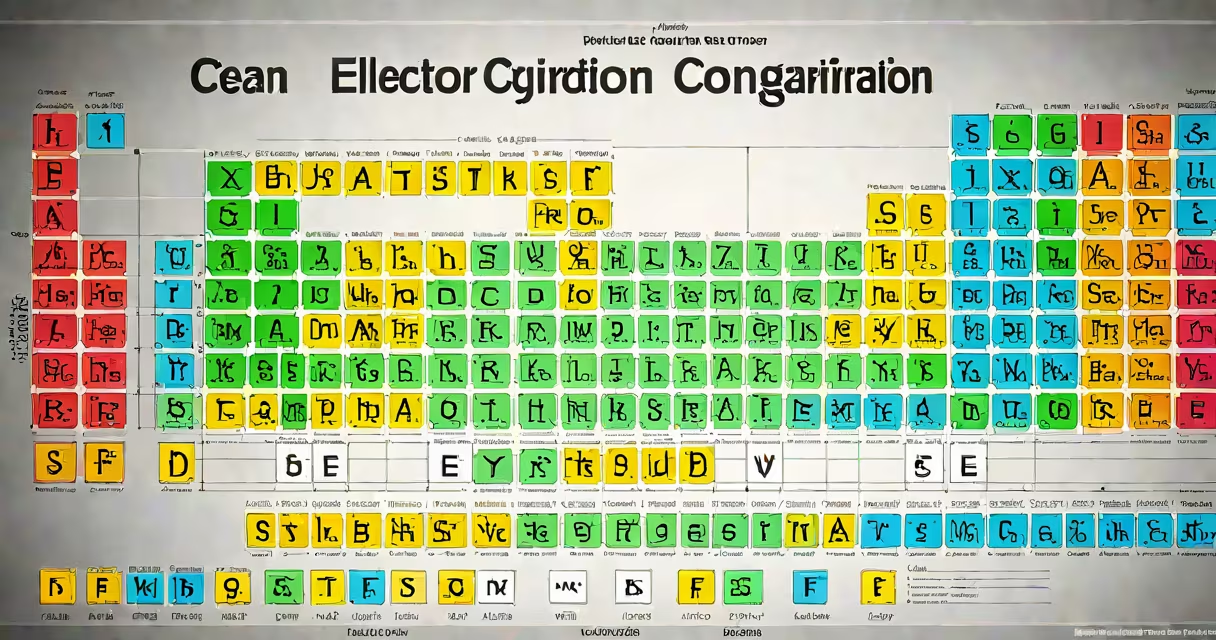
The electron configuration chart on periodic table displays how electrons fill atomic orbitals based on an element's position, revealing patterns in valence electrons, chemical behavior, and periodic trends. Each row and block corresponds to specific energy levels and subshells.
Electron configuration describes the distribution of electrons in an atom's orbitals. On the periodic table, this pattern emerges through the layout: elements are ordered by increasing atomic number, and their placement reveals the sequence in which orbitals are filled. The table's structure reflects the Aufbau principle-the rule that electrons occupy the lowest available energy level first.
For example, sodium (Na, atomic number 11) appears in period 3, group 1. Its electron configuration is 1s² 2s² 2p⁶ 3s¹. The last electron enters the 3s orbital, placing sodium in the s-block. This alignment between position and electron filling allows quick prediction of configurations without memorization.
The periodic table is divided into four blocks: s, p, d, and f. These correspond to the subshell being filled. The s-block spans groups 1 and 2 (elements with outermost electrons in s orbitals). The p-block includes groups 13-18, where p orbitals fill. The d-block covers transition metals (groups 3-12), and the f-block holds lanthanides and actinides.
Each period (row) represents a principal quantum number (n). Period 1 has n = 1, period 2 has n = 2, and so on. As you move left to right across a period, electrons fill orbitals within the same shell. For instance, carbon (atomic number 6) lies in period 2, group 14. Its configuration is 1s² 2s² 2p²-two electrons in the 2s subshell and two in the 2p subshell.
Elements in the same group share similar outer electron arrangements. Group 1 elements (alkali metals) all have one electron in their outermost s orbital (ns¹), explaining their high reactivity and tendency to form +1 ions. This consistency makes the periodic table a predictive tool for chemistry.
While all configurations follow the same physical rules, they fall into recognizable categories based on stability and electron count:
| Type | Subshell Filled | Examples | Stability Note |
|---|---|---|---|
| Alkali metals | s¹ | Lithium (1s² 2s¹), Sodium (1s² 2s² 2p⁶ 3s¹) | Highly reactive; lose one electron easily |
| Noble gases | ns² np⁶ | Neon (1s² 2s² 2p⁶), Argon (1s² 2s² 2p⁶ 3s² 3p⁶) | Full valence shell; chemically inert |
| Transition metals | d¹-d¹⁰ | Iron (1s² 2s² 2p⁶ 3s² 3p⁶ 4s² 3d⁶), Copper (1s² 2s² 2p⁶ 3s² 3p⁶ 4s¹ 3d¹⁰) | Copper violates expected order due to stability of full d¹⁰ |
| Lanthanides | f¹⁴ | Cerium (4f¹ 5d¹ 6s²), Europium (4f⁷ 6s²) | Variable oxidation states; complex magnetic properties |
A common misconception is that electron filling strictly follows the order of energy levels. In reality, exceptions occur due to electron-electron repulsion and exchange energy. For example, chromium (Cr, atomic number 24) has the configuration [Ar] 4s¹ 3d⁵ instead of [Ar] 4s² 3d⁴. Half-filled d subshells offer greater stability, so one electron moves from the 4s to the 3d orbital.
This deviation illustrates why the electron configuration chart isn't just a lookup table-it reflects deeper quantum principles. The chart shows both the expected path and the deviations that reveal the complexity of atomic interactions.
Many assume that the periodic table's layout is arbitrary or purely historical. In fact, it was designed to reflect electron configuration. Mendeleev's original version grouped elements by atomic weight and chemical similarity, but modern tables are ordered by atomic number and structured around electron shell progression.
Another error is thinking that all elements in a period have the same number of electron shells. While all elements in period 3 have electrons in n = 3, the number of occupied shells increases from left to right. Sodium (Na) has three shells (1s, 2s/2p, 3s), while argon (Ar) also has three shells but fills the 3p subshell completely.
Some users confuse electron configuration with oxidation state. Oxidation state indicates charge in compounds; electron configuration describes neutral atoms. Iron (Fe) has the configuration [Ar] 4s² 3d⁶, but in Fe³⁺, it loses two 4s and one 3d electron-resulting in [Ar] 3d⁵. The configuration changes upon ionization, but the periodic table still predicts the neutral atom's setup.
When I taught introductory chemistry, students struggled to predict bonding behavior until they mapped configurations to positions. A student once asked why fluorine forms F⁻ but oxygen forms O²⁻. Using the electron configuration chart on periodic table, we saw that fluorine (1s² 2s² 2p⁵) needs only one electron to complete its octet, while oxygen (1s² 2s² 2p⁴) needs two. This explained their respective anion charges.
In materials science, engineers use electron configuration to design semiconductors. Silicon (Si, atomic number 14) has configuration [Ne] 3s² 3p². Its four valence electrons allow covalent bonding in crystal lattices-ideal for transistors. By analyzing the periodic table's s and p blocks, researchers identify elements with similar band structures.
For a full example: take iodine (I, atomic number 53). It sits in period 5, group 17. Following the Aufbau sequence: 1s² 2s² 2p⁶ 3s² 3p⁶ 4s² 3d¹⁰ 4p⁶ 5s² 4d¹⁰ 5p⁵. The last five electrons fill the 5p subshell. Because it's in group 17, it has seven valence electrons-just one short of a noble gas configuration. This explains its strong oxidizing ability and tendency to gain one electron, forming I⁻.
When working with atomic structure, always verify configurations against established databases. The National Institute of Standards and Technology (NIST) maintains the Atomic Spectra Database, which provides experimentally confirmed electron configurations. For example, NIST confirms that gold (Au) has the configuration [Xe] 4f¹⁴ 5d¹⁰ 6s¹-not [Xe] 4f¹⁴ 5d⁹ 6s²-as expected from the Aufbau principle. The exception arises from relativistic effects in heavy elements.
Understanding the electron configuration chart on periodic table is essential for predicting reactivity, designing compounds, and interpreting spectroscopic data. It turns abstract quantum rules into tangible patterns visible across the table.