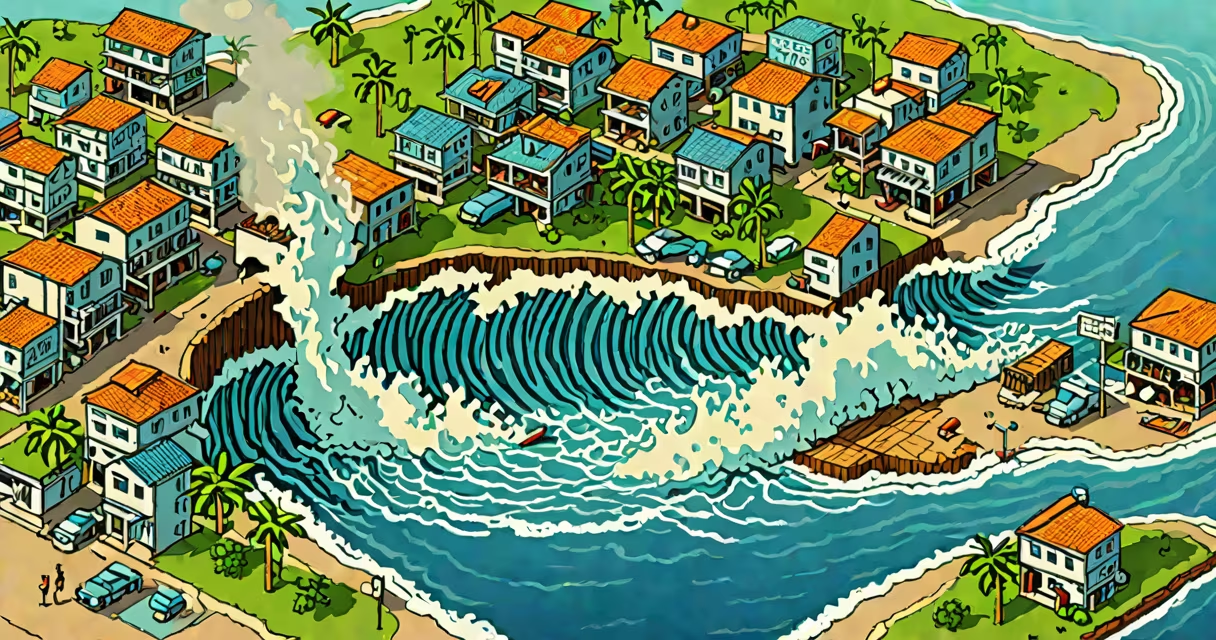
Tsunamis are large ocean waves triggered by underwater disturbances such as earthquakes, landslides, or volcanic eruptions. They can travel across entire ocean basins at speeds exceeding 500 mph and grow to heights over 100 feet when reaching shallow coastal areas.
These waves are not typical ocean swells. Unlike wind-driven waves that affect only the surface, tsunamis involve the movement of the entire water column from the seafloor to the surface. This allows them to carry immense energy across vast distances with minimal loss of height.
Despite their destructive power, tsunamis often go unnoticed in deep water. A wave that measures just a few inches high in the open ocean can grow to devastating proportions near shore due to wave shoaling-the process where wave speed decreases and height increases as water depth reduces.
Tsunamis begin when a sudden vertical displacement of the seafloor occurs. Most commonly, this happens during subduction zone earthquakes, where one tectonic plate slides beneath another. The abrupt uplift or subsidence displaces water above the fault line, generating a series of waves.
Once formed, tsunami waves move outward in all directions from the source. In deep water, they travel at speeds comparable to jet aircraft-up to 700 km/h (435 mph)-but remain barely visible, often less than a meter high. Their wavelength can stretch over 100 kilometers, making them among the longest waves on Earth.
As the wave enters shallower coastal waters, friction slows the bottom of the wave while the top continues moving forward. This causes the wave to compress vertically, increasing its height dramatically. A wave that's invisible in deep water can reach 30 meters (100 feet) or more upon landfall.
While earthquakes cause the majority of tsunamis, other events can also generate them. The table below outlines the primary sources:
| Trigger Type | Frequency | Example Event |
|---|---|---|
| Subduction zone earthquake | ~90% | 2004 Indian Ocean tsunami (M=9.1) |
| Underwater landslide | ~5% | 1946 Aleutian Islands event |
| Volcanic eruption | ~3% | 2018 Anak Krakatau eruption (Indonesia) |
| Meteorite impact | <1% | Chicxulub impact (66 million years ago) |
Earthquake-generated tsunamis are most common in the Pacific Ring of Fire, where tectonic activity is intense. The 2011 Tōhoku earthquake in Japan, which measured 9.0 on the Richter scale, produced a tsunami that reached 40 meters (131 feet) in some areas and caused widespread devastation.
A lesser-known trigger is a pyroclastic flow from a collapsing volcano. When hot ash and rock plunge into the sea, they displace water rapidly. The 2018 eruption of Anak Krakatau in Indonesia generated a tsunami that killed over 400 people, despite no significant offshore quake being recorded.
Many assume tsunamis are single massive waves. In reality, they arrive as a series of surges-sometimes spaced minutes apart. The first wave may not be the largest. Survivors of the 2004 Indian Ocean tsunami reported multiple waves, with the second and third causing the most damage.
Another myth is that tsunamis are tidal waves. This term is outdated and misleading. Tidal waves refer to regular ocean tides influenced by the moon. Tsunamis have nothing to do with tides and are unrelated to lunar cycles.
One non-obvious fact: tsunamis can travel across entire oceans. The 2004 Indian Ocean tsunami originated off Sumatra and reached the east coast of Africa-over 4,000 kilometers away-in under seven hours. Waves were detected in Sri Lanka, Thailand, India, and even Somalia.
The 2011 Tohoku earthquake off Japan's eastern coast was one of the most useful ever recorded. The rupture extended over 500 kilometers along the subduction zone. The resulting tsunami traveled at 700 km/h and hit the Japanese coast within 30 minutes.
Wave heights reached 40 meters in Miyagi Prefecture. Coastal towns like Ōtsuchi were submerged under 10 meters of water. The disaster led to over 15,000 deaths and triggered the Fukushima nuclear crisis.
Afterward, Japan upgraded its tsunami warning system. Sensors placed on the seafloor detect ground motion and send alerts within seconds. Early warning systems now provide evacuation time ranging from 5 to 20 minutes depending on distance from the epicenter.
Not all tsunamis are destructive. Some pass through populated areas with little effect. In 2015, a magnitude 7.8 earthquake in Chile generated a tsunami that crossed the Pacific and was recorded in Hawaii-but wave heights remained under 30 cm, posing no threat.
Also, tsunamis don't always come from the sea. In rare cases, a tsunami can be generated by a meteorite impact. Scientists estimate that a 1-kilometer-wide asteroid hitting the ocean could produce a tsunami capable of crossing continents. While unlikely, such events are modeled using historical impact data.
When visiting coastal regions, pay attention to natural warnings. A sudden withdrawal of the sea-exposing reefs and seabeds-is a sign of an approaching tsunami. This phenomenon occurred before the 2004 Indian Ocean event. People who noticed the receding water had a chance to flee inland.