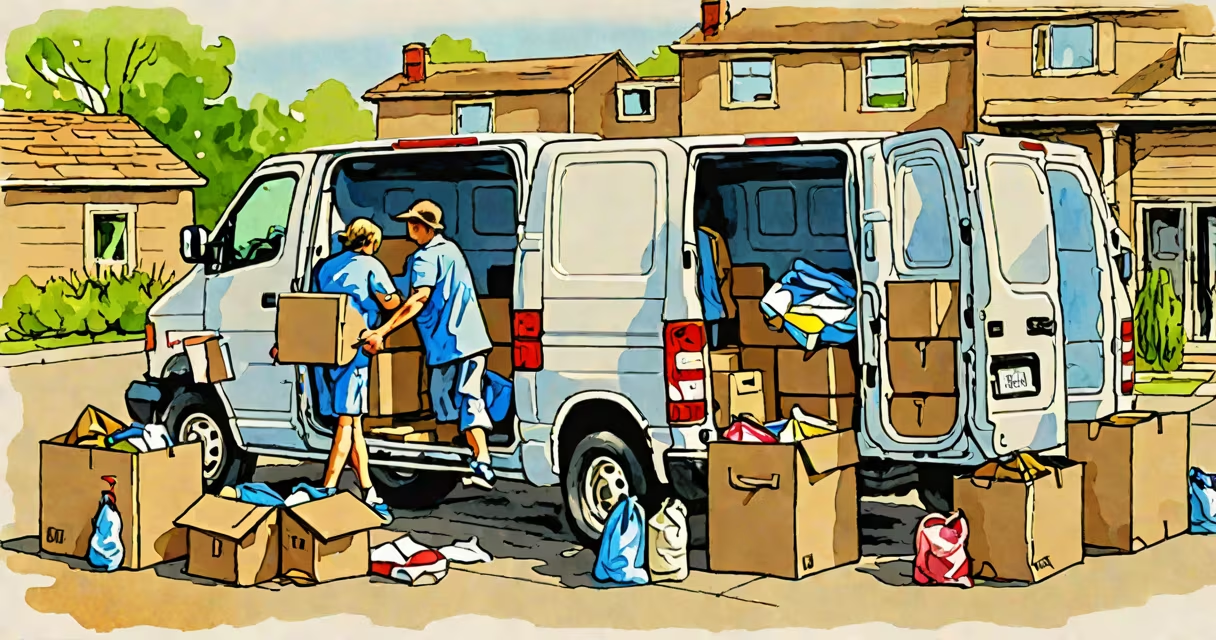
Goodwill pick up donations is a free service that collects gently used clothing, furniture, electronics, and household goods from homes for resale at Goodwill retail stores. The program supports local communities by funding job training and employment services through proceeds.
Donors schedule a pickup online or by phone. A trained volunteer arrives at the agreed time, loads the items into a marked vehicle, and transports them to the nearest Goodwill location. The process typically takes under 30 minutes and requires no shipping costs or drop-off trips.
Goodwill operates this service in over 3,000 U.S. locations. Pickup availability varies by region, but most urban and suburban areas have access. The service is free for donors and available for both small and large donations.
Donors begin by visiting the Goodwill website and entering their zip code. The system displays available pickup windows based on volunteer schedules. Users select a date and time slot, then confirm the appointment.
On the scheduled day, a Goodwill volunteer arrives in a branded vehicle with a visible Goodwill logo. They bring a reusable bin or bag for sorting items. Volunteers do not assess value or accept damaged goods. Items must be clean, functional, and suitable for resale.
After loading, the donor signs a digital receipt confirming the donation. This document includes the date, estimated value, and a unique tracking ID. The receipt serves as proof for tax purposes if claimed later.
Goodwill accepts most gently used items. Common categories include:
Items not accepted include:
Goodwill does not accept items that pose safety risks or require special disposal. For example, old batteries or expired medications cannot be collected. Donors should avoid placing such items in donation bins.
Goodwill pick up donations operates in 48 states. Availability depends on local volunteer staffing levels. Urban centers like New York City, Los Angeles, and Chicago have daily pickup options. Rural areas may see weekly or bi-weekly service.
Service hours are typically between 8 a.m. and 6 p.m., Monday through Saturday. Some locations offer Sunday pickups during holiday seasons. Appointments are confirmed via email or SMS within 24 hours of scheduling.
For example, in Seattle, Washington, 62% of ZIP codes offer same-day pickup. In contrast, rural ZIP codes in eastern Montana report average wait times of 14 days due to lower volunteer density. These differences reflect regional resource allocation.
Many people assume that all donated items are sold immediately. In reality, Goodwill evaluates each piece for quality and marketability. Items that don't meet resale standards are recycled or repurposed. About 25% of all donations are diverted from retail sale to recycling streams.
Another misconception is that pickup volunteers appraise items. Volunteers do not assign value. They only confirm that items are clean and functional. The donor must estimate the fair market value for tax purposes.
A lesser-known fact: Goodwill does not charge for pickup, but it does not guarantee a specific time window. If a donor misses the appointment, the pickup is rescheduled. No fees apply for missed appointments, but repeated cancellations may reduce future booking eligibility.
In October 2023, a family in Austin, Texas, donated 14 bags of clothing, two dressers, and a working microwave. They scheduled a pickup online and received confirmation within 15 minutes. On the appointed day, a volunteer arrived at 10:15 a.m., loaded all items, and signed the digital receipt.
The family later used the receipt to claim a $320 deduction on their federal tax return. IRS Publication 526 confirms that donations of non-cash items valued under $500 do not require a written appraisal. The family filed Form 8283 with their return and reported the donation without audit risk.
Donations of non-cash items to Goodwill qualify as tax-deductible gifts under Section 170(e)(1) of the Internal Revenue Code. The deduction amount equals the fair market value at the time of donation.
For donations under $250, a receipt from Goodwill is sufficient. For amounts over $250, donors must complete Form 8283 and attach a qualified appraisal if the value exceeds $500. The IRS notes that valuation errors are common in self-reported claims.
Goodwill provides a digital donation receipt automatically after pickup. This document includes the date, donor name, address, and a list of item categories. It does not state the total value. Donors must calculate fair market value using tools like eBay sold listings or charity valuation guides.
For example, a 2019 laptop in good condition with 10% battery life was valued at $180 based on recent eBay sales in the same region. The donor used this figure to report the donation. Without accurate valuation, the IRS may disallow the deduction.
If you're considering taxable donations, review IRS guidelines carefully. Some items, like art or collectibles, require specialized reporting. For donations over $500, consult a tax professional to ensure compliance.
When claiming deductions, remember that the IRS audits less than 1% of individual returns annually. However, discrepancies in valuation or missing documentation increase audit risk. Keeping records for seven years is standard practice.
Goodwill pick up donations streamlines charitable giving by removing transportation barriers. It enables consistent participation from individuals who lack vehicles or time. The service supports social impact through job creation and community programming funded by resale revenue.