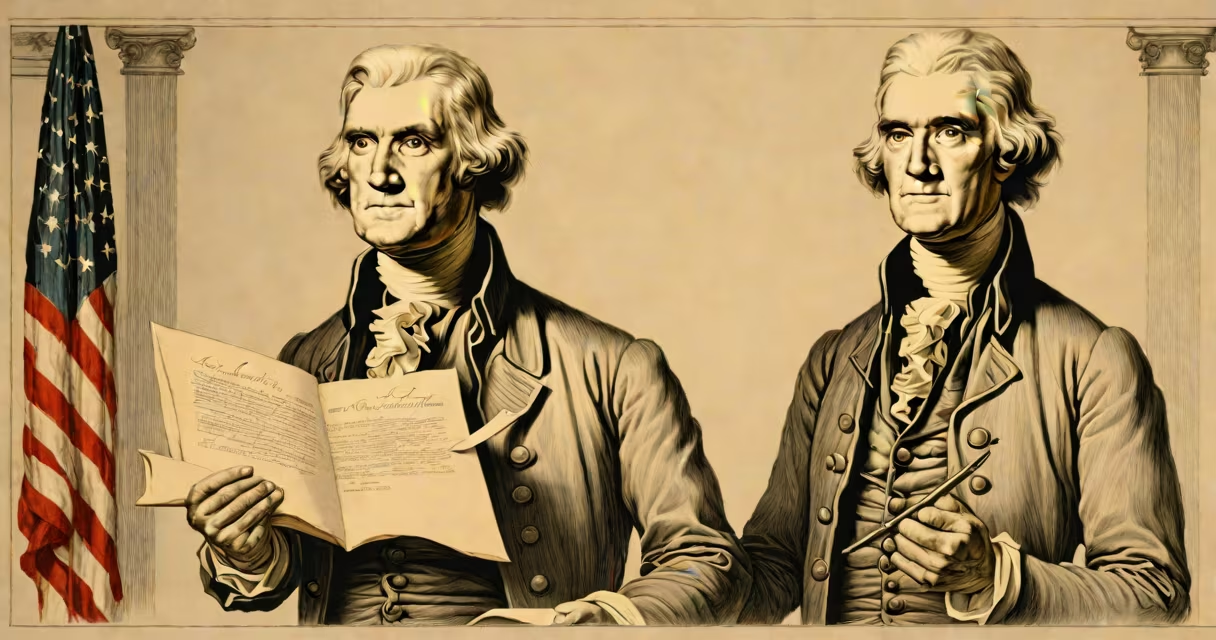
The phrase "life, liberty, and the pursuit of happiness" appears in the Declaration of Independence, not in the U.S. Constitution or any constitutional amendment. It is a statement of philosophical principle, not a legally enforceable right. The term "amendment" in the phrase is a common misunderstanding-it does not refer to a formal addition to the Constitution.
This declaration was drafted by Thomas Jefferson in 1776 and asserts that governments exist to secure unalienable rights. The phrase is part of a larger sentence: "We hold these truths to be self-evident, that all men are created equal, that they are endowed by their Creator with certain unalienable Rights, that among these are Life, Liberty and the pursuit of Happiness."
Despite widespread use in political discourse, no constitutional amendment bears this name. The idea behind the phrase influenced later constitutional developments, especially through the Fourteenth Amendment's due process clause, which protects life and liberty.
The Declaration's language is not law in itself. Courts do not cite it as precedent. However, its principles have shaped how courts interpret constitutional rights. The phrase reflects Enlightenment thinking, particularly John Locke's theory of natural rights.
When the Supreme Court ruled in Lochner v. New York (1905), it cited the "liberty of contract" as protected under the Fourteenth Amendment. Though the decision was later overturned, it shows how the idea of personal freedom evolved from the Declaration's ideals into legal doctrine.
Modern cases often reference the Declaration's values indirectly. For example, in Lawrence v. Texas (2003), the Court struck down laws criminalizing consensual same-sex relations. While the opinion did not quote the Declaration, it emphasized personal autonomy and dignity-core ideas embedded in the phrase "pursuit of happiness."
The phrase originates in the intellectual tradition of natural rights. Jefferson drew from Enlightenment philosophers like Locke, Montesquieu, and Rousseau. Locke argued that individuals possess inherent rights to life, liberty, and property-Jefferson replaced "property" with "pursuit of happiness" to emphasize opportunity and personal fulfillment.
"Pursuit of happiness" was not a legal term in 1776. It meant the right to seek well-being through work, education, religion, and self-determination. The phrase was deliberately vague to allow broad interpretation across diverse communities.
Historical records show Jefferson revised the phrase multiple times. Early drafts included "property," but he changed it to "pursuit of happiness" during revisions. This change reflected a shift from material ownership to personal flourishing-a concept central to American democratic ideals.
Many people assume "life, liberty, and the pursuit of happiness" is a constitutional amendment. This is incorrect. The U.S. Constitution has 27 amendments. None bear this name. The closest constitutional protection is found in the Fifth and Fourteenth Amendments' due process clauses, which safeguard life and liberty.
Another misconception is that the phrase guarantees happiness. It does not. The Declaration states that people have a right to pursue happiness-not to achieve it. The government cannot ensure personal joy, but it must not interfere with efforts to attain it.
A third error is treating the phrase as a legal standard. Courts do not apply it directly. In Brown v. Board of Education (1954), the Court referenced equality and dignity, not the Declaration's wording. Still, the document's ideals helped frame the argument that segregated schools denied equal protection.
The phrase appears in three primary contexts:
For example, in 1963, Martin Luther King Jr. invoked the Declaration in his "I Have a Dream" speech. He said, "It is obvious today that America has defaulted on this promissory note... insofar as her citizens of color are concerned." He linked the promise of equality to the original ideals of the Declaration.
Another example: In 2015, the Supreme Court's Obergefell v. Hodges decision legalized same-sex marriage nationwide. The majority opinion noted that marriage is central to personal dignity and the ability to pursue happiness-echoing the Declaration's spirit, though not quoting it directly.
Consider the 2018 case Masterpiece Cakeshop v. Colorado Civil Rights Commission. The baker refused to make a wedding cake for a same-sex couple, citing religious beliefs. The Colorado commission ruled against him, saying his actions violated anti-discrimination law.
The Supreme Court reversed the decision, not on the grounds of religious freedom alone, but because the commission showed hostility toward the baker's faith. Justice Anthony Kennedy wrote that the state's actions "undermine the free exercise of religion" and "threaten the rights of conscience."
While the Court did not cite the Declaration, the underlying conflict involved balancing individual rights-the baker's right to religious expression and the couple's right to equal treatment. The "pursuit of happiness" ideal is relevant here: both parties sought to live according to their values without infringing on others' rights.
One overlooked fact: the phrase was not originally intended to apply universally. The Declaration's "all men are created equal" referred to white male property owners. Women, enslaved people, and Indigenous nations were excluded from its protections.
Another non-obvious point: the phrase was not translated into other languages during the Revolutionary War. It remained in English, unlike later documents such as the Bill of Rights, which were widely disseminated in multiple languages.
Also, the phrase appears on the National Archives' display of the Declaration of Independence. But it is not listed as a constitutional provision. The Constitution's Preamble begins with "We the People," while the Declaration begins with "When in the Course of human Events." They serve different purposes: one is a legal structure, the other a philosophical statement.
However, the Fourteenth Amendment is enforceable in court. The Declaration is not. The difference lies in legal authority: one is a foundational document, the other a binding constitution.
Even when courts cite the Declaration, they do so as historical context. In United States v. Carolene Products Co. (1938), Justice Harlan Fiske Stone mentioned the Declaration to explain the purpose of constitutional rights. But he stressed that the document itself is not law.
I once attended a high school civics class where students debated whether the government should fund programs to increase happiness. A student argued that "pursuit of happiness" meant the state had to provide therapy, housing, and jobs. The teacher corrected the misunderstanding: the phrase means individuals have the right to seek fulfillment, not that the government must deliver it.
That moment highlighted how easily the idea gets misapplied. The phrase is aspirational, not prescriptive. It sets a vision, not a mandate.
The term "life liberty and the pursuit of happiness amendment" is a misnomer. The phrase comes from the Declaration of Independence, not a constitutional amendment. It expresses core American values-individual dignity, freedom of choice, and the right to strive for well-being-but it is not a legal right enforceable in court.
Understanding this distinction prevents confusion between moral ideals and legal obligations. The concept lives on in policy debates, court rulings, and national identity-but only as inspiration, not as law.